Get ready for a weekend of fun, food, and fellowship as our COA youth invite the entire church to a Churchwide Campout & Youthlympics in Rader Park, happening Saturday, August 2 to Sunday, August 3!
Join us for an afternoon of wild and wacky games, think wiffle ball, three-legged races, and more! Stick around for a potluck dinner, then gather ’round the campfire for s’mores before settling in for an overnight campout under the stars.
Tentative Schedule:
3-6 PM: Youthlympics games outside the Youth Center
6-8 PM: Potluck cookout at the Rader Park Pavilion
8-10 PM: Campfire + s’mores
10 PM: Overnight campout
Come for a few hours or stay the night, whatever fits your summer vibe! Friends and family welcome!
Old preachers are like old baseball players and old gamblers.
They want to make one more bet or be in one more game. Old horse racers want to race one more time. We want to do one more sermon.
So, we agonize over what it is that we want to say to folks. Do we find the sermon that they need to hear and preach that sermon? Or do we find the sermon we’ve always wanted to preach and preach that sermon, or do we preach the one about the house of religions?
Like golf, you play it with other people, who keep their own score and nobody knows if you cheat or not, except you and God.
Then it occurred to me that I needed to take a chapter from my own book.
We are now all in English 101 at Mon University, and I had a group of students, not unlike all of you, that I started one of my classes by telling them that they were all poets. They’re all thinking, no, we’re not poets. We don’t like poetry. We don’t do poetry. And I said, yes, you are poets, and I can prove that you are all poets because I’m going to give you a poem and you’re gonna respond with the next line.
“Twinkle, twinkle little star…
“Up above the world so high,”
We are hardwired to see the world in patterns. Poetry is a pattern. You are all hardwired to be poets. Now, people have told you that you can’t do poetry. People have told you poems have to be a certain way. People have bored you to death with poetry. Teachers have made you memorize poems that you didn’t like. You’ve come to believe that you’re not poets, but you are.
There’s a huge amount of poetry in the Bible that we ignore because we’re not poets, so we don’t read the Psalms very often. We stay away from the books of wisdom. We don’t like to be inspired that way because it’s not who we are, but that is who we are. We are all hardwired as poets. Some people see their poetry in rhythm and sound, but we are all poets.
I am going to give you another line to complete, ready for it? “For God so loved the world…That he gave his only Son”
You are hardwired to love.You are hardwired to be the lovers of the world.
It goes back to Genesis when God creates men and women in his image. We have creation stories in the book of Proverbs, we have all kinds of language in the Bible about how God calls us to something. Jesus himself said, “Truly I tell you, whoever believes in me will do the works I have been doing, and they will do even greater things than these, because I am going to the Father.” (John 14:12)
Most of the people that Jesus talked to towards the end of his ministry, when he talked about whether there’s going to be a judgment or not, were people who didn’t even know they were doing it.
You are hardwired to be the lovers of the world, and people have told you your entire life that you can’t do that. You’re not young enough, you’re not wealthy enough, you’re not strong enough, you’re not intelligent enough, you’re not old enough. Sometimes you’re too young. People have given us reasons why we are not to consider ourselves to be created to be the lovers of the world.
I’m here to tell you that all of that’s untrue. Just like you are all poets and don’t know it. You are all lovers, and you haven’t found your way to love the world yet, but that’s what you’re made for. That’s what God has asked you to do.
One of the problems that preachers have is how deeply we wanna become scholars.
There was once upon a time when the only scholars in the community were preachers. Harvard University was founded because preachers were the most learned people in the community, and they wanted to get smarter.
I’ll tell you a conversation I had with one of the little old ladies in the church that I was telling them about something I’d found in the library, in the Pastor’s study. She said “Our pastors don’t read books.” And I thought, “I’m not gonna tell her that I write books.” If you don’t like pastors who read books, you’re certainly not gonna like pastors who write books.
There was something about being a scholar that became bad news at some point. We have to walk a fine line between how deeply we dive into the text. Because people don’t want to hear from scholars that they don’t know what’s going on in the Bible. Most people understand the Bible because they’ve been told their whole lives what it means. So they don’t pay any attention to what it says, which is the best reason for reading it as to find out what it actually says to us.
God created you to be lovers in the world. He did not create us to be in torment.
Sometimes the biggest tormentors in the world are simply other folks. Other folks who can’t be accepting, other folks who don’t understand, other folks who refuse to be loved or to love the world the way it’s supposed to be loved. God did not create us to be tormentors, and he did not create us to be in torment.
One of the gifts of the self-help programs is that in the first step of the program, you must come to believe that a power greater than yourself could restore you.
In our text today, we have a man who is insane. People don’t like others being insane, so he’s living out in the cemetery somewhere and a power greater than himself restored him to sanity. We don’t like to think that we’re insane, but the program makes us have two confessions. One is that there is a power greater than ourselves, and second, that we are not sane in the moment. We are not the lovers we are intended to be. We are not the people we are created to be. We’re not as whole as we want to be, and we need to be restored to who we are meant to be. But first we have to admit that we are broken, we are not whole, and we’re flawed. Once we make that admission, then healing is possible.
I wanted to point out that when I saw the title for today, and I never title anything, by the way. My editor titled all my books for me. When I saw the title for the sermon, I thought I could have written that book, but I didn’t. It’s not my title, it’s Rev. Kathryn’s title, but it speaks to the fact that we live in a world where we have somehow accepted being tormented as a normal state of affairs. And it’s not normal to be tormented or to be the tormentors.
One of the ways that we can be lovers in the world is to speak out when we see torment happening, either the people who are doing the tormenting or the people who are being tormented, and simply say, it’s not the way it’s meant to be. It’s not right. It’s not the blessed community. It’s not who we are as a people, because we are the people that God created us to be. And God so loved the world that He gave it you. There are days I like to think it’s working, and days I believe it’s not.
But God gave us each other. He gave us a blessed community where we could be more together than we are by ourselves.
I’m very fond of historical period pieces, such as movies and TV series.
I love Downton Abbey, and I kept hearing about this series on HBO called The Gilded Age. So, I started watching it to see what I thought. Then, when I read Luke 7:44-50, I thought these two go together. Because the thing about The Gilded Age is, a lot of the period pieces that I watch are about England, but this is set in America.
This is set in New York City in the late 1800s, and it is about old money versus new money. The families who started in New York City, old money. Then, the people who were making money, and a lot of it in the beginning of the Industrial Revolution and moving into the city, such as the Rockefellers. That’s a name they drop a lot during the movie. I don’t think that any of the characters are based on real people. I think that it is all fictional. But they certainly talk about the Rockefellers.
But what I noticed in this is how the old money generation uses their privilege to be arrogant and judgmental of others. The old money people are always peeking out their windows and peeking around corners. I think that there’s a bit of that at play in our scripture today.
On Friday, when I was at home, my neighbor next door got a new shed, and it came as the heavens opened, and it just started pouring. I realized I was the neighbor peeking around the corner saying that they better not drive that through my yard. I don’t know how they’re gonna get that in his backyard, but it better not go in mine, because that’s gonna make some ruts. I’m no better.
We need those realizations that we can be just as petty as the rich people.
There’s a moment where the one woman doesn’t want to have anything to do with her new money neighbor across the street, but she finds out that her lead servant had asked for time off, and is serving at the house across the street. She barges in there with gusto until she realizes she’s just walked into a dinner party, and she has to save face because she just broke her own rules.
The old money people created rules that the new funny people don’t even know about. They only find out about them when they bump into them.
I hope that helps you to see where this ties in into the scripture because it’s about figuring out how we can be together.
I think that there’s a bigger societal lesson in this, too, where those of us who want to make the rules need to realize that not everyone has the same life experiences that we’ve had.
So, how do we open ourselves to hear the stories of others with compassion? How much room do we make for those who think differently from us? I think that’s big for us right now. Do we put ourselves in places to hear stories of different people?
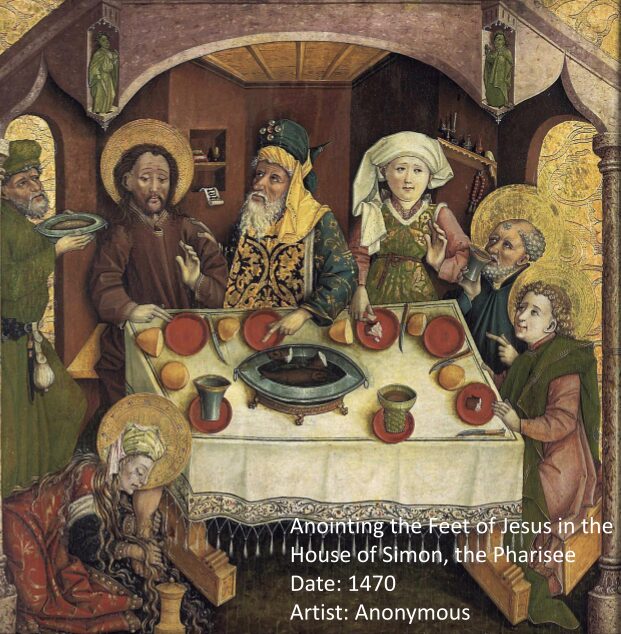
So, as we look at the scripture, Luke 7:36-50, I want you to think about where you would be in the scene. Who do you most identify with? Do you identify with the woman at Jesus’ Feet? Crying and washing his feet with her hair. Are you the Pharisee saying these are the rules? Or are you just one of the disciples or a bystander watching the scene unfold? I want you to think about that as we look at this.
This scripture was very important to the early church, and I say that because it’s in all four gospels, and that does not happen often, so that means it’s something to pay attention to. Now, each one is a little bit different. In Luke’s version, the woman is unnamed. She is unnamed, and she has no voice. That’s important. In other versions, she’s called Mary Magdalene or a prostitute, but here she’s just a woman of sin. It doesn’t tell us what kind of sin. We put all kinds of labels on her. We want to name her sin, but here’s the thing: that’s not for us to do.
That’s not our place. This scene makes us uncomfortable because there is a lavishness to this. She is so grateful that she is weeping at his feet and bathing them with her hair. That is very sensuous, even a little on the erotic side. And that makes us uncomfortable.
It makes sense that we go there because when Ruth was trying to get with Boaz, she walked into his tent and uncovered his feet. So, there is something about all of this that has a sexual overtone to it that makes us uncomfortable. But Jesus recognizes what she needs. Jesus sees her need for healing and immediately forgives her and blesses her by saying, “Go in Peace.”
In contrast, I did choose this particular artist rendering of this scene. I hope you can see that there’s a golden halo. This is a classic icon that artists put a golden halo around people whom they want you to perceive as divine or having some holiness about them. The artist gave one to the woman, gave one to Jesus, and gave one to the two other people sitting across the table. Which makes me think that maybe they’re disciples of Jesus, but the Pharisee does not get a golden halo. He is all dressed up in his finery, which is where my brain was going with the connection to the Gilded Age. It’s like those from the upper class who think that because they are upper class, because they are the 1%, they get to write all the rules for everyone else.
Luke’s version is a little different in that he gives us Simon’s thoughts. We get to know that Simon thinks this is not a good thing. He says, “If this man were a prophet, he would have known who and what kind of woman this is who is touching him, that she is a sinner.” His thinking is not wanting to have anything to do with her. She would be at the of the servant class, but without noting what Simon’s thinking, Jesus tells that little parable about people who had borrowed money, and their debt was forgiven.
He has this classic line, which to me is the heart of it, “But the one to whom little is forgiven loves little.” (7:47) I think we have to sit with that. Jesus is letting Simon know he knows what he’s thinking. While Simon’s trying to discern who Jesus is. Jesus’ answer proves that he is much more than he appears, as he knows the character of both the woman and of Simon.
So who do you think you most connect with?
I’m guessing there aren’t a lot of us that want to be the Pharisee, even though, like I was telling you in my story about the neighbor’s shed, I think far too often we are the Pharisee judging other people. Judging other things as being less than or how we might be taken advantage of.
Do you feel like the woman who’s broken and in need of healing? Because if so, I hope that you find it today. I hope that you connect with someone here and they are able to hear you, be a listening ear, and a comfort to you.
If you’re like the Pharisee and you wanna remind us all about the rules, maybe we need to look in the mirror more closely and recognize our own failings because none of us in here are without sin. The image of the church as a hospital where sinners can come for healing is certainly more attractive to me than a place where only saints hang out.
If you’re a disciple, then I think that our job as disciples is to come alongside people, knowing that we’re not here to fix it. We’re here to listen, to comfort, and to say that we’re going to walk with you. I think that we are here to create a spiritual home where grief can be tended and rage can be organized, and hope can be reimagined because hopelessness is the worst. We don’t wanna reach that point, but together we can remind each other to see the things that help draw us along.