Students, teachers, and school staff from across the Greater-Lancaster Area are invited to join us for a special Back-to-School Blessing during our 10 AM worship service.
Children and youth are encouraged to bring their backpacks to receive a blessing as they begin a new school year. Teachers and school staff will also be recognized and blessed for the important role they play in shaping young lives.
Our youth group will lead this meaningful service, with Nathan Moore delivering the sermon. We’d love to celebrate the start of the school year with you, come and support our students, teachers, and youth leaders!
Listen More, Speak Less
I want to begin today by thanking you, because I’m going to be starting a class in September through June in Gestalt Pastoral Care.
I’m thanking you because the Rader-Schellenberger Endowment for Theological Education is paying for it. I believe you will find that it will be mixed into my sermons as well as the pastoral care that I give to all of you and to anyone who comes to the door.
Gestalt Pastoral Care, what does that mean? Well, the Gestalt model is a holistic model. Gestalt Pastoral Care is about realizing that our emotions, our spirit, our mind, and our body are all connected. We can’t just talk about what’s going on in our minds. We have to look at our bodies, our souls, and our emotions. We have to look at all of that.
What I love about this approach to pastoral care is that it does not seek to prescribe anything. It’s not about giving advice or setting goals for anyone. It is merely about asking questions, listening, and helping the person find their truth because we believe God is already at work in all of us. It is learning to listen to God and learning to listen to the Holy Spirit, to recognize how the Holy Spirit is working in each of us, continually stretching us towards healing and wholeness.
I’ve been looking at it for about a year, and I’ve gone to a couple of workshops on it, and I have seen amazing things happen with it. So, I’m starting this course and I want you to know about it. In this coming year, I’m gonna be focusing more on pastoral care. We’ve been in this shift of job descriptions and figuring out what’s Melissa’s and what’s mine, and how do we work together? Now I’m at a point where I feel like I have more time and energy to put into the care of our members and to those outside.
I will also note that there’s just an interesting thing that’s going on, and that is that I’m getting emails from people outside of the church who wanna be baptized or who want their children baptized. I don’t know what’s happening, but I’ve got two Preschool families that I’m talking to. Then we have our babies who are gonna get baptized. Breanne and Carlos’ baby, Bella, and Adam and Sarah’s baby, Lucy, are both going to be baptized at the end of September. The spirit’s moving and I don’t know what that’s all about yet, but we’ll see.
We have this scripture today, Ephesians 4:1-6. This makes my top 10 of scriptures.
We have our favorite scriptures, and this is definitely in mine, particularly the fourth chapter of the book of Ephesians. We’re not sure if Paul wrote it or not, but that doesn’t matter. There is a lot of truth in it and there’s a lot of wisdom in it that we can still take.
It’s not really clear what the issue was. You know, usually there’s a specific issue that a letter is written for. It’s not clear what it is in this book, but there is, especially in this chapter, and in the first three chapters, this sense that the writer wants this church to come together. That they were separated between Jews and Greeks, and they wanted them to come together and recognize that they were better together. In the course of this book, it does say about them being tossed and blown about with every wind of doctrine.
There’s some other information that is coming to this congregation, and whoever wrote the book didn’t like what was coming. There are several references to the devil. There’s a reference to cosmic principalities and powers, and there’s a reference to deceitful teachers. I’m not sure what they were saying, but this author was trying to bring them back to the wisdom of Paul because Paul started the church. He founded the church in Ephesus, and this is still the church in Ephesus.
What is clear is that it’s saying that we need to come together with our differences because we are one humanity. Then this part is near the end of what I was reading, and it’s interesting, the author lists seven things that are one, one body, one spirit, one hope, one Lord, one faith, one baptism, one God. Now that’s important because the number seven is the number of completion in the Bible.
That’s just like one of those things you need to learn about the Bible that scholars have figured out over the years. There’s nowhere in the Bible that says if it’s seven things, that is complete, but that’s wholeness. So the world is complete and all is well and perfect when seven things happen. This is the wish of the seven things, or the author is trying to convince the church in Ephesus that these seven things are present, that even though they might have disagreements in the church, that’s okay.
In fact, I was listening to a podcast this week where they talked about the need for antagonism. We need to have some tension between us. We need to have differences of opinion so that we wrestle with where, we should be. What’s the best answer in this?
This is where it gets interesting because I want to say that I think we are in a moral moment.
Because there are a lot of truths being said right now, or claiming to be truths, and we are at a time when we need to determine whether we opt out or whether we opt to participate. What happens in the future, what the future’s gonna look like for our grandchildren and our great-grandchildren.
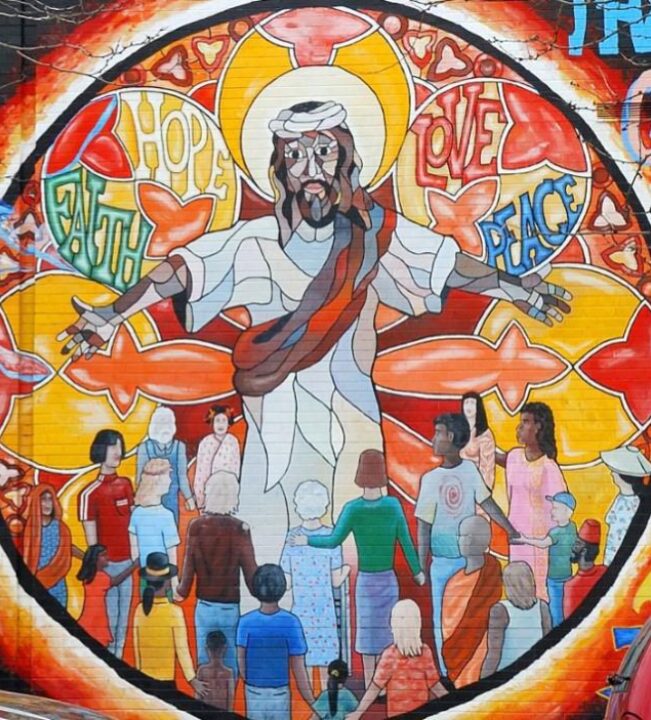
We can be about faith, hope, love, and peace, and the ways of Jesus. That’s who we say we follow, or we can be a different thing. I hear Christians, they call themselves Christians, they say they follow Jesus, but they follow someone who is all about power over others and being militant. They say, “We don’t agree with you, so you are the enemy”, and they’ll squash us, arrest us, detain us, and do all kinds of things.
There’s a lot of dehumanizing language in our society right now, and we need to hear that. If we’re able, we need to say, “That’s not what I want us to be.” That’s not who I think we are, and I don’t think that’s who we want to be in the future, because Jesus was not about that. Jesus never belittled somebody else. Jesus was never demeaning to people. Maybe to the Pharisees a little bit, he tried to teach them about humility, but he never put himself above everybody else. He had power with people, not power over.
There are tensions between our liberties and everybody getting to do what they want. But that’s when our liberties step on someone else’s rights. We have to figure out where the right point is between those. You don’t get to just take away someone else’s rights because you don’t like it. How do we figure this out? I don’t think we have that. We’re at a really important moment in time, and I think that there’s wisdom that we can rely on.
So what are we gonna be about?
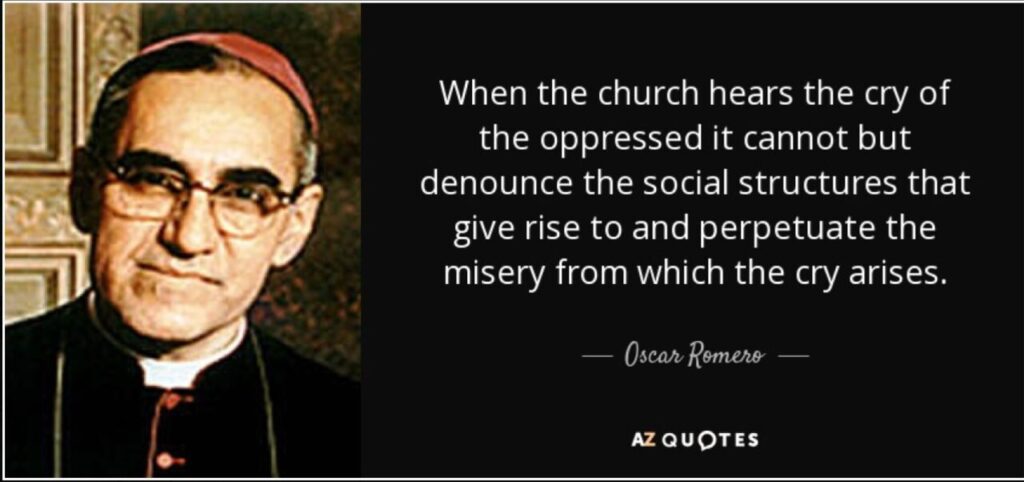
I don’t know how many of you know who Archbishop Oscar Romero was, but he was an archbishop in El Salvador. He spoke against the militarization and authoritarian regime that was there, and this is one of his quotes. “When the church hears the cry of the oppressed, it cannot but denounce the social structures that give rise to and perpetuate the misery from which the cry arises.”
He took a strong stand at his time, and he was gunned down in the middle of a mass by a member of the military who didn’t appreciate what he had to say, but he stood for what he believed in. I think that’s part of this moral moment. We need to figure out who we are and what we stand for, and we need to stand for it. Because, by being silent, we allow the other.
Now that I’ve taken you to a dark place. Let me give you some light, because remember, Christ is the light that comes into the world. Well, I also found some light in a quote from a bluegrass band called The Jet Rows. I’ve never heard of them, but I found their quote.
“When people in power try to remove our humanity and our dignity. Art and music provide a reason for being. The simple act of making music in difficult times becomes an act of defiance and self-determination. Creation of art and music is cathartic and reinvigorating. It can inspire action, collaboration, and resistance. Music eases our minds during difficult times in our lives. It reminds us that we are a community. We are all in this mess together. Music reminds us that even when life is difficult or when the odds are stacked against us. Life itself is beautiful and worth celebrating.”
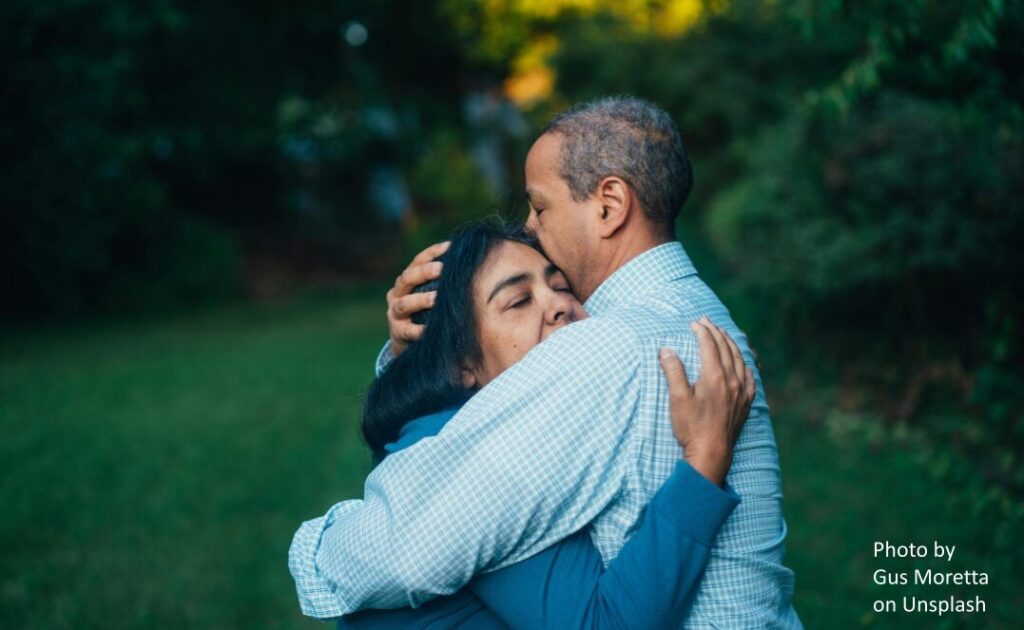
We are not called to be perfect, but God does call us to be our best selves. So let’s do that by listening more and speaking less, but speaking when we need to. Let’s listen to the pain of others, because I think that’s where a lot of this is coming from. It’s coming from a place of pain.
I want to begin by thanking you for the time last month when I got new eyes.
I had my cataracts removed, which is like having new eyes. The time off allowed me to have the surgery, but it also allowed me time to heal and time to rest. I took that time and I learned two things. The eyes are the second most complex organ of the body, next to the brain. The brain is the most complex organ of the body, but I was told that the eyes are second. I also learned perspective is everything. Because when I had my first eye done, they said “don’t worry. It’ll clear. Just give it time.” I kept thinking, this eye is not clear until I had the second eye done. Then suddenly, I mean, as soon as I could see after the surgery. The first eye was incredibly clear.
Now, that was not a miracle. That is called perspective. My first eye after surgery compared to my eye, pre-surgery was fuzzy, but compared to the second eye after surgery. Wow, what a difference. It’s all perspective. What the piece about perspective is that there’s a bit of choice in that. I mean, not with how my eyes see, but boy, did I find color. Maybe I shouldn’t have chosen the colors to have my kitchen painted last year. Maybe I should have waited till I had my eyes done and taken off those, it was like I was wearing yellow glasses. My kitchen’s bright. I still like it, but it’s bright.
But that perspective piece is where we have agency and choice, and we can choose how we view others.That’s gonna be my point.
I said to somebody this week that our sermon is about loving your enemies. And somebody said, “Well, I don’t have any enemies.” Good for you. I wouldn’t say that I have enemies, but I have a shorter list. But it’s a choice for me to change that. I can choose differently. I can choose how I perceive that person.
When we see a person standing on the corner of Prince and King St asking for money. We can immediately think, “Oh, they’re lazy.” Or we could choose to think, “I wonder what’s going on in their life that has taken them to this point.” That’s a choice. That’s a perspective choice and I’m going to try and make that a theme in this sermon.
So, this scripture, Luke 6:27-36, has two big verses, love your enemies and do to others as you would have them do to you.
These scriptures are a part of Luke’s Sermon on the Plain, which is very similar to Matthew’s Sermon on the Mount. And in both of those, they’re not identical; there are differences. Luke’s is called the Sermon on the Plain because he was among the people, whereas the Sermon on the Mount talks about him and the disciples going up to the mount and him talking to the multitudes.
But both of these verses are in both gospels, and they’re hard, especially that first one. The beauty of them being in those sermons is that they were not directed to one person or an individual; they were directed to the corporate body, to the community, because loving your enemies, that is just too hard by ourselves. We need each other to say, “Hey, you can do it. You can find that compassion, you can find that empathy within you. I know you’ve got that in you.” We need that.
The golden rule, and you might be thinking, “That’s not that hard. We teach that to our children because that’s a good thing.” Right, but do you follow it? If somebody cuts you off in traffic, are you following it? If somebody charges you more than you expected, how loving are you in that moment? How loving are you when the person you’re talking to is espousing a position and arguing for a position that makes your blood boil? That’s hard. That’s hard work.
This is an expectation. It’s God’s expectation about what the beloved community should be like. And that’s why we come together and have community, so we can do it together. Because you know what? We’re all gonna mess it up. We are all gonna fail these, maybe even every day. But we come together and we remind each other that God is still with us, that God’s love and God’s grace covers a multitude of sins, thank goodness.
So, in spite of all of our failure to meet the expectation, we are still loved and we are not alone.
We are kin. We are meant to be family. We are meant to see the Christ in each other. This always brings to my mind the concept of Ubuntu, which I learned from a book by Bishop Desmond Tutu. I am Ubuntu, says I am because you are. The divine in me is connected to the divine in you. The love in you is the same as the love that is in me. We are interconnected, and we need to remember that.
That’s where we start putting people as enemies or on our “less-liked” list. But I have to remember that it doesn’t matter; the reality is, we are 99% the same, every single person on this earth. It’s not just the people in this room. It’s not just people with white skin. It’s not just people of European ancestry, Western European ancestry. It is everybody, all of humanity. We are kin.
We are all children of God, and we are called to remember that first. We have to put that in our mind and let that be the lens.
Today, we’re talking about having kindness be the lens through which we look at the world. As I was going through this, I thought about Joanna Macy.
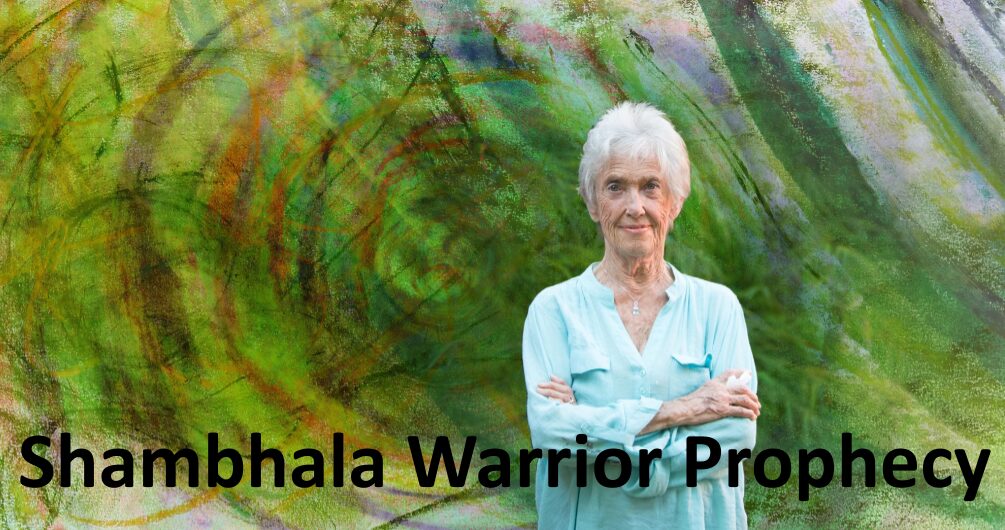
She passed away in July. I don’t know if you know who Joanna is or not, but she did a lot of teaching, and one of her pieces that she often shared was called the Shambhala Warrior Prophecy. I want to share that with you.
She says it says in a future time of great danger, when the earth will be ravaged and all humanity hangs by a thread, a new kind of warrior would emerge, not with weapons of destruction, but with tools of healing.
This is not a fantasy or a metaphor, but a call. Shambhala warriors will not destroy, but will dismantle poisoned systems with compassion and insight. They will be led by compassion. So that the suffering of the world breaks their hearts even when the world is unraveling or without shutting down or turning away, and the insight to see clearly the interconnectedness of life, even when, or especially when the world is unraveling.
The Warriors are not limited by race, gender, or belief, not chosen or ordained by institutions. They will be ordinary people, teachers, gardeners, artists, organizers, students, and elders trained in being present. Refusing to be numbed or distracted, willing to stand in love when fear would be easier.
This is who we are called to be. This is us. The question is, how will we train for them? How will we become these people? Because we don’t need any more heroes. We need people who can hold fire without burning others. Hear that again.
People who can hold fire without burning others doesn’t mean that we don’t get burnt.
People who have faced grief and choose to sing. The most radical thing any of us can do at this time is to be fully engaged and present in what is happening in the world. The choice is ours.
How often do we make assumptions about someone based on their age?
We might assume someone is “too young” to understand something, “too old” to learn something new, or that certain activities, responsibilities, or opportunities are meant for a particular generation. Sometimes these assumptions are obvious. Other times, they are so familiar that we hardly notice them.
Ageism can affect people at every stage of life. It can show up in the words we use, the opportunities we offer, the way we communicate, and even in the expectations we have for ourselves and others. Phrases like “You’re too old for that,” “Kids these days…” or “She’s having a senior moment” may seem harmless, but they can reinforce stereotypes about what people can or cannot do because of their age.
So, what might we notice if we look a little closer?
Do we make assumptions about someone’s abilities based on their age?
Do we create opportunities for people of different generations to learn from one another?
Are we making information and activities accessible to people who may not use technology in the same ways?
Do we make room for both new ideas and years of experience?
Have we ever decided something wasn’t “for us” simply because of our age?
At Church of the Apostles, we believe every person has something valuable to offer. Across worship, service, learning, leadership, fellowship, and community outreach, people of different generations help make COA what it is. We continue looking for ways to make those spaces welcoming and accessible, while recognizing that inclusion is not something we check off a list. It is something we practice.
Being inclusive means asking not only “Who is here?” but also “Who might be missing, and why?”
There is no expiration date on learning, serving, leading, growing, or making a difference. And there is no minimum age for having something meaningful to contribute.
How can we make sure every generation has room to grow, participate, and be heard?