Seeds of Life
Last week I preached about the ground and humility and I felt that I got a dose of humility as that sermon did not flow like it normally does.
So I had to sit with why that was true, and maybe the reason is that I, too, have a difficult time believing that the ground we walk is sacred all the time, rather than just when a miracle occurs. Even though I look for God’s mysteries and graces in nature, I also take much of it for granted.
I wonder if this is why there are more creation stories in the Bible than the first two chapters of Genesis. Just as we needed four gospels to begin to understand who Jesus was, what he taught, and the difference he made to the world, we need multiple creation stories to remind us that this world is not just about us and what we want.
They remind us that we are a piece in the web of life that is God’s creation.
Psalm 104 reminds us to be grateful to God for all that is created, and to recognize that God is also the one who sustain us through it.
“All creatures depend on you to feed them at the proper time.” v.27 “Take away your breath – they die and return to dust.” V.29b
And how does God feed us at the proper time? By creating a system that creates more life, sustains it, and then, as it dies, creates new life in its place. Every plant and animal can reproduce not for itself but for the benefit of creation. The oak tree produces acorns, which can create other oak trees to supply needed shade on hot days as well as cleaning the air, but they also supply food for the rabbits and squirrels which supply food for larger creatures, including us.
The Genesis scripture gives a bit more detail on this process as we hear God command the Earth to produce vegetation – “Plants that scatter their own seeds and every kind of fruit tree that bears fruit.” In this, we see the abundant potential of God’s creation. The Earth’s vegetation will produce enough food for all its creatures – including us. And God saw that it was good!
But, we have always had a mindset of scarcity and never believed in the abundance of God. So, we have hoarded resources and are still trying to deny folks of food, water, shelter and safety. We are told that groups of people – Black, Brown, and Indigenous people, and the LGBTQ community are to blame for our pain rather than realizing that all people – regardless of who they are, where they live or how they live are created by the same God and are entitled to the same gifts of creation that we are. And for those who are struggling, we say their lack of hard work puts them there rather than acknowledging that we have created systems to protect the white, straight people out of our fear.
Metaphorically speaking, we too are God’s seeds with abundant potential to care for creation and all its creatures.
We were created to reproduce, care for each other, and the rest of creation. So I’m wondering what seeds within you do you nurture through your relationship with God? What are the “seeds” you plant with those around you? Within each of us is a call from God. That call wants to help us be the best version of ourselves. If we are struggling or hurting, God wants to heal us. If we are unsure of our way, God hopes we will listen for God’s guidance Which will lead us to abundant life now and for eternity.
Hear this quote from former President Jimmy Carter – “I have one life and one chance to make it count for something. I’m free to choose what that something is, and the something I’ve chosen is my faith. Now, my faith goes beyond theology and religion and requires considerable work and effort. My faith demands—this is not optional—my faith demands that I do whatever I can, wherever I am, whenever I can, for as long as I can with whatever I have to try to make a difference.”
This means the types of “seeds” he tried to plant with others – Seeds of patience, kindness, generosity, and faithfulness – Come to my mind when I think of him.
Yesterday we had our first booth at the Lancaster Pride festival, and we were planting seeds.
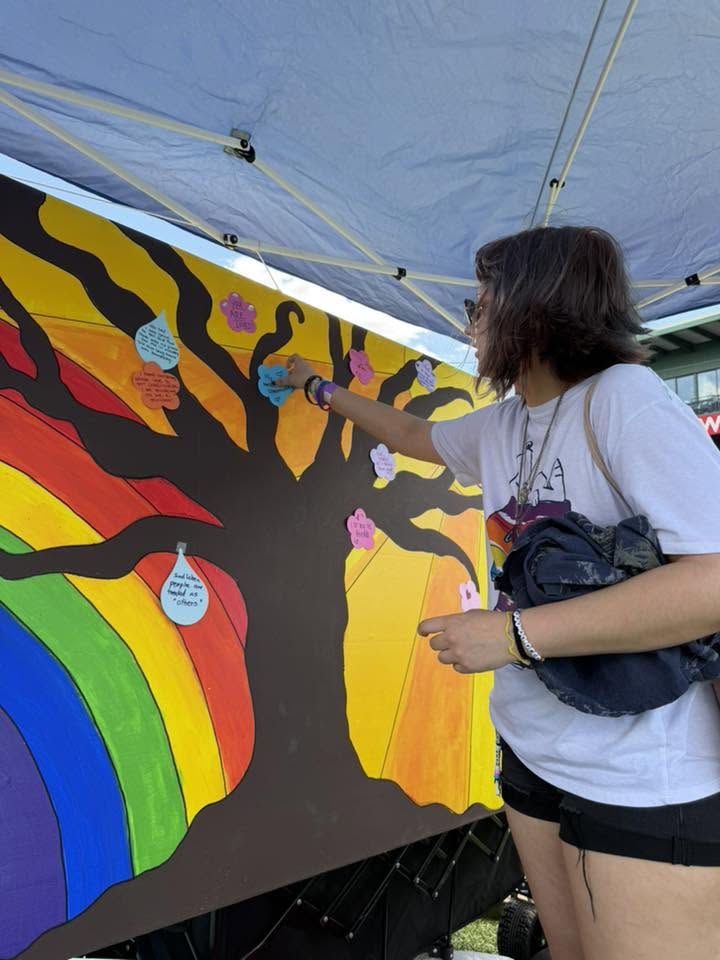
We were planting seeds with people who did not know us and were unsure what kind of church we were. The booth directly next to us reminded us that there are a lot of people with religious trauma, they were a counseling service that offered services for religious trauma.
In our booth, we had this beautiful mural that was designed and painted by Deklan, Monica, and Monica’s brother, which had the tree of life on it, but just the branches. We invited attendees to put something on the tree, and they did! Once this mural is finished, I hope you’ll take time to really read what people wrote. Because we asked them to share the ways they’ve been hurt, and some people did. We also asked them to write their hopes for the whole community, LGBTQIA+ and beyond.
I want to share with you just one interaction I had while I was there. A woman and her young child came up, and her child had just the biggest smile, so I said, “What a beautiful smile you have.” The mom then asked what our booth was doing, and I explained. She looked at me, a little concerned, and asked if her child could just color on one. I said, of course, so I handed him a flower, and he used his markers to decorate it. When he was done, I asked if I could put it up on the board for him. He ripped up his flower, and the mom looked scared. I just put out my hand and asked, “Would you like me to take the pieces?” To ease the mom’s mind, I said, “It’s okay, this is what this is about. It’s about making space for everyone, however they need to be here and express themselves.” I think she was afraid I would be angry that the child didn’t do it right. She thanked me because I knew they just needed some grace. So what if the child didn’t do it the way we planned? It’s about knowing that her child was accepted and that she was accepted and cared for.
That’s what PRIDE is about. That no matter who you are, you are a child of God. You are loved and worthy of God’s love and grace just as you are. We had a chance to make a difference in that mother and son’s lives, just in that short interaction. But hopefully, they got a different sense of the church. There was a different sense of the church in the parking lot, telling attendees they were going to hell for going to Pride and bringing their children to Pride. But inside, there were people, like us, who just offered them grace.
That’s who we are called to be, people who offer love and grace.