Building Community
Last Sunday, Nathan Moore preached as part of our youth Sunday service.
If you were not here and you haven’t either watched it on YouTube or listened to the podcast, I’m gonna encourage you to do so because he did an excellent job. It’s very much worth listening to.
But one of the issues that he brought up was the issue of Satan and demons, and he said that we don’t talk about Satan and demons much. That’s true. He actually told me later that one of his friends had told him that at his church, if that word is in the text, they just skip that word, which I find interesting. I don’t try to skip it. I don’t go into it; I believe in evil. I think we are the ones who want to personify evil and make evil more of a being that we can challenge, or more to the point, someone who we can blame.

I think that is the bigger issue when we start talking about Satan and demons, it’s because we want to take the responsibility of our inappropriate and cruel actions away from ourselves and say that someone else, something else, Satan, demons are to blame. They’re the reason that this happened, not me. Looking around, several of you are as old as I am and may remember. I still have a very vivid memory of Flip Wilson with an angel on one shoulder and the devil on the other, you know, and he had this expression, the devil made me do it. That’s all about not taking responsibility for our own actions, all of it.
Just this week in a family text thread, an unimportant topic came up, but I chose to respond to it with a GIF of Ursula laughing. And I thought if there’s an evil side to me, I believe it might be Ursula, and I apologize to all of you who don’t know who Ursula is. She’s a Disney villain from The Little Mermaid.
Evil is in the world, and there are temptations. Think about the story of Jesus and the temptation of Christ, right? There are temptations around power, greed, and wanting to control others. I think that’s very real right now. I feel like I’m seeing that right now, but we have to accept the responsibility and own the fact that I can be as kind and compassionate as I can be, and I can be Ursula and laugh and do evil, cruel, and hateful things. In every minute of every day, we choose who we’re going to be and we need to think about that.
Who does God want us to be? God wants us to be the kind, compassionate ones. Jesus came so that we would learn and see what that looks like. Jesus said to us, “Whoever wants to be my disciple must deny themselves and take up their cross and follow me” – Matthew 16:24. That is a call to risk our lives to risk everything.
Evil wants to say, “Take care of yourself. Be safe. Put up the walls to protect yourself. Build the walls, accumulate your money. Build a bigger barn.” That’s not what Jesus says. Jesus said to the rich man, get rid of it all, and pick up your cross. Be vulnerable. Take risks and follow me. Because Jesus didn’t protect himself. He showed that with his life. He knew what Judas was gonna do, but he didn’t stop Judas. He said, do what you need to do.
That was one lesson. It ties into the rest of it, but now I want to go into this parable of the dishonest manager.
As we get into this, let’s first remind ourselves what a parable is. So first of all, it’s a story. It’s not a true account. This didn’t really happen. Jesus knew that we learned better and we remembered better through stories. So he told stories to teach us things, to teach us about what the kingdom of God would be like.
This scripture I have wrestled with for a lot of my life because it just didn’t make sense. Why is the dishonest manager being praised? Why is he being praised for cheating the employer? I’ve been an employer. I didn’t like it when I got cheated, but that was the first lesson I learned. And this is the beauty of parables.
The first lesson I learned about this parable was, God doesn’t think like me. Imagine that God has bigger thoughts and more compassion and grace than I do. Praise be to God.
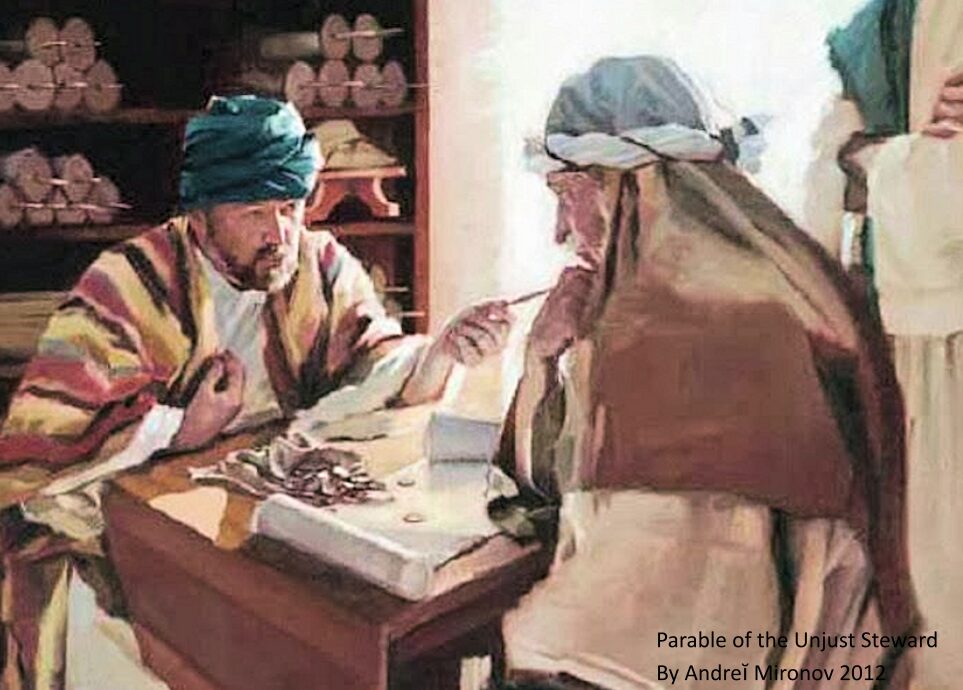
Then today I looked at this scripture, and I said, what else happens in this scripture? Let’s go deeper. Well, what the dishonest manager does is he builds community. That’s what Jesus wants us to do. Jesus wants us to build community. I would say he did the right thing for the wrong reason. He built a community to save himself so that when he didn’t have a job, he at least had friends.
Jesus wants us to have friends. Jesus knows that we can’t survive this life without community. But this time I found something else. I realized what the dishonest manager did. He helped those who were struggling. He went to them and reduced their debt for the people at the bottom who were indebted to his employer. He went to these people who owed his employer money and said, “Take half off your bill. We’re just gonna cut your bill in half.” And that’s what never made sense to me. The employer thanked him and praised him for cutting these people’s bills in half, because I was missing the fact that he was helping those who needed it the most.
Again, he did the right thing for the wrong reason, but he still did the right thing because Jesus wants us to go out and help the least of these. To the thirsty one, you gave a cup of water, and to the hungry one you gave food.
It’s about recognizing that there are those who have less than we do, who are in need and helping them in that need.
I was talking about Jesus calling us into risk. There was a risk for the manager in the scripture.
Paul and Barnabas took a big risk. They were in trouble with the Council of Jerusalem because they weren’t following the tradition. After all, the council believed at that time that you had to be fully Jewish to follow Jesus. There are people now who are shocked that Jesus was Jewish, or they don’t know it at all. It’s true. And what Paul and Barnabas went to Jerusalem to say, but the Holy Spirit is working with them, whether they’re circumcised or not.
They went and pleaded their case, and interestingly, Peter sided with them. Now, if you haven’t read the book of Acts, you need to, because in the Book of Acts, it talks about Peter’s ministry. Peter was the rock upon which I will build my church. And then you have Paul, who had this experience on the road to Damascus, and they had different ideas of what Christians were. Although they didn’t call themselves Christians at the time, they were people of the way. How do people of the way live this out? They were actually often in opposition to each other. They essentially decided to go their separate ways, which is why Paul went off into what is now Turkey with Ephesus. And, you know, he planted all these churches in Philippi and Ephesus and Galatia, and he did all of that.
But in here, Peter stands up for Paul and he says he’s right, because Peter had this dream, several chapters before this, where God said to Peter. Do not call anything unclean that I have made. If I have made it, it is clean. It had to do with eating and what they could eat and how they ate it and all that stuff. But it opened Peter’s mind to realize that there were people who were not keeping kosher, and yet they were being welcomed by the spirit to become part of the way.
If God is bringing someone and working with someone to bring them into a closer relationship, it is not our place to deny them or to put a stumbling block in front of them.
We are at that point where we need to decide if we are going to live or die, and that is our choice. We can just drift off into oblivion, and when there aren’t enough people here, sell the assets and close the doors, and go about our business. Or we can decide that there’s something here that is important enough to us that we need to save it.
That’s the wrong word, because we are not saving it; God is. We invite God to do the work. We get out of the way of the spirit and let the spirit bring whomever is coming, and we welcome them. We give them safe refuge here. And we don’t talk about them behind their back, and we don’t snear at them, and we don’t make comments because they don’t dress like us, talk like us, look like us, or act like us. We just accept them for who they are because they want a relationship with Christ. Thanks be to God.
We have to decide, are we all in on this? It’s not about forcing others to do something. It’s not. It’s about owning our responsibility to live with our fears and build a community by being an active part of it.
The United Church of Christ has a motto, and it goes like this, “In essentials, unity; in non-essentials, diversity; in all things, charity” And that charity is the Caritas, the agape love the care for others in all things, be compassionate in all things, care for the other, and we have to decide what are the essentials in which we have unity. I think it has to do with the table that we believe this is Christ’s table and you built the sanctuary so that it is accessible to all.
So let us invite all to this table to experience God’s love & God’s grace.
May it be so. Amen.
Like this Sermon? Click Here to View More in this Series
Prefer to Listen to this Sermon? Click Here to Listen to our Being Apostles Podcast