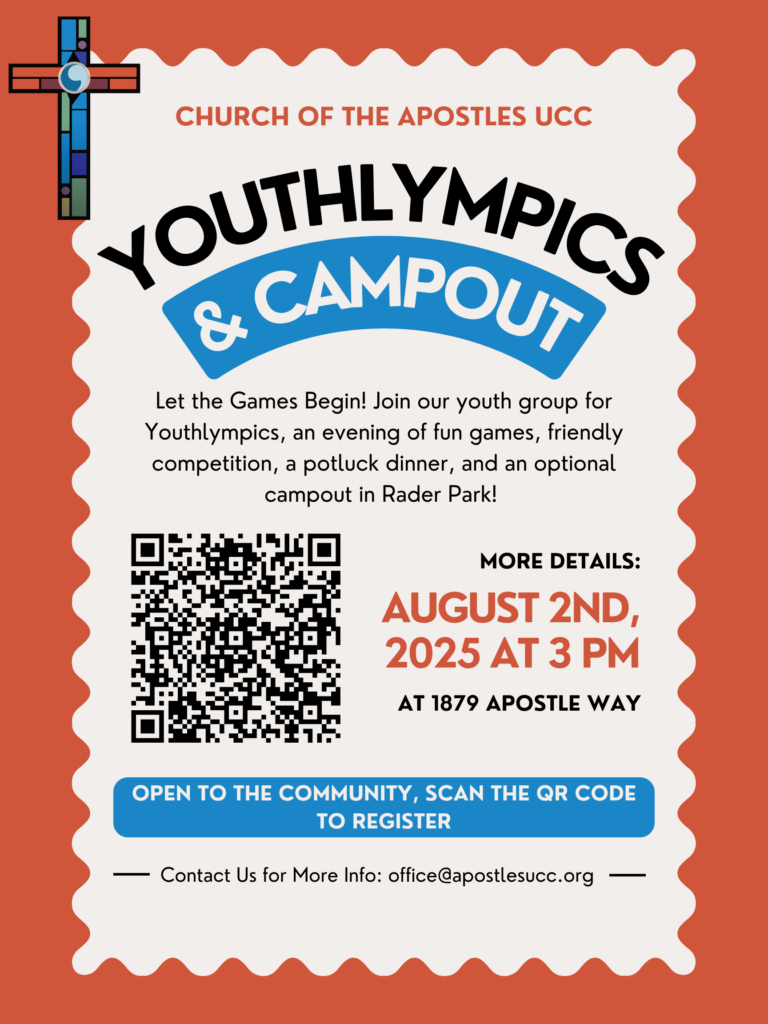
Get ready for a weekend of fun, food, and fellowship as our COA youth invite the entire church to a Churchwide Campout & Youthlympics in Rader Park, happening Saturday, August 2 to Sunday, August 3!
Join us for an afternoon of wild and wacky games, think wiffle ball, three-legged races, and more! Stick around for a potluck dinner, then gather ’round the campfire for s’mores before settling in for an overnight campout under the stars.
Tentative Schedule:
3-6 PM: Youthlympics games outside the Youth Center
6-8 PM: Potluck cookout at the Rader Park Pavilion
8-10 PM: Campfire + s’mores
10 PM: Overnight campout
Come for a few hours or stay the night, whatever fits your summer vibe! Friends and family welcome!
I want to start by having you think about what it means to be blessed.
If someone asked you to say who is blessed or to name someone that you think is blessed, who would that be for you? Do you follow the same definition that our society does? I mean, many of us do.
Our society teaches that you’re blessed if you have financial means. Maybe it’s a nice house or it’s nice cars. There’s this image that our society says is what we’re to all strive for. I remember the catchphrase from quite a few years ago that said, the one who dies with the most toys wins. So that’s the one who’s blessed.
But that’s not the way it is in the Bible. That’s not what the Bible tells us. It is the way the Empire, Romans, and the Greeks looked at life. I mean it’s been around for a while. It’s not a new concept. But the word that is used in the scripture today, the Greek word is makarios. It does mean happy, but it truly means favored. It means it’s you’re blessed because you are favored by God. You may not necessarily be happy about your situation, but you can be happy because you’re favored by God.
Think of the story of the rich man that came to Jesus looking for eternal life. Jesus says, if you want to find eternal life, go and sell off everything, give away everything you have. Because it’s all of our stuff, and caring for all of our stuff, that gets in the way of our relationship with God, Jesus Christ or the Holy Spirit, whatever name you want to use. We end up focusing on our stuff and ourselves rather than on who God’s calling us to be and how we are to be in this world.
There’s a saying that when you have nothing else, all you have is God. So it makes it a little bit easier to focus your attention on Christ.
Our scripture today is Luke’s version of the Beatitudes. The Beatitudes are in both Matthew and Luke.
Scholars believe that they came from a source that we call Q. It’s a source that we’ve never found. But there’s a whole set of stories that are in both Matthew and Luke, but not in Mark.
We have to remember that one of Matthew’s goals is to make sure that everybody understands that Jesus is the Messiah. Matthew has Jesus on the top of a mountain preaching down to all those who are beneath him. That’s not the way Luke does. Luke has Jesus on a level place. He’s accessible. In fact, the people have come to him, they’ve touched him and have been healed. He’s accessible, relatable, literally touchable. Not up on the mountaintop. He is equal with them in that moment.
There’s also a difference in the way they read. Matthews is a bit more obscure because it’s blessed are the poor in spirit. Where’s Luke? Blessed are you who are poor. It’s direct. It’s very tangible. Matthew, blessed are those who hunger and thirst for righteousness. Those are the ones where we can say, that means me, Jesus means me. Luke says, Blessed are you who are hungry today. Who didn’t have food today. Blessed are you who are grieving. Blessed are you who are excluded, reviled, and defamed.
And we want to say, isn’t one of those us? But, Luke has a different message for us. Because Luke goes on then to say, And woe to you who are rich. Woe to you who have enough, or more than enough. Because you will have a time when you won’t. And woe to you who are laughing because you will experience hardship. Not his words, my words.
Matthew and Luke are very different messages. We hear them very differently. In Matthew’s we can almost feel like it applies to us and we want it to apply to us. Luke is very clear. I don’t think it means us. At least not most of us. For most of us, we’re in the woe category. Whether we feel like we’re in the woe category, or not, we don’t want to be there. But it goes back to Luke 4, where Jesus read the scripture that’s very similar, except he put in sight for the blind.
And here is Jesus proclaiming it. This is who I’m going to be about. This should not be a surprise to us. Because from the very beginning, God has given preference to the poor, to the orphan, and to the widow. The one who is unclean and not welcome in society. The stranger. It’s amazing when you read Leviticus we get hung up on a few of those rules and ignore the rest. Like the one that says you don’t harvest the edge of your field because that is for the poor. You allow the poor to glean your field, so that they have food. That’s not a popular concept anymore. We call that stealing. But that’s in there. That’s one of those laws we’re supposed to be following. Because we’re supposed to take care of the poor.
This hits hard this week. Because this week, in the news, the Presidential administration called the poor, the parasite class.
One member of the administration team suggested that they be melted down for biodiesel.
We need to think about who we are, what we’re doing, and how we’re living in this world. Because we, too, are to bring good news to the poor, release for the captives, sight to the blind, and freedom for the oppressed.
This week is also about vision. The theme is fill our cup up with vision. I see that in two ways. Vision is our purpose and it’s our ability to see.
That is our current vision that we have agreed on. I want you to read it. Think about what we need to be involved in right now based on our vision. Because this is the work that our board is doing. Our board is saying this is our vision and we need to be about this. If we’re not, if what we’re doing is not taking us to this, then we shouldn’t be doing it. This is our focus and when I look at that, I think that we need to do more work around being a safe space for those who feel afraid or powerless.
When I think about what’s going on in our country and community right now, I think those people are people of color, they are people of different faiths, they are the LGBTQ community, they are the immigrant community. I did say immigrant, and I know some of you want me to clarify that as an illegal immigrant. But I want to say that ICE arrests people first, and then they get to show their papers. It’s not they come to your door and you show them your papers and they walk away. Those are different.
So what are we to do now? Today? Tomorrow?
We’re in this season of light. We are to be light for the world.
I think we go back to that beginning and we say, so it’s about being in right relationship with God. That has to be our first and primary focus. But we don’t get off the hook. We don’t get to let ourselves off the hook there. It’s not just about being faithful to God and listening to Christ. We also need to be the light. We need to be about Love and grace. We need to be looking and seeing what’s going on. We need to see when our neighbor is uncomfortable.
Rabbi Jack Paskoff was at a meeting with me this week and I asked how he was doing. He said, “I’ve been better” because even he is feeling the pressure of being Jewish in Lancaster County.
It’s our neighbors who aren’t white Anglo-Saxon Protestants. We need to check on them. We need to check on our LGBTQ friends. Because they’re telling me they’re terrified. Those are the people who need safe space. Those are the people who need to know where the advocates are and where their allies are.
I stopped preaching about the kingdom of God and started using the words beloved community of God. Because there’s a section of Christianity that uses the kingdom language. They have a very different outcome. They are about power. They are about military might. They believe in the sword. And they’re looking to hurt people. Because they think they want to be on top.
This message from Jesus is not about being on top. It’s about standing with people and equality and love and grace.
So what is the next most loving thing you’re going to do? That’s what I want you to think about this day.
Recently I was made aware of this film called The Kingdom of Heaven, which is a piece of historical fiction, um, with one of the characters being Balian of Ibelin.
In it, he is preparing at one point to defend Jerusalem and he needs more knights. He needs a larger army. So, he begins knighting ordinary men. In the movie, there’s this scene where he says to these ordinary men that he is making into knights, “Look up at me. See in my eyes something more and far greater than you see and know in your limitations.” He wanted these men to have more strength and courage than they knew of themselves.
It reminded me of Hafiz. “I wish I could show you when you are lonely or in the darkness the astonishing light of your own being.”– Hafiz of Shiraz
When I heard this, I thought about Onesimus in our scripture. We know why the letter’s written, but we don’t know what relationship Paul and Onesimus really had. It seems that, that Onesimus was quite helpful to Paul, and Paul saw him as more than he saw himself, and certainly more than a slave to Philemon.
So I wanted to start there as we get into this scripture lesson for today, Philemon 1:8-17
If you read my come Sunday, it’s the third shortest book of the Bible, based on word count, um, it’s only beat by the letter of first John and the letter of second John. It’s this very short piece and it is this letter from Paul to Someone Paul knows.
Paul knows Philemon and has met Onesimus and wants Onesimus to go back to Philemon. Onesimus is a runaway slave. Now you need to know something about slavery in Roman culture. It was economic, but it was economic based on debt. You became someone’s slave while you paid off your debt to them.
So, what Paul has done in this letter is he is reaching out to Philemon and saying, I’m sending Onesimus back to you. I’m returning your slave, but I don’t want you to treat him as a slave. Because in that culture, a runaway slave, if they were captured or brought back, they were branded on their face with an F for fugitive. Which even if they paid their debt, that brand stayed there for the rest of their lives. Paul’s trying to avoid that. He’s trying to avoid any punishment for Onesimus.
Onesimus has great value. He can be of use to both Philemon and to Paul. So rather than punishing him, Paul asks for forgiveness. He asks that Onesimus be welcomed as a brother. Be welcomed in love more like the story of the prodigal son who is welcomed back into welcoming arms and brought back into the table, part of the family, no longer a slave.
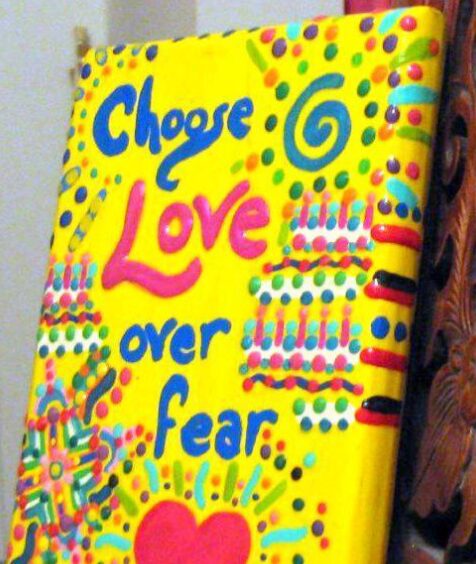
If you continue, I’m not sure if we hit that part or if it’s in the next verses, Paul is willing to even pay Philemon’s debt. Paul will cover that debt. So Philemon has lost nothing, but gained a brother. This is Paul in his most persuasive. Trying to be that person who says, choose love over fear.
When I was sitting with that, this scripture from 1 John came to my mind. “There is no fear in love, but perfect love drives out fear, because fear expects punishment. The person who is afraid has not been made perfect in love.”
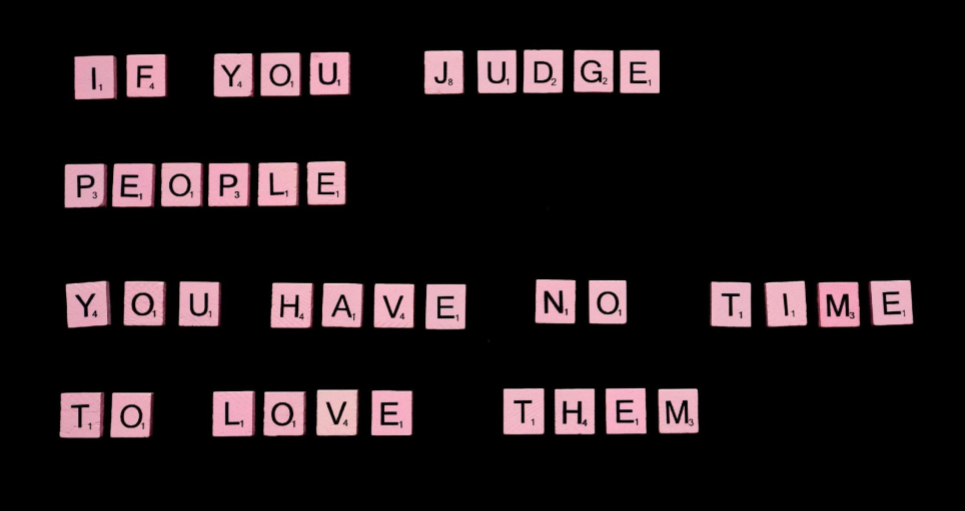
I think that’s something important for us to think about and remember right now. You see, there is within all of us judgement. It is a piece in our brain that can be very critical of us and of others.
It can help us make sense of the world. It can help us avoid danger. But it also can be an impediment. To relationships. It can stop us from forgiveness. It can stop us from loving the way we are called to love because it prevents us from being our best selves. It prevents us from seeing them as a child of God. And that’s our charge.
That’s Jesus expectation of us, that we see each person as a child of God, worthy of God’s love, a person who has received the mercy of God. Even though they may be someone who is saying something that we completely disagree with, we are still called to be in relation with them. We are called to love them because we are called to love the stranger and the enemy.
And one of the other Christians in the group said, we are called to love the enemy. And Jack said, we’re not. It surprised me, but he’s right, that’s only in the New Testament. The Old Testament is the love your God with all your heart, mind, soul, and spirit and to love your neighbor as yourself.
They are called to care for the stranger. The alien is actually is is the way it’s translated, the alien in your midst the one you don’t know. Just to clarify neighbor, although that is next week’s sermon, “Who Is My Neigbor?”
But, we are also called to love the enemy. That is Jesus call on us. That is a call that I think we need to take very seriously right now.
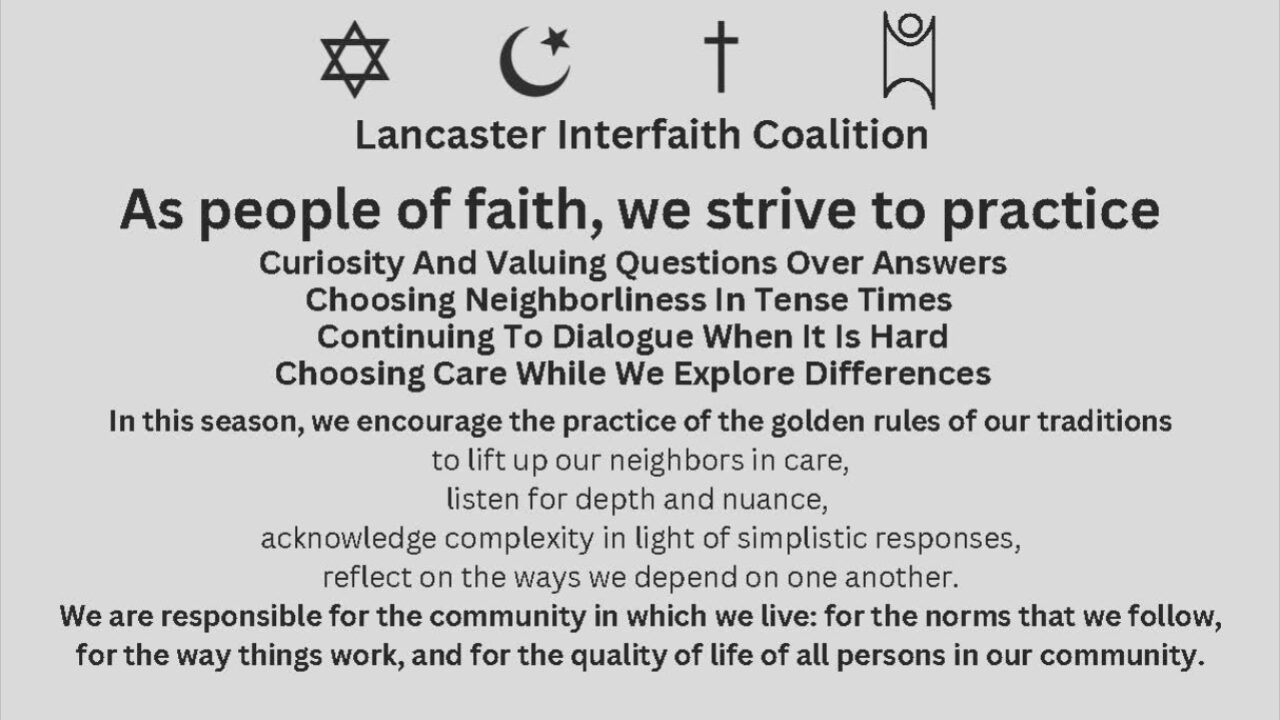
So I told you that I was in this conversation with Jack and this is what came of it. I get to give you a sneak preview. Below is an ad that’s going to show up in the Lancaster newspapers. I think it’s going to run twice because I am still part of the Lancaster Interfaith Coalition.
We are called to be co-creating with God the beloved community.
Recently, Pope Francis got the Catholic community pretty excited. Did you see that? If you didn’t, I’m going to share it with you because I’m proud of him.
He recently said, all religions are paths to God. I will use an analogy. They are like different languages that express the divine. If Pope Francis can get there, I think the rest of us can too. This is not about demonizing anyone.
We have to learn to work together, to find the commonalities, to appreciate the differences and to figure out how we will be ONE beloved community.
It’s a tall ask, but it is what Jesus looks for us to do. May it be so. Amen.
The Windows of Church of the Apostles UCC
God’s Mighty Acts
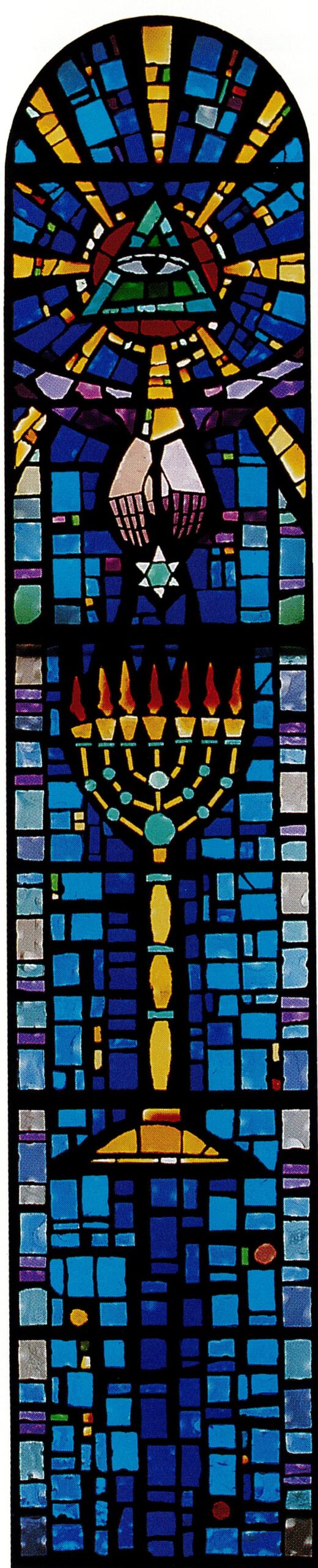
Creation
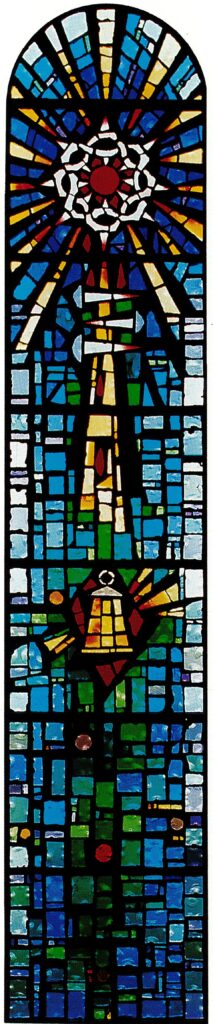
The ancient symbol of God’s all-seeing eye – a triangle with the eye at its center – at the top of the window proclaims the omniscience and wisdom of God. The triangle represents the Trinity: Father, Son and Holy Spirit. Below the eye is a pair of hands representing God’s fashioning of Creation. The Hebrew word translated “formed” in the second account of Creation (Genesis 2:7-8) is the same Hebrew word used for a potter at the wheel. So God, with his hands, forms Creation out of the dust of the Earth moistened with water. Below the hands is a large menorah, the seven branched candlestick or lampstand. In the Tabernacle built by Moses stood a candlestick made of pure gold. In this window the menorah represents the first seven days of Creation.
The Law
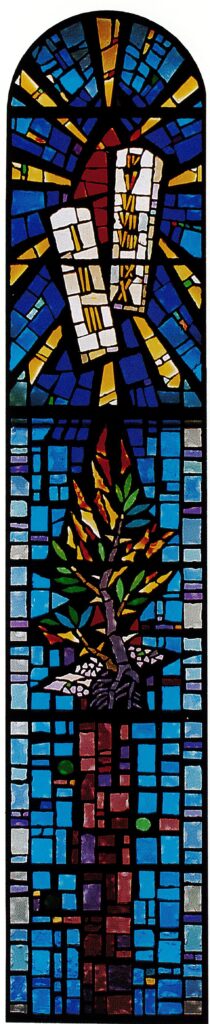
Stone tablets with the Ten Commandments God gave Moses on Mount Sinai (Exodus 20:1-17) dominate this window. There are two tablets. One represents the commandments which define the human relationship to God, the second those which regulate humane interpersonal relationships. Jesus Christ summarized the entire Torah (Law of God) when a scribe asked him, “Which commandment is the first of all?” He answered, “The first is, ‘Hear, O Israel: The Lord our God, the Lord is one; and you shall love the Lord your God with all your heart, and with all your soul, and with all your mind, and with all your strength.’ The second is this, ‘You shall love your neighbor as yourself.’ There is no commandment greater than these” (Mark 12:28-31). Jesus here quotes Deuteronomy 6:4 and Leviticus 19:18. Below the tablets of the Law is depicted the burning bush at which Moses experienced God’s presence and God’s call to lead Israel out of Egypt to the promised land. Tradition places the site where the Fifth Century Monastery of Saint Catherine now stands at the foot of Mount Sinai.
Prophecy
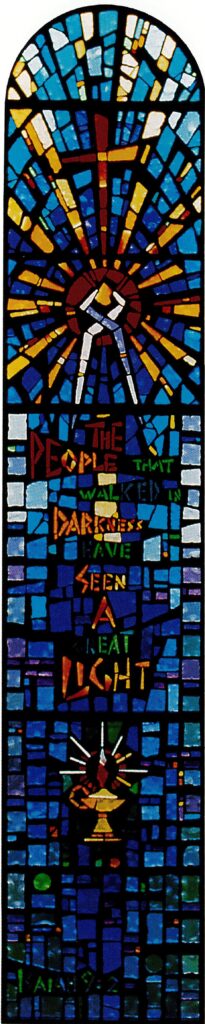
The theme of this window is the important prophet Isaiah. At the top us a pair of tongs holding a burning coal, referring to God’s response to Isaiah’s confession, “I am a man of unclean lips,” at his call (Isaiah 6:5). A seraphim touched his lips with a burning coal from the altar and said, “this has touched your lips, your guilt is taken away, and your sin is forgiven” (Isaiah 6:7). Below the tongs are Isaiah’s words which help interpret the coming of Christ, “the people that walked darkness have seen a great light” (Isaiah 9:2). The lamp below these words symbolizes that holy light. It also reminds us of the Word of God, as the psalm writer expressed it: “Thy word is a lamp to my feet and a light to my path” (Psalm 119:105). Radiating from the top of the burning coal is a cross which points prophetically to Jesus’ death.
The Birth
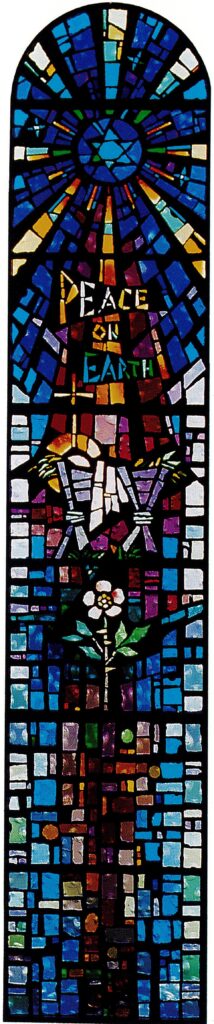
The window of the birth of Jesus has at its top small stars against deep blue for that “silent night, holy night.” The six-pointed star is the star of David, since Jesus was of David’s household and lineage. This star (two equilateral triangles superimposed) is also known as the Creator’s star. To Christians it may suggest the Holy Trinity. The words “Peace on Earth” are from the song of the angels, “Glory to God in the highest, and on earth peace among men with whom he is pleased” (Luke 2:15). Below these words is the manger with child. The white cloth folded over the crib portrays the swaddling cloths. The face of the child (without features, identified with no people) is surrounded by an orb (halo). Rising out of the halo is a cross foretelling the manner of his death. Below the manger is the traditional white rose, which withstands the ravages of winter and blooms at Christmas. The flower symbolizes the truth that, despite the ravages of catastrophe and war which shake the earth, there exists a Mighty Power which can shape a rose, lead shepherds to a king, and fulfill creation’s destiny.
Light of the World
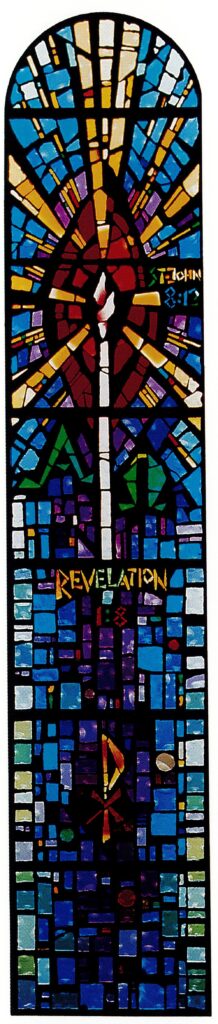
Jesus Christ is the light of the world. This window’s theme is previously announced in the Prophecy (Isaiah) window. Here a large candle represents light. The reference is to John 8:12, the words of Jesus, “I am the light of the world; he who follows me will not walk in darkness, but will have the light of life.” On either side of the candle are the Alpha and Omega, first and last letters of the Greek alphabet, affirming that Jesus frames all of life. Revelation 1:8 states, “I am Alpha and Omega…who is and who was and who it to come, the Almighty.” Christ’s light is not ephemeral; it does not quickly shed its light only to fall to the earth a cinder. This light is from everlasting to everlasting. In the lowest section of the window is the Chi Rho, two Greek letters superimposed. Chi looks like the Roman letter X, pronounced CH. The Rho looks like the letter P, Greek for R. Hence the letters CHR, the first in the name Christ.
The Agony
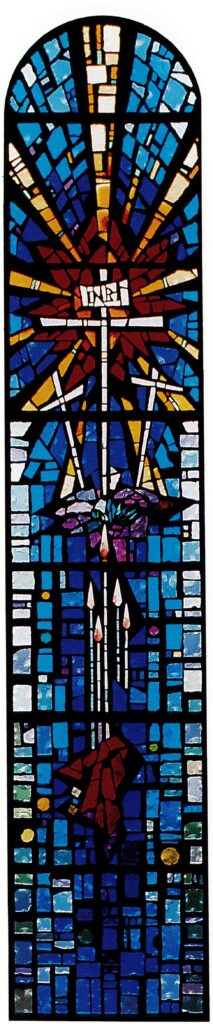
At the top of this window is a crown of thorns for the one pressed on the head of Jesus by Roman soldiers who mocked him as a king. Below are nails representing the nails driven into the hands and feet of Jesus to hold him on the cross. The nails are tipped in red-blood. The lantern in the lowest section of the window represents the arrest of Jesus at the night in the Garden of Gethsemane.
The Crucifixion
The upper section of the window shows Calvary (Golgotha, which means the place of the skull) where Jesus was crucified. The large cross represents the cross on which Jesus died. Attached to the head of the cross is the sign with the letters INRI. These are the first letters for the Latin words, Iesus Nazarenus Rex Iudaeorum, Jesus of Nazareth King of the Jews, the title Pilate fixed to the cross (John 19:19). The smaller crosses to the left and right are those on which the two thieves died (Luke 23:39). The crosses are set in rock, while green grass is growing from the cracks in the rock as a sign of hope. Rising to the center of the rock are spears representing the role the Roman soldiers played in the crucifixion. At the bottom, at the end of the spears, is a red cloth for the garment worn by Jesus. To the left of the garment are two small white squares, dice thrown by the soldiers for its possession (John 19:24).
The Resurrection
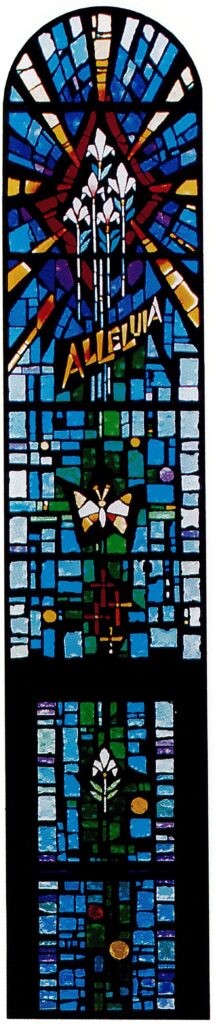
The last window on the west side represents the climax of the mighty acts of God; the resurrection of Jesus Christ. White Easter lilies dominate the window with the word Alleluia, which means “Praise the Lord.” The butterfly is a symbol of the resurrection. As the butterfly emerges beautifully from the cocoon, the resurrection of Jesus Christ is the assurance of a more glorious life after death. “What is sown is perishable, what is raised is imperishable. It is sown in dishonor, it is raised in Glory” (1 Corinthians 15:42). An Easter lily appears below, again proclaiming the resurrection.
The Human Response
The Apostles
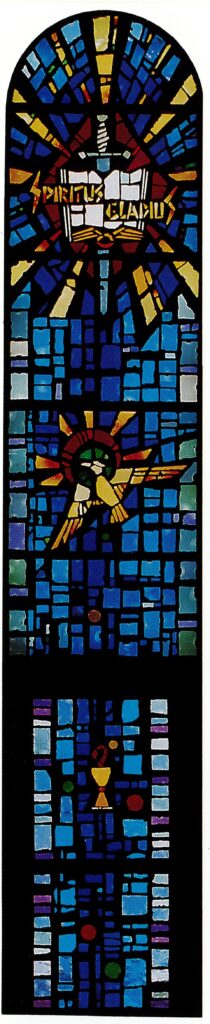
The Church of the Apostles is itself a response to God’s mighty acts. The congregation was founded May 18, 1975 when St. Paul’s congregation (founded in 1850) and St. John’s congregation (founded in 1870) united. In this window are the symbols of the apostles St. Paul and St. John. At the top of the window is the symbol of St. Paul, an open Bible with a sword behind it. The Bible bears the Latin inscription Spiritus Gladius, Sword of the Spirit, from St. Paul in Ephesians 6:17, “and take the helmet of salvation, and the sword of the Spirit, which is the word of God.” Below is the symbol for St. John the Evangelist, the eagle. It is said that the eagle can look directly into the sun without harming its eyes. St. John’s Gospel penetrates the depth of the Gospel; it is like an eagle soaring to the throne of grace. In the door is the unusual symbol of a cup out of which issues a serpent. Its source is the tradition of an attempt to poison John, which God foiled as the poison vanished in the form of a serpent. Another basis for the cup is Jesus’ statement that James and John were to drink of his cup (Mark 10:39).
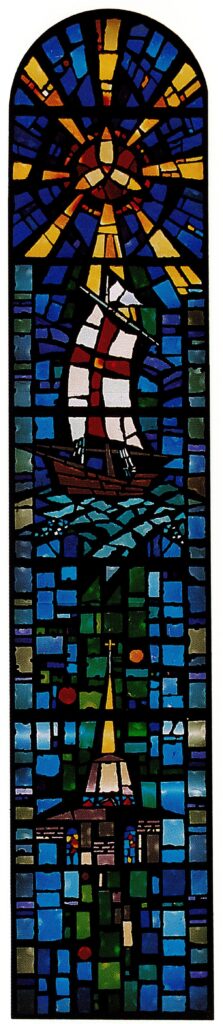
The Catholic (Universal) Church
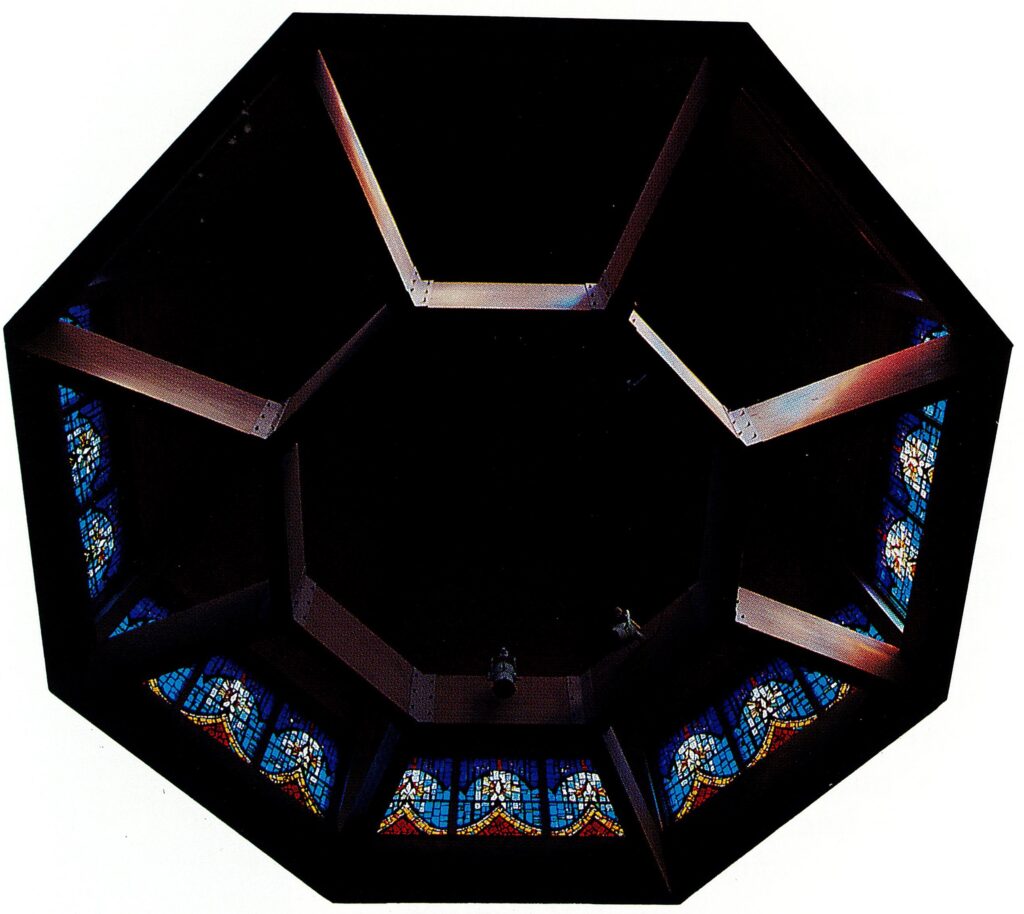
At the top of this window is the Triquetra, a design consisting of three equally shaped leaves, a symbol for the Holy Trinity. There is a legend that St. Patrick was asked to explain the Trinity. Seeing a shamrock with its three leaves he plucked it and said, “God is like the shamrock. The plant has three petals and the petals form the shamrock. So God consists of three persons, Father, Son and Holy Spirit, yet is one God.” The ship at the center of the window represents the church universal. Its sail bears a cross. While the waters in the window (aqua glass) are calm, storms can soon make them tempestuous and could drive the ship aground on the rocky shoreline. Through the ages the church rides the seas of persecution, conflicts, and division, yet remains faithful to its captain, Jesus Christ. This truth is symbolized by the ship. In the lower part of the window is a presentation of the crown of Church of the Apostles. When artist Leanis Linauts first saw the church he said, “the tower is a magnificent crown.” The 24 windows (red in blue) at the base of the crown, at the roof line, represent the jewels of the crown. A cross surmounts the crown. While the cross reminds us of Christ’s death, the fact that it is empty proclaims the resurrection. There are more than four hundred styles of the cross, this one being the familiar Latin cross.
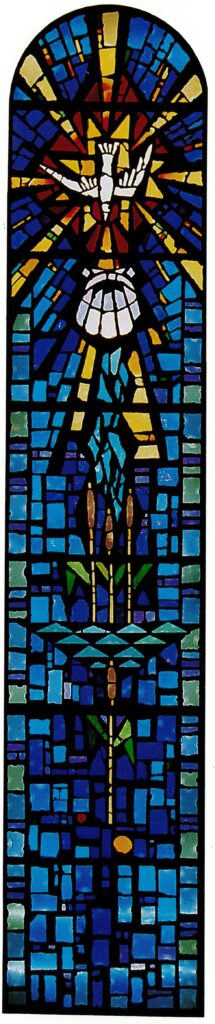
Sacrament of Baptism
The top of this window portrays the scene in the gospels of the Lord’s baptism with “the Spirit of God descending like a dove” upon Jesus (Matthew 3:16b). Below the dove is a sea shell, an ancient symbol for baptism. This symbol was used in pagan religion to stand for fertility and deification. Hence, it was used in tomb art to speak of immortality. Christians used it for baptism for this reason and because of the obvious water association. Coming from the shell are droplets of water, the outward manifestation of baptism, symbolizing cleansing from sin. The ridges of the scallop shell also suggest rays of divine love. Below the water droplets are triangular pieces of aqua-colored glass, which represent the Jordan River where Jesus was baptized. The reed rising from the bottom of the window shows the banks of the river.
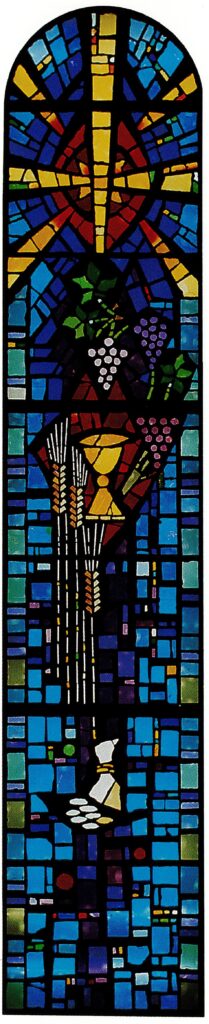
Sacrament of Holy Communion
Wine and bread are the outward elements of the Sacrament of Holy Communion. The elements are represented by clusters of grapes at the top of the window and stalks of wheat with ripened kernels rising from the window’s lower section. Between the grapes and what is a chalice, the most important symbol for Holy Communion, reminiscent of the cup used by Jesus at the Last Supper. Though for hygienic reasons communion trays and individual cups are often used today, the chalice speaks of the cup blessed by our Lord. At the bottom of the window is a curious configuration of white glass. When questioned as to its meaning the artist said, “it represents the bag and the thirty pieces of silver for which Judas betrayed Jesus.” But why place this symbol in the Communion window? It was just before the Last Supper that Judas agreed to betray Jesus and received the silver. Judas had the silver with him at the Supper, from which he arose, went out and betrayed Jesus.
Christian Service
Christians respond to God’s mighty acts with service to their fellow human beings. This window is a pictorial representation of the Parable of the Good Samaritan (Luke 10:25-37), told in answer to the question, “Who is my neighbor?” At the top of the window are the letters IHC. Five interpretations are given to this symbol and its variant, IHS: The Latin, Jesus Hominum Salvator (Jesus, Son of Man); the German, Jesus, Heiland Seligmacher (Jesus, Lord, Savior); the English, I (Christ) have suffered; the Latin, In Hoc Signo Vinces (In this sign I conquer). The preferred interpretation is from the Greek for Jesus, IHCOYC. The first three letters IHC are a monogram for Jesus. As knowledge of Greek became rare, C changed to S and IHS has perhaps become more familiar. In the window the Greek form IHC is retained, reminding us that our service is in the name of Jesus. In the center of the window is the portrayal of the Good Samaritan parable. The Samaritan (dressed humbly in brown) is kneeling over the beaten man. Note the left hand and foot of the wounded man lying on the road. In the bend of the Samaritan’s knee in the rear and to the left is the head of a donkey. Above the Samaritan to the left and rear is the inn surrounded by green trees. Below the scene are the concluding words of Jesus to this parable, “Go and do likewise,” and the figure of a flaming heart.
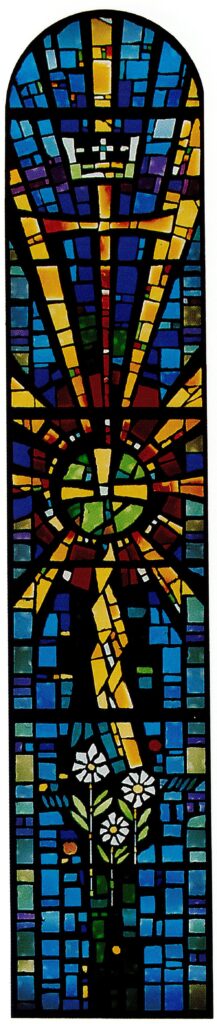
The Triumph of the Gospel
This is the only window in which brilliant rays of light do not erupt from the top of the windows. Here the light breaks forth from a circle at the center of the window. One image dominates the window, a semi-abstract form of the symbol of the United Church of Christ. This consists of a cross on an orb, surmounted by a crown and a smaller cross. The circle represents the earth. The cross standing on the orb symbolizes the triumph of the Gospel over all the Earth. The crown and cross at the top of the cross proclaims Jesus sovereign over all. The rays of light emanating from the orb flowing down to the flowers portray the triumph and kingship of Jesus not only in the heavens but reaching into every valley and field where people pursue daily life and work.
Song of Praise
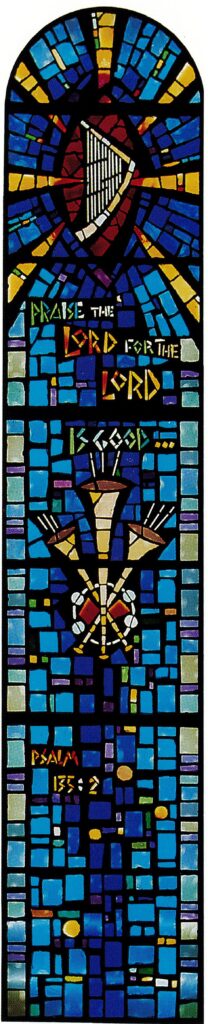
In response to God’s mighty acts Christians worship and sing God’s praise. This window was presented by the Senior Choir of Church of the Apostles. At the top of the window is a harp. It represents the harp of David and stands for joyful worship. The words “Praise the Lord for the Lord is good” are from Psalm 135:3. A trumpet stands at the center of the window. Many musical instruments were used in worship in Bible times, among them the lyre, pipe, flute, tambourine, bell, shofar, horn, harp, psaltery, cymbal and trumpet. The Psalmist wrote, “Praise Him with trumpet sound” (Psalm 150:3), and that instrument calls people to worship. Psalm 135:2, appearing in the lower section of the window, is an exhortation that all who stand in the house of the Lord shall praise the Lord.
God’s Rule and Protection
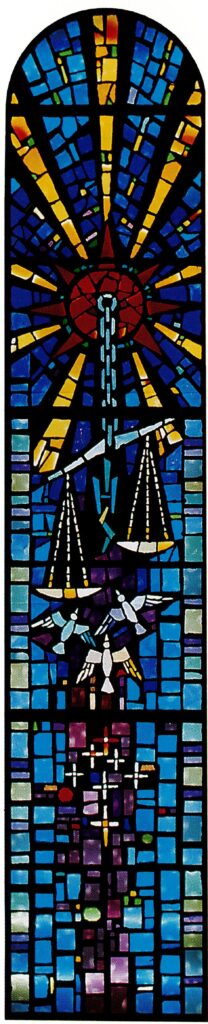
The scales symbolize God’s final judgement. Judgement will not be by Law only but by the grace of God through Jesus Christ. This is the significance of the monogram IHS in brilliant green between the balances. Here IHS is used, rather than the IHC in the Service window, though still symbolizing the name Jesus. The ascending doves and four-pointed stars, or crosses, show humanity’s aspirations for the fulfillment of God’s eternal purpose in creation.
The Crown
In addition to the sixteen windows in the sanctuary there are 24 windows (three in each section) in the tower of the church. The windows are all the same design. They are decorative and have no specific symbolic meaning; as a whole the 24 windows represent a jeweled crown. At the top of each window there are connecting arches, while in the center is a flower. In the lower portion of the windows are connecting scallops. The arches and scallops create the effect of a crown. Of these windows Mr Linauts said, “In the top of the whole building is a style-type which in the bottom parts holds stained glass windows. Twenty-four of these are created in the form of a crown.”
Ash Wednesday Service
February 26, 2020 • 7:00 PM • Sanctuary
All are invited to an evening of reflection as we begin the Lenten season.
JAZZ SUNDAY • Dec. 29th
JAZZ SUNDAY & COOKIE SOCIAL • December 29 After the hustle and bustle of Christmas, enjoy a relaxing time of “Cookies and Conversation” in the narthex, after today’s service, to help welcome in the New Year!
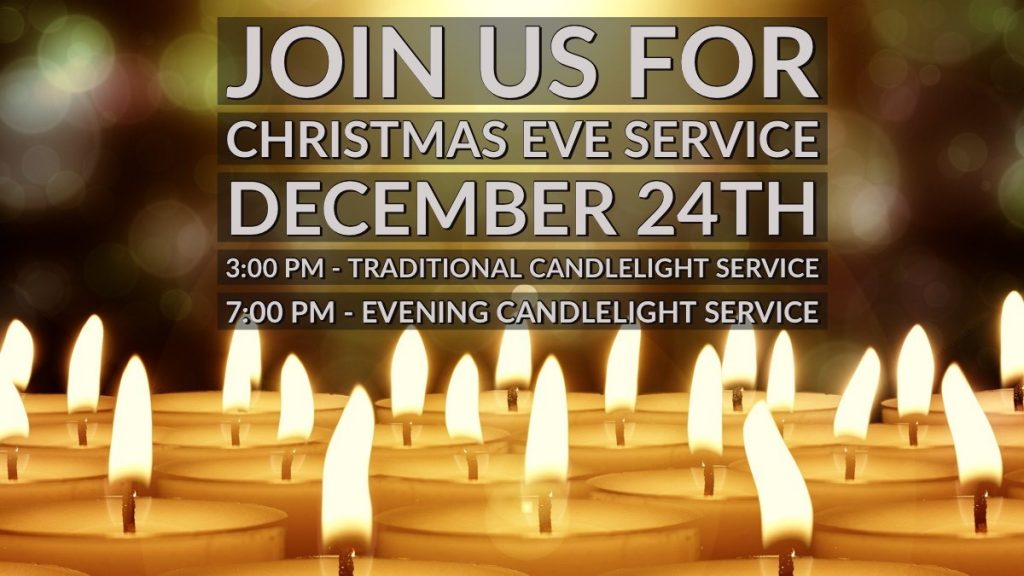
CHRISTMAS EVE SERVICES
December 24 • 3 PM and 7 PM
3 PMAfternoon Christmas Service – Traditional service with candlelight, communion and instrumental music.
7 PMEvening Service: Traditional service with candlelight, orchestra and our adult and children’s choirs.
Blue Christmas Service
December 18 at 7 PM
If Christmas is difficult, come to this quiet, contemplative service in our Sanctuary to listen to scripture and remember the wonder of God’s gift in Jesus Christ as we acknowledge that Christmas no longer feels the same.
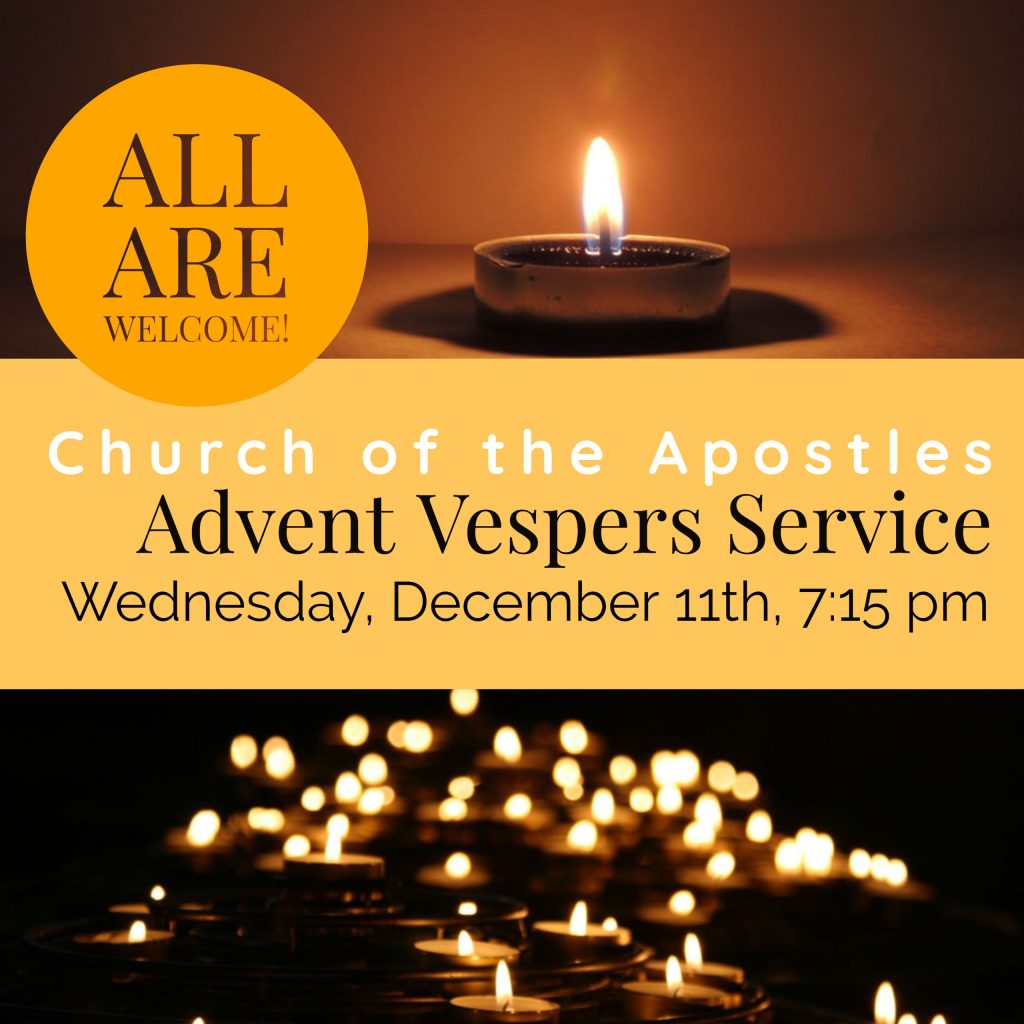
Advent Vesper Service
• Wednesday, December 11th • 7:15 PM
This season of Advent is a time of preparation, anticipation & reflection on the humility and wonder of God becoming human, like us, to reveal the depth of His Love. Let the music, contemplative readings and prayer light the way and prepare us for the Christmas season with a sense of peace-filled joy!
Penn Central Conference
Men’s Retreat • January 17 – 19, 2020 • Retreat Theme: “The Seasons of a Man’s Life: Explore the themes of Ecclesiastes 3:1-8