Questioning Conversations
Today’s scripture, John 9:1-34, was quite involved, and we did not read it to the end.
In the seven verses we didn’t read, Jesus seeks the blind man and asks him if he believes, and the formerly blind man worships him. Then, Jesus has another confrontation with the Pharisees in which he reminds them that because they do not “see” him for who he is, their “blindness” continues.
But I’m wondering what questions you may have after hearing this scripture?
The goal of John’s gospel is to prove the identity of Jesus as the Messiah, Son of God, Savior of the world.
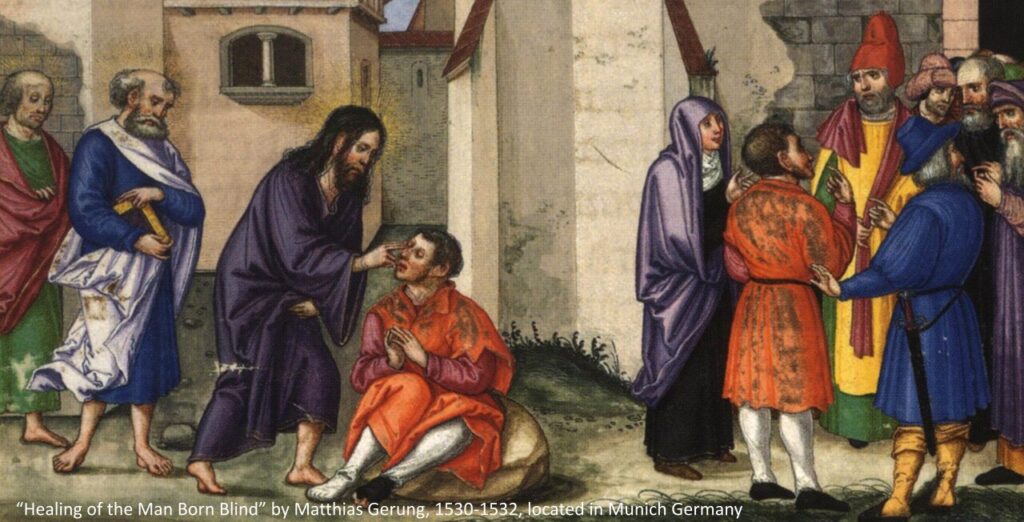
To make that point, the writer employs two strategies which are evident in this scripture – a “sign” of his power and an “I am” statement. In this scripture, Jesus gives sight to a man blind from birth, a sign that Jesus is one who restores our sight and he declares, “I am the light of the world,” naming that he reveals truth.
Jo-Ann Brant, a Johannine scholar at Goshen College, theorizes that this story is a miniature version of the larger story of Jesus.
- the crowd questions his identity (9:8-9),
- he asserts “I am” (9:9),
- he speaks frankly and logically throughout but is treated as an invalid witness (9:18),
- he is accused of being a sinner,
- he combats the Pharisees with sarcasm and truth (9:34),
This story ends in irony as the one who was blind “sees” who Jesus really is and those who claim to have vision are “blind” to who Jesus is. Jo-Ann A. Brant, John, Paideia Commentaries on the New Testament (Grand Rapids, MI: Baker Academic, 2011), 151-52, 154-59.
As this is Women’s History Month, I want to name the connection I see with this scripture, and it is how the formerly blind men’s and women’s experiences are generally not believed.
Unfortunately, this is also true for people of color and the LGBTQIA community. As the townsfolk questioned if the formerly blind man was even the same person when he told his story, I think of women who were violated, and others failed to believe them.
The popularity of the #MeToo movement the other year was based on that fact. It was finally a way in which women could name the demeaning and violent experiences they had without getting into the details.
Our problem is now complicated by AI, where our images can be used to create stories that did not happen, and because in the 20th century, we learned to trust video and pictures, we are left struggling.
I think we have reached a time when we need to tell our stories in-person and in safe spaces – thus the need for us to provide a safe space for this to happen. AND we need to listen to another’s truth and accept it and whomever they are as true – and here’s the challenge – even when it does not fit into our understandings of the world.
We have to be open enough to accept and respect another’s experience, even if it hasn’t been ours, and it makes us rethink how we understand others.
So where does this leave us?
Well, it may not feel good to hear, but we are like the disciples and Pharisees who want to judge others and point out their failings without looking at our own. And Jesus’ words provide corrections to our thoughts and actions.
We want rewards from God, so we think there needs to be punishments too. But maybe there aren’t. No one was being punished by the man being born blind.
To the Pharisees, just because Jesus healed on the Sabbath does not mean he is not of God. We, like the disciples and Pharisees, focus on the wrong things. Instead of seeing the gift of God, we disqualify it.
This week was a hard week with several attacks within our own country and abroad. We can let our legislators know that this is not the world we want. But we also need to name what we do want. We need to name that we want each person to be valued and respected, no matter who they are. Then we need to practice that too!
We need to be the love we want to see in the world. We need to put ourselves in positions to hear the stories of others –even if it is through documentaries on TV or reading non-fiction biographies of those whose lives are different. We can maintain our hope by reading about the hope and courage of those who have lived through hard times.
This is not the first time our country has experienced hard times. Let us focus on being and building the Beloved Community of God.
May it be so. Amen.
Like this Sermon? Click Here to View More in this Series
Prefer to Listen to this Sermon? Click Here to Listen to the Being Apostles Podcast