R.E.S.P.E.C.T
Last week, I said that we were in a moral moment, and I’m going further with that because I think that we are living in a time when people are looking to see how far they can go until we raise a fuss.
I just need to remind you that the crisis in Palestine needs to be on our minds. That’s one of those places where there is a moral issue. But I’m gonna talk about the injustice in our country.
There is a detention center on an unused airstrip in Florida. It is made of tents. I lived for four years in South Carolina. I’m gonna tell you that the alligators are the least of their problems. Because when you put a tent on asphalt in Florida with no air conditioning and no running water, that is called an oven, and no one, regardless of what they did or did not do, belongs there.
This is a picture from NPR of Washington. It triggers me because I remember when I went to Lebanon, and the road in and out of the Beirut airport had manned machine guns on it. As we walked around Beirut, soldiers were walking around with a K-47’s and when you pulled into a parking lot, your vehicle was scanned for bombs. I thought to myself, I never want to live like this.
I heard yesterday that the National Guard has now been given permission to carry weapons too. The other problem is that, in DC, they’re not in the areas where the crime is. They’re in the areas where the white people are, and the black and brown people are the ones being arrested. In Texas this week, they changed the districts, and by doing that, the districts with a higher number of people of color were reduced from 13 to 8.
We are creating the world that our grandchildren are going to occupy. My grandson’s in the room, and that’s not the world I want for him. That’s not where I want him to grow up.
I also look at that picture and think, do we not know? Remember Kent State? Bad things happen when somebody gets anxious. If there’s any people in the room who are young enough not to know what Kent State is, please Google it. You need to know.
Paul, in the scripture today, was talking to the church in Corinth, and the church in Corinth was a mess.
Paul uses both of his letters to try and help. But what always shocks me is that so many weddings want 1 Corinthians 13 read, and they don’t realize that it was written for a bunch of people who couldn’t get along. It is a beautiful passage about what love is, but in context.
What he’s trying to do in that very long diatribe is my issue with Paul. For those of you who’ve been here long enough, you know that I hate it when Paul goes on and on and on trying to prove his point. But they had forgotten that they were called by God to come together and be one body. They were called to come together and work together for the common good. And the common good has to mean that it’s good for everyone, and that’s part of the problem.
One of the issues, if you read Corinthians, is that the wealthier people decided that they should have more rights. One of the big things was the table. They would come early when communion was being offered because they had all the time, they weren’t working. They didn’t need to be anywhere. They had all day. They could sit and feast at the Lord’s table. The poor people, the people who were working hard, didn’t get in until much later. There’s a whole section where Paul says, You all rich people, you’re just going to have to wait. You don’t get to come in and eat up all the food so that the poor people don’t have anything.
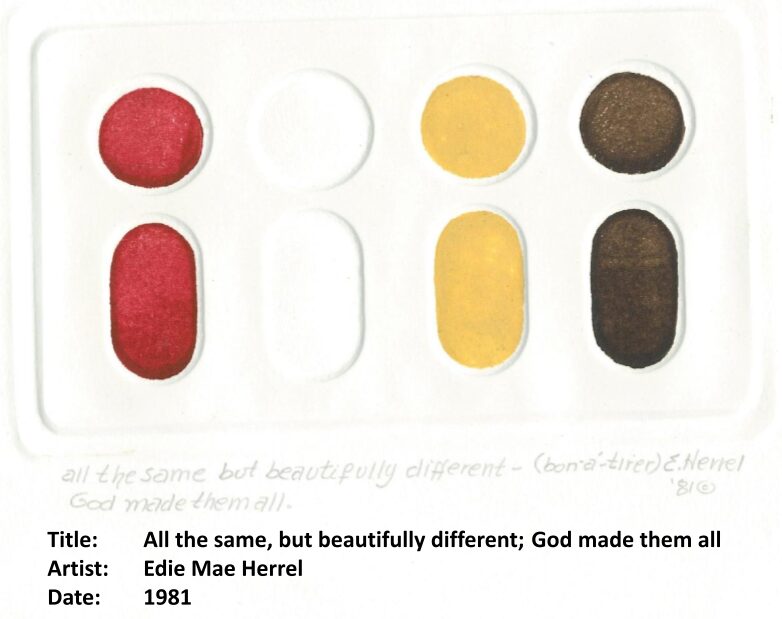
We’re all created equal. We are all created good, and then we make choices, and choices are made for us. That’s another sermon we’ll not go into today, or we’ll be here all day. We make choices and our country makes choices together. We make choices about who has rights and who doesn’t, and we need to pay attention, because stuff’s happening. We are called to respect each other. And I’ve been sitting with that, and I want you to sit with this.
I want you to think about how Jesus calls us to love our neighbor as ourselves.
What part of that love has to do with respect, because where I’m landing is that I have a really hard time loving someone whom I do not respect. That’s hard for me. I can try and love them as a child of God.
There’s a line out of my favorite movie, which is the American President, where Michael Douglas says, “Democracy is about me protecting the rights of the person who says something that makes my blood boil.” But, in a democracy, he has the right to say it; that doesn’t mean it’s the right thing to do. We live in that tension between what is right, the right thing to do, and what our rights allow us to do.
The thought that just came to my head is that thing you say to kids, “just because you can doesn’t mean you should.” Maybe we need to remember that. I looked up respect, and this was the definition that I liked. It is due regard for the feelings, wishes, rights, or traditions of others.
The Stephen Smith Community Development Program Project is coming to Columbia, and I’m gonna tell you more about it.
But when I got this information, I thought, there’s a backstory to this. I wanna know the backstory, who was Steven Smith? And so I asked my friend who sent me the information. I think this is worth you hearing.
Reverend Steven Smith came to Columbia at five years of age. She didn’t tell me what year it was. I’m guessing it was in the 1700’s, but I could be wrong. He was brought to Columbia as a 5-year-old enslaved child. He was the first pastor of Mount Zion in Columbia. When he grew up, he started a lumber business, which was extremely successful, and he became the wealthiest African American in Columbia. He owned the most stock in the bank in Columbia, but he was not allowed to be president because he was black. And so, in his wrath, he built the Wrightsville Bridge. I didn’t know that he paid to have the Wrightsville Bridge built, which was part of the Underground Railroad eventually. But, when the riots broke out in Columbia, his office was destroyed and he was run out of town.
There was a marker at the Mount Zion Church. The Pennsylvania Historical Society had put markers around the state to designate African American history. And it has recently disappeared. The church asked the Columbia Historical Society what happened, and they didn’t know. So, they went to the Pennsylvania Historical Society, and what they learned was that all the historical markers in Pennsylvania regarding African American history and the contributions of African Americans have been removed in our state. I haven’t seen that in the news; it wasn’t reported on, but it’s happened.
Mount Zion Church is taking a building that they had and converting it into the Stephen Smith community development project. It is named that to honor Steven Smith, who was a prominent African American in Columbia. Their purpose is, or what they believe is, that youth thrive when their basic needs are met and educational resources are provided. The programs that they offer will be tailored to their individual needs. The programs will be specifically designed to help empower and equip them. We believe as they are prepared educationally and fundamentally, the result will be productive citizenship. The center is long overdue as a safe space for academic support, STEM projects, peer interaction, as well as the reinforcement of core values.
They are dedicated to empowering youth in Columbia and surrounding areas, providing a safe and inclusive space for them and their families through education, support, and connection. Their goal is to rebuild, restore, and inspire a stronger, brighter future for our youth. If you would like to donate to that project, visit https://www.zeffy.com/en-US/donation-form/the-stephen-smith-community-development-project
We need to decide where we’re at and how we’re gonna speak and live in this moment.
We do live in tension, but we have to decide what world we want our children and our grandchildren, and our great-grandchildren to grow up in.
May it be so. Amen.
Like this Sermon? Click Here to View More in this Series
Prefer to Listen to this Sermon? Click Here to Listen to our Being Apostles Podcast