Acting Through Love
Love is our theme for this fourth Sunday in Advent, and that seems like something we shouldn’t have to define, but right now I feel like we do.
I decided to define love by saying what it is not. It is called a negative argument. Love is not violence against someone who has different beliefs or values from us. Love is not violence against when we see our brothers and sisters of any faith or no faith hurt. That is not love. When we see it, and we remain silent, that is not love. Love is not cruel words meant to create hardship or pain for another; that is not love.
Then the scripture from 1 Corinthians came back to me, because we need a little bit of positivity here. “Love is patient; love is kind; love is not envious or boastful or arrogant or rude. It does not insist on its own way; it is not irritable; it keeps no record of wrongs; it does not rejoice in wrongdoing but rejoices in the truth.” – 1 Corinthians 13:4-6
Our God has made it quite clear that the expectation of us is that we love. We are to love our God. We are to love our neighbor as ourselves. We are to love the stranger among us. We are to love our enemy, and we are to love ourselves. That is the commandment of God. We are to be people of love doing loving acts for others.
The Isaiah scripture today, Isaiah 7:10-16, was written 3,000 years ago and was written in Hebrew. Then in about the third century BCE, it was translated into Greek.
A lot of people didn’t speak Hebrew; the religious leaders spoke Hebrew, the scholars spoke Hebrew, but the people spoke Greek because that was the language of business at that time. There was a translation of the Old Testament from Hebrew into Greek. That was called the Septuagint translation. Sep meaning seven, it was the translation of the 70 because it was translated by 72 translators, six from each of the 12 tribes of Israel. So remember, like that’s still important. The 12 tribes of Israel were still important, so six people from each tribe got to come in, and they translated it, and when they translated it, they wrote, “Behold, a virgin shall conceive and bear a son and shall call his name Emmanuel.”
However, it wasn’t really accurate to the Hebrew. Fortunately, the NRSV, which is the Bible that you have in your pews, instead of using the Septuagint, went back to the original Hebrew. This is also a whole lot closer to what I have. “Look, the young woman is with child and shall bear a son.” – Matthew 1:23.
Do you see the differences? One, she’s a virgin. It’s just she’s young. One place, she shall conceive, future tense. The other one, she’s already pregnant a thousand years before Jesus is born. I just told you all of that to say that this is one of the scriptures that Christians, particularly some Jewish people, feel that we have co-opted to make it fit Jesus. Because Matthew used the Septuagint when he wrote, so that is what was in Matthew’s gospel, and they like that to match. People want you to read it in Matthew and then go back to Isaiah and find it.
Scripture’s messy, folks, it’s not clean. It’s precise. But today is Joseph’s day, and I don’t wanna take time away from Joseph. I want you to think for a moment what you know about Joseph.
I’m going to guess that you know Joseph as the one who did what the angel told him to do. He gets lifted as that he gets celebrated. The angel told him not to be afraid, take Mary, and that’s what he did. But let’s give Joseph a little bit more credit. Not that, you know, if an angel shows up, listen to him, but we don’t all get angels. We can all sit and think about what the right thing to do is.
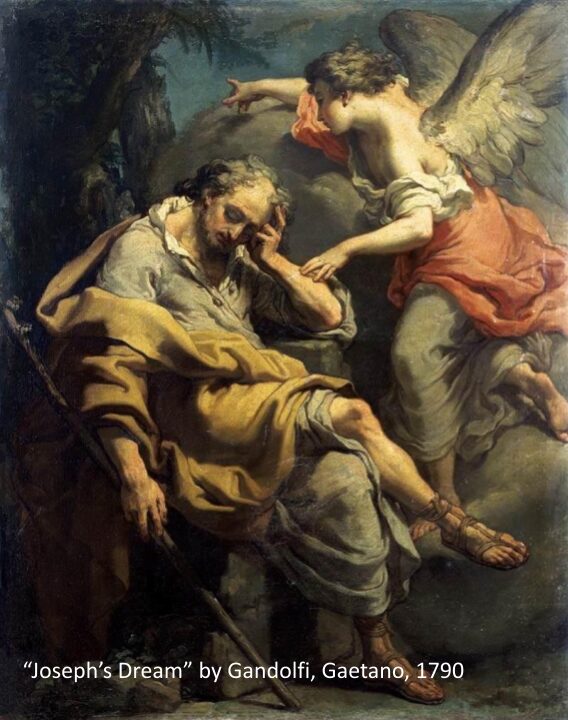
Joseph and Mary were not two teenagers who fell in love, and this was all wonderful. That’s not what marriage was in the first century. Mary was a liability to her family, especially when she was pregnant without being married. But Mary was a liability even before she was pregnant. She was a drain on the family system, so she needed to go. She needed to be married off. Where’s the dowry? Where’s the money for her? Let’s get her out. She’s of marrying age. Let’s get this woman married.
Joseph is portrayed as such a nice, innocent young man. What was good about that was that they did not portray the harshness of how the people lived under Roman oppression. I tell you that, but they depicted it well because the people were really struggling with poverty under Roman oppression.
But I think Joseph really struggled with this as he followed the angel. He looked at this situation, and he said, “What does Mary need?” Mary needs to be protected, and she needs security. She needs safety and security. He realized he could provide that. Joseph knew that he could do that. If Mary were pregnant out of wedlock, she would have been killed. That punishment is stoning. She would not have survived. So whether the baby was God’s or not, he was saving a life by taking her as his wife.
I think he just needs credit. Joseph needs credit for being the kind of man who is willing to stand up and say, I choose family. I can choose to be the earthly father of Jesus, and he accepted that choice.
They chose love. In the midst of fear, they chose love against all odds, and they knew that being together was better than being apart.
We are called to choose love.
As I sat with that, what came to me was how I love the church calendar because it is circular or maybe a spiral. We come around to the same stories, and hopefully we grow a little bit. I read the first verses of John’s Gospel on Christmas Eve and on Good Friday. I know that you probably didn’t pick up on that, so I’ll clue you in to that.

But I went back to see how I was closing my sermons in Lent, and this is what I said in Lent. One of the pieces that I love about the church year is that Lent and Holy Week tie to Advent and Christmas. So to complete the circle, how we treat others matters. What is the most loving thing to do now?
To quote Stephen Sills, love the ones you’re with, and remember from the wisdom of Stephen Sondheim, and maybe this will come back to you. Careful. The things you say. Children will listen. Careful the things you do, children will see. Learn. Children may not obey, but children will listen. Children will look to you for which way to turn, to learn what to be careful before you say, listen to me, children will listen.
May it be so. Amen.
Like this Sermon? Click Here to View More in this Series
Prefer to Listen to this Sermon? Click Here to Listen to our Being Apostles Podcast