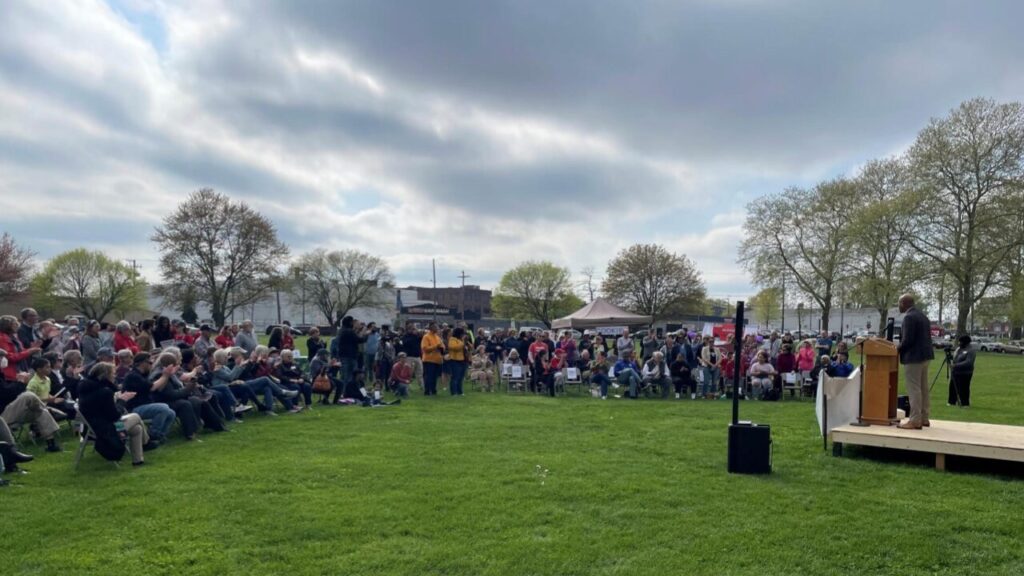
So here we are – gathered in this “new to us” space where we will be for worship this summer.
For the next few minutes, I invite you into a piece of faith imagination. This is a means by which we can experience the scripture, and based on the gifts we have been given, learn something about ourselves or about the Holy Spirit through it. So, I ask that you participate.
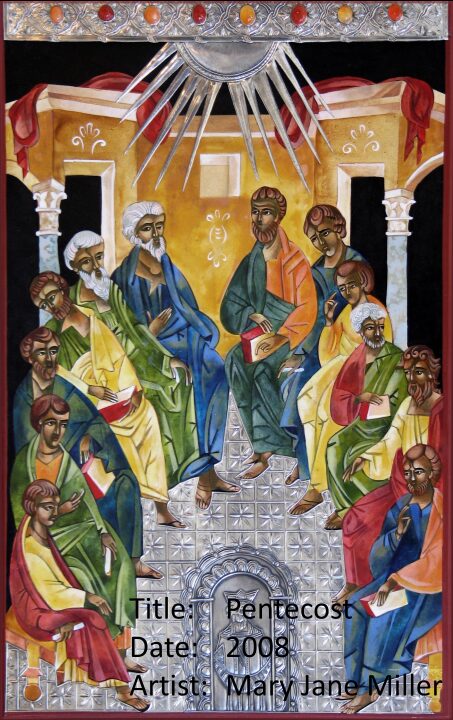
“When the day of Pentecost arrived, they all met in one room.” – Acts 2:1
Close your eyes and imagine the room. What does it look like? What details do you see? The disciples were there but so were many other people That you do not yet know. Where do you choose to stand within the room? By whom? Look at the others. There were:
“Parthians, Medes, Elamites, and residents of Mesopotamia, Judea and Cappadocia, Pontus and Asia, 10 Phrygia and Pamphylia, Egypt and the parts of Libya belonging to Cyrene, and visitors from Rome, both Jews and those who have become Jewish, those from Greek and Arab areas.” – Acts 2:9-10
How do you feel in this group? They are all speaking in their own languages, and although you are fluent in a few languages, you cannot understand much being said. Draw your attention to your body. What do you notice?
“Suddenly they heard what sounded like a violent, rushing wind from heaven; The noise filled the entire house in which they were sitting.” – Acts 2:2
Now that the wind has rushed passed you. What do you notice within yourself? Look at the others around you. What do you see?
“Something appeared to them that seemed like tongues of fire; these separated and came to rest on the head of each one.” – Acts 2:3
Look at the flames above each person’s head. How are you feeling? Scared? Intrigued? Overwhelmed? Excited?
“They were all filled with the Holy Spirit and began to speak in other languages as she enabled them.” – Acts 2:4
Suddenly you can understand everything being said around you! Where you felt left out of conversations and wondered what was being said, now you know what they’re saying. How do you feel? What are you thinking? What has happened in this space? How did the Holy Spirit blowing through and becoming like flames over each person affect you? Are you anxious? Questioning? Amazed? Confused? Frightened? Look at the people around you. How are they reacting? Do they feel like you do?
Suddenly, the one they call Peter stood up and said,
“Women and men of Judea, and all you who live in Jerusalem! Listen to what I have to say! These people are not drunk as you think – It is only nine o’clock in the morning! No, its what Joel the prophet spoke of: ‘In the days to come – it is our God who speaks – I will pour out my Spirit on all humankind. Your daughters and sons will prophesy, Your young people will see visions, and your elders will dream dreams.” – Acts 14-17
What are you thinking? How do you feel? Are you one of the ones seeing visions or dreaming dreams? Pause and allow the Holy Spirit who is with you Speak to you. What do they say?
Since this is how your day just started, What do you want to do next?
If you don’t know this about me, the word “obey” has negative connotations to me.
I was raised in a house, yes, I said house, not a home, Because although we looked similar to the Brady Bunch, we were not – we co-existed. So when I am told to “obey,” I want more specifics. Obey what rule? Who wants my obedience? And for what reason?
I am one of those people who does not respond well to “Because I told you so,” even though I used that line on our children, too. It is with this context that I approach this week’s scripture.
So if we look at the problem in the scripture, we remember from last week, we are still in the 14th chapter of John.
This was written to Jewish people who have been ostracized from their Jewish community -put out of their synagogues for believing in Jesus as the Messiah. It was NOT intended to create new followers but to sustain the faith of those already following “The Way.” This happened in the late first century.
Again, this context is crucial to working through the language of John’s gospel. Our focus verse for this week is the words of Jesus saying,
“Those who obey the commandments are the ones who love me,and those who love me will be loved by God.” – John 14:21a
And…being me…I want to know which commandments we are referring to. In the Gospel of John, Jesus gives the “New Commandment.” In John 13:34 and two other times later, “Love each other.Just as I have loved you, so you also must love each other.” I would add to this, “Love the Lord your God”
Because they are Jewish – That is the first and most important commandment. It is also the one used by Jesus in the other Gospels where Jesus says, “Love the Lord your God with all of your beingand love your neighbor as yourself.”
But do you hear the difference? John’s version is inwardly facing. We are to love “each other.” It doesn’t say anything about our neighbor. And the answer to the question of why the difference is the same reason that John’s Gospel appears to look harshly at “The Jews.” Because John’s audience is the minority who are grieving the loss of their community.
They are the outsiders trying to find their way of living “The Way!” Jesus’ statement is an invitation to participate in God’s loving mission!
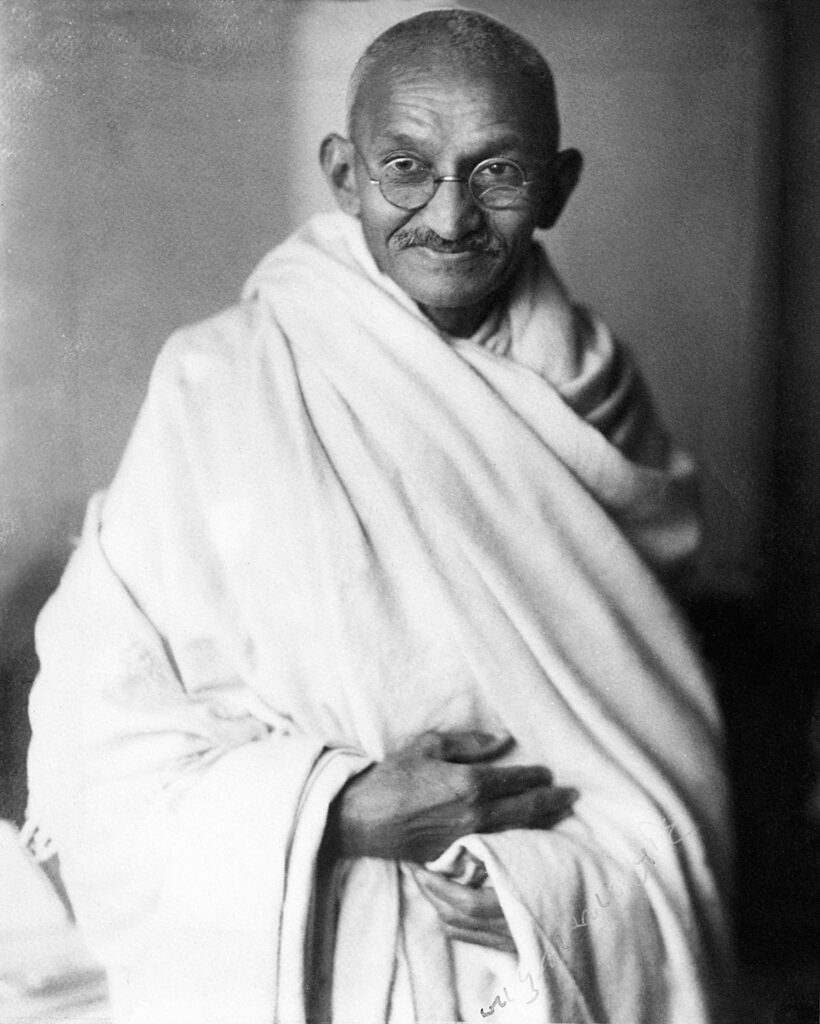
A2FP81 Rare studio photograph of Mahatma Gandhi taken in London England UK at the request of Lord Irwin 1931
In the Acts scripture, Peter has just had a dream where God told him there is no such thing as clean and unclean in creation.
All creatures in creation are clean and can be eaten as all people are clean and worthy of baptism and inclusion in God’s Beloved Community. So Peter has an attitude adjustment and welcomes the Gentiles. Here I think the words of Mahatma Gandhi are relevant: “Whenever you are in doubt… recall the face of the poorest and the most vulnerable person whom you may have seen, and ask yourself if the step you contemplate is going to be of any use to them“
The love that God has for us and the love we are being called to share is an expansive love rather than exclusive.
It seeks to help us grow in knowledge and wisdom to find more hope, peace, love, and joy in the world. So, as we gather, we have to remember to make space.
For instance – for those with disabilities we cannot see. It is allowing others to name what they need that includes them rather than deciding that we know best. And if we are honest, we have done that A LOT!!
This is a humble love that wants the best for others without declaring what that is. God declared God’s ultimate love for us in sending us Jesus, so that we can learn to love as God loves. And this love transcends greed, prejudice, self-Interest, fear, and narrow-mindedness. Instead, God’s love is one that embraces all people and creation! This is the love we are called to experience and to share!
And I leave you with the wisdom of Gandalf… A dismayed Frodo said, “I wish it need not have happened in my time.”And Gandalf responds, “And so do all who live to see such times.But that is not for them to decide.All we have to decide is what to do with the time that is given us.”
We don’t choose the times we live in, but it’s often the case that the times choose us, to live out our faith, our resistance, and our healing. It is seldom, if ever, fun. Or easy.
But remember the words from 8th Chapter of John’s gospel where Jesus says, “If you continue in my word, you are truly my disciples, and you will know the truth, and the truth will make you free.” – John 8:31-32
I was going to talk about the spirit and how the spirit is experienced differently in today’s scriptures, Acts 2:1-6 & John 14:8-17 and 25-27. But something wasn’t sitting with me.
I’m going to call that the spirit wasn’t sitting with me. I even woke up this morning and said, “This isn’t the sermon I want to do.” Which is kind of scary on the day that you’re gonna do it. But it opened me to read my email, and in my email, I found a very heartfelt, but serious email from Rabbi Jack Paskoff letting me know just how afraid the Jewish population is right now. After this, we just had the attack in Washington not too long ago, and then there was the attack in Colorado, and I knew that the attack in Colorado left me almost numb with grief.
I’m sharing this because as Christians. We have had a habit of saying that our beliefs trump theirs. That’s where we started, but now we know better. It sets up this hierarchy. Like they’re not as evolved, they just haven’t come to the belief or faith that we have. That is the understanding within Christianity that fuels antisemitism. And right now in our country, there are so many people hurting, and there is this permission to be cruel and hateful that the church cannot abide with.
That is not who we’re called to be on any level. We need to remember that as we talk about our faith, as we talk about Christ, as we talk about Pentecost.
We often talk about Pentecost strictly as the birth of the church. As if we came up with this all by ourselves. But, the Jewish people already had a holiday and we took it and called it something different. Their holiday is Shavuot. It celebrates the spring harvest, the barley harvest, I think it was specifically.
They read the Book of Ruth. Now, two things about that to make note of. Shavuot is 50 days after the second night of Passover. But by celebrating Ruth, she became one of the ancestors of King David. They get King David because of Ruth.
But Ruth was not born of Jewish heritage. You can convert to Judaism, and it means that it’s more inclusive. Judaism itself is more inclusive then we give it credit for.
Then we use this term Pentecost, Penta meaning five. Pentecost is supposed to be 50 days after Easter, and you’re going, “wait a minute, it’s been eight weeks. That’s not 50 days.” But we don’t count the Sundays because we need to make it complicated. Pentecost is supposed to be the gift of the Holy Spirit, and the Holy Spirit’s been with us since the beginning.
We talk about that in Genesis 1. The word for the pronouns we use for God are all plural. I hope you’ve noticed that. If not, go back and read Genesis one again, and you’ll be surprised. We talk about those plural pronouns, saying that it is because God is plural. We have a plural understanding of God in that we have God the Father, God the Son, God the Holy Spirit, or the Creator, Redeemer Sustainer. That’s one of the reasons we are sometimes accused by other religions of not being monotheistic. That’s the whole Trinity piece. That’s next Sunday, come back and we’ll try to try to unpack how we have one God that we know in three different ways.
In Proverbs 8, the spirit is described as wisdom. Wisdom was there from the beginning. a All of this is trying to come together. Maybe not very clearly, but in a way that is part of it because the spirit is mystery.
I was going to start this sermon by saying, “How do you experience the spirit of God or the Holy Spirit?”
In our scripture, Acts 2:1-8, it comes as this rushing wind and fire. There are flames, tongues of flame up above everybody’s head. Suddenly this group of people, who would’ve been gathered in Jerusalem because of their festival. According to Luke’s version, it’s this large group of people who suddenly, because of the Holy Spirit, can understand one another in languages they didn’t know. It’s this inclusive nature of Christianity.
The point is that everybody there was able to communicate and be together. Then, they decided this was so good that they needed to live together, and they chose to call themselves followers of the way. The name ‘Christians’ came much later. They were followers of the way, and they chose to live together to share their things and to create a whole different way of being. That attracted people. People wanted to have what they had. To know that spirit that calls them to be loving, compassionate, and caring. That’s the same spirit that in John 14:8-17 and 25-27 was being promised.
But, in John 20, according to John’s gospel, it happens in the upper room when Jesus breathes on the disciples. It’s a breath.
So, whether the spirit comes to you as the breath of God that enlivens you and brings humanity to life. From the very beginning, we are breathed on again to put more and new energy into us, and all of this breathing, all of this inclusion. It’s all about relationships. It’s all because from the very beginning, God has been trying to be in a relationship with humanity. And humanity has constantly done otherwise.
But God continued to speak and God spoke through the priests, God spoke through the prophets, and we continued to say that when things were going wrong, we needed God on our side. But, when the storms cleared, everything’s great now, we got this. Our story is that God finally decided to come and be one of us, that we just weren’t getting it. And so God came and took on this body because then God was relatable. God was one of us, and yet still wasn’t enough for us. We rejected that God, crucified that God, and God still came back and said, “I’m going to make sure that my spirit is in all of you, so that everyone has the opportunity to follow God.”
The question is whether we choose to or not? Do we choose to listen to that still, small, forever speaking voice?
Maybe it’s this energy in us that’s telling us something’s wrong? Something’s not right here. The way I’m supposed to live, I need to do something. If you have that kind of energy within you, I call it a nudging, but sometimes it’s a bit stronger than a nudge. God’s given me a head slap once or twice. Because I, too, can get caught up in what I want and what I think is important, but it’s not about me, and it’s unfortunately, not about you. It’s about our relationship with God.
I do mean OUR relationship, because we have our relationships, but we need the body. We need the group because it’s within the group that we keep ourselves on track. It’s within the group that when one of us is falling apart, the group can come together and be the hands and feet of Christ. That’s why we come together. We gather each week because life is hard.
I get frustrated and depressed watching the news, and I need to come together with the rest of you so that I remember who I am, that I remember who God is, and our reform traditions. We believe God’s got this. We just keep going because God loves us and cares about us, and we, too, love and care about others. So when we see someone who’s being picked on, we reach out to them.
God calls us to be those people, and God calls us to have a little bit of fun. So we’re we’re going to close this sermon with having some fun.
I know that some of you are now panicking, asking, “what is she going to have us do?” You are going to be the spirit. Because today for Pentecost, the spirit came as a rush of a mighty wind. I’m gonna have you breathe and ask, “Who?”
Every time I say the word spirit, that’s what we’re gonna do. “On that day, the Spirit broke through every barrier, language, culture, fear, and doubt. That day, the Spirit turned hiding into preaching, confusion into clarity, and death into life. That was just the beginning because the Spirit kept moving through baptisms, through brave words, through acts of love and justice. The Spirit did not stay in the upper room or the temple. The Spirit moved into hearts and homes and every corner of the world. Today, the Spirit is still moving, still breaking barriers, still breathing hope, still calling you, calling each of us. So if you wonder, am I ready? Am I good enough? Am I brave enough? Remember Pentecost, and remember this: you don’t have to be perfect. You just have to be open because the Spirit is already moving.
Today is Mother’s Day, and as I have talked to many people over the years, that can bring a wealth of emotion.
I want to name that upfront because there are people who specifically stay away from church on Mother’s Day. After all, it’s not easy. Some people have complicated relationships. But today I wanna celebrate with you. All of the people in your life who have nurtured you, who have encouraged you, who have been there and loved you, all of those people who have helped you to have second chances.
I’m going to lean on this idea of second chances because I think that’s what it means to rise again. That’s the theme of today. Let’s celebrate all of those people who’ve helped us over the years, whether they are biological or chosen family. Let’s acknowledge that everyone needs someone who believes in them, who reminds them that they are loved. And someone who encourages them to be all that they were created to be.
This week, the theme is rising again. To do that, though, before you can rise again, you have to admit that you’re not up at the moment.
Life isn’t the way you want it to be. We all experience loss. I think right now we are going through what could be called life-draining times. There seems to be a lot that people are carrying, and I want to read this piece by Cameron Trimble this week that I thought touched on some of the pieces of loss that we may not be thinking about.
“Modernity told us that if we played by the rules, contributed productively, and kept our side of the social contract, then the ledger would stay balanced, that we’d be safe, respected, and protected. But the ledger is burning.” – Cameron Trimble
What’s being revealed is that the system of modernity has never worked for all of us. It was never built to hold everyone equally. This is not just about a collapse. It is about a revelation. It reveals the systems that were never just, never sustainable, and never sacred. Even if we thought that they were. Saying that might sound like I went to a really dark place. But the good news is that it provides us an opportunity to change and to create new systems to work on being different people.
To rise again and create a world where everyone is seen as a child of God, where everyone is encouraged to fully be who they are, and to live into their potential. That is what we have the ability to do. This time, it is an opportunity to look at the potential rather than just wallowing in the sorrow.
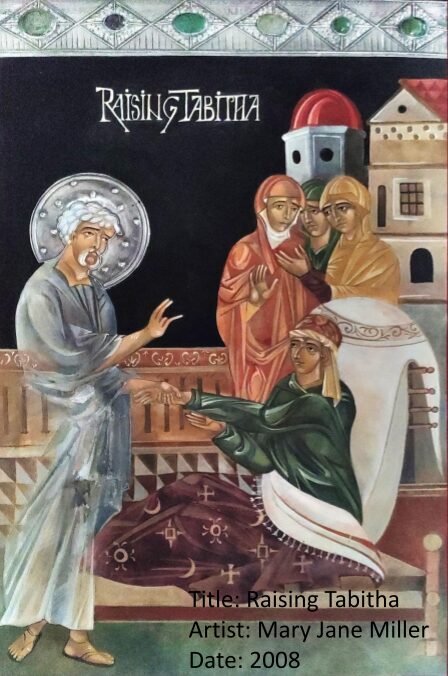
That’s where this scripture, Acts 9:36-43, hits us because we meet this group in Joppa that was grieving.
The whole town was grieving the death of this woman because it tells us she was very active in the community. She did a lot of good work for the community and was very charitable. She was generous with her time and her money. She was an important person to the town and they were devastated that she had died.
They heard that Peter was nearby. Now, remember Peter is our one who during the gospels could never get it right, but now that the resurrections happened, he seems to have been able to put it all together. Peter had just been in Lida and had gone to a man who had never walked and commanded him to walk, and he did. Now that’s not about Peter, it’s about Christ working through Peter. But Peter being open to that and being able to have that work through him.
They called for Peter and told him to come to Joppa. What isn’t said is what they think Peter would do? We don’t know that. Did they know that Peter was going to bring her back to life? They might have wished it, knowing that he had just done a miracle in the town over. They may have hoped for a miracle. In this moment, in this story, they receive that miracle.
He goes in and he commands her to rise, and she wakes up and walks out with him like Lazarus coming out of the tomb. Jesus says, get up and she gets up and comes out. The whole town believed because they saw something that is beyond our understanding and imagination. I don’t wanna get caught up in that.
But what I want to focus on is the fact that Tabitha was given a second chance. The whole community was given a second chance to be maybe even more like Tabitha.
Maybe they need more people in the community who operate like Tabitha, people who care about another person and live that out. I think that’s who Christ wants us to be. I think that’s what Christ was trying to teach us in the way he lived. That was part of the whole message, he wanted us to love each other.
One of the ways that we do that is by being there and supporting one another. The smiles that we give to each other. You’re supposed to tell the person who is down that everything’s gonna be all right. That’s not what I think you should say. I think you should say, we’re gonna get through this together. Because we don’t know what the future brings, but we can choose to do it together, to support one another, and to be that positive influence that reminds. Sometimes we need a reminder that there are second chances.
It may be raining today, but the sun will come out tomorrow. We won’t stay in this place. There will be another tomorrow. However you’re feeling right now, know that it won’t last forever. There are always resurrections.
Resurrections are about reawakening to life, to God’s presence, to the life source that is within creation that can energize us as much as it energizes the rest of the world.
The indigenous people call that the grandmother spirit, and I wanna tell you a little bit about the grandmother’s spirit. It is more than a person. It is a presence. It is the wise one who lives within the trees, the ocean, and the moon. It is the ancestral hum that echoes through generations. It is the womb of the earth, the fire of the hearth, and the medicine in our bones. The grandmother’s spirit lives in all who choose to love with depth, nurture with grace, and hold others in sacred remembrance.
To me, that is no different than the Holy Spirit, the Christ spirit that is within each of us. Where each of us can love with depth, nurture with grace, and hold others in sacred remembrance.
Now your challenge, there is someone in this world who needs you to be that person. They need you to believe in them, to love them, to nurture them, to embrace them, and to encourage them with grace and patience.
Because there are a lot of hurting people right now. People who are scared and who need to know that they are valued, that their lives count, that they are seen, heard, and loved as they are for who they are.
So let us go out into the world and make that difference. Help those people to have a second chance.
This Easter, we are talking about freedom, which is a very important value to us as Christians and as Americans.
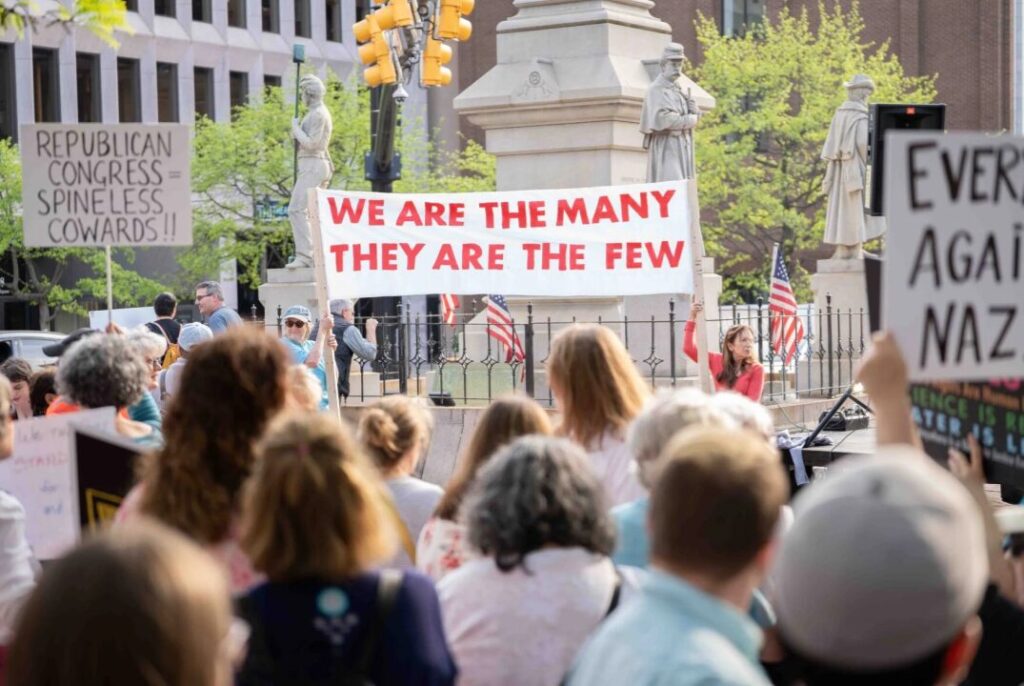
The First Amendment of our Constitution protects free speech, including freedom of expression. It includes freedom of religion, freedom of assembly, peaceful protest, and freedom of the press. There have been actions this year that have challenged those freedoms. This picture is from the Mayday protest this past week downtown, which was Mayday as in urgent help needed, that was supporting immigrant workers who appear to be under attack.
There is also a desire among an influential group to make our nation a white patriarchal Christian nation, and that is not what the Constitution says. Our faith also has freedom. The Roman gods became very jealous and required their subjects to give to them and to listen to them. Our God has never required that. Our God has always invited it. Now, there are consequences when you choose not to, and those consequences still exist.
But in our scriptures for today, we hear two very clear examples of people who were going in a way that was against God. Yet they are invited back to come and be God’s people once again.
There is a Saul in the Hebrew Testament who becomes king. That is not this Saul. In the scripture, Acts 9:1-6, this Saul is a Pharisee who has gone after people within the Jewish community, who are following Jesus, who believe that Jesus was the one who is more than a prophet, but the Son of God.
Saul’s story starts actually in Chapter Seven, where he is present at the stoning of Stephen. So he endorsed that, even encouraged it. And in Chapter Eight of Acts, we hear this about Saul. He was ravaging the church by entering house after house, dragging off both men and women, and committing them to prison. That’s what Saul was doing to the people who followed Jesus. Saul saw his work as eliminating those who followed Jesus, and he did so with violence and cruelty. It seems that he felt entitled to continue this violence until he had this moment, which I call his come-to-Jesus moment, where Jesus shows up and says, why are you persecuting me?
I think this scripture is meant to send us back to Matthew 25, where Jesus says, “When you do it to the least of these, you do it to me.” So Saul went after the followers of Jesus. Jesus felt that he was being persecuted. When we go after the people who are the poor, the orphan, the widow, those are the ones that we are supposed to care for, and yet those are the ones that Saul was attacking.
While we’re on Matthew 25 and we’re remembering that story, I think we need to be reminded that at the end of that, it tells us that at the end of time or in our death, we get to stand for how we lived our lives. The sheep and the goats are separated. Have we used our lives to make a difference in this world? Have we used our lives to care for others or not? There are consequences for our behavior, even though I still believe in forgiveness and grace.
Our gospel reading is another come-to-Jesus moment for Peter, and I really do mean another one for Peter.
I think throughout the gospels, Peter has had more than one. If you think about all the times Peter gets called out by Jesus, Jesus kept trying to turn him around. I often say that Peter is our best reason for why you can believe because Peter appeared to have done everything wrong, including denying Jesus in his hour of need, and yet we bring them back.
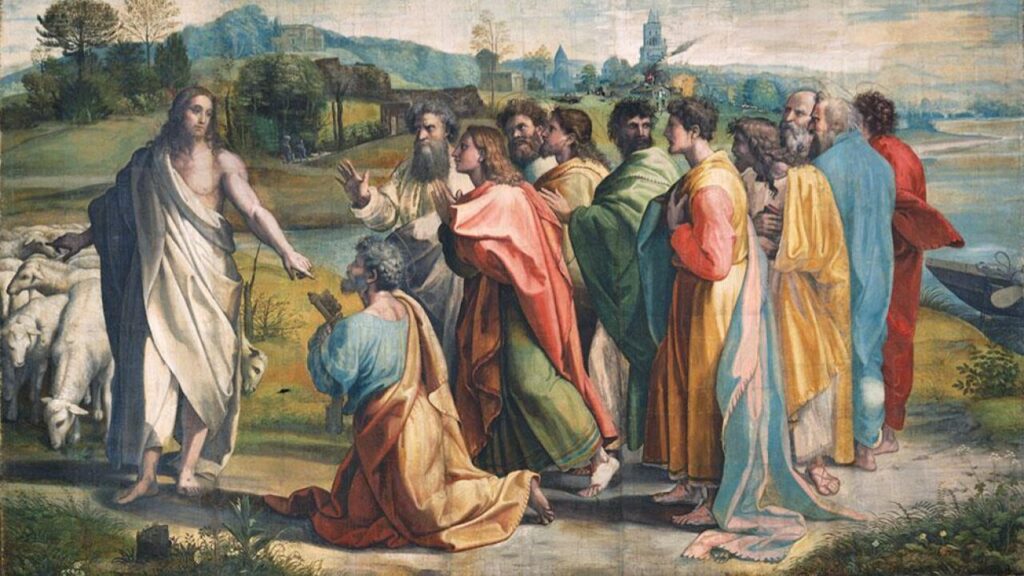
When I think about this moment, this is a piece by Raphael. A little bit more traditional than some of the ones I show, but in this moment, Jesus is calling Peter to say, What are you gonna be about in your life? And if you love me, then you’re going to feed my lambs and tend my sheep and feed my sheep?
Because the Easter story is that love transforms. It forgives and it sets us up and sends us out to serve others. That is who we are to be. What does that entail? Well, I think it’s about loving our neighbor. It’s about recognizing the stranger in our midst and offering hospitality. That’s how Christians were known in the beginning.
They were known because they welcomed people. They invited people in. As Pope Francis reminded us in his living, it’s not our place to judge. We want to judge. The church has been doing that for a long time, and it worked for quite a while, so we tried to make people feel guilty and come to church because they feel guilty.
That’s not working anymore. I don’t think it was ever a good strategy. I think this strategy is to remind people of the love, the grace, the forgiveness, and the accountability that we have to face, that we are called to be our best selves, and how are we living into that?
So where does that leave us?
Well, today is May the 4th Be With You. The empire uses fear to control. The resistance acts freely to protect and defend all beings. Our God is not one of vengeance and fear, but a God of love and forgiveness and justice for all.
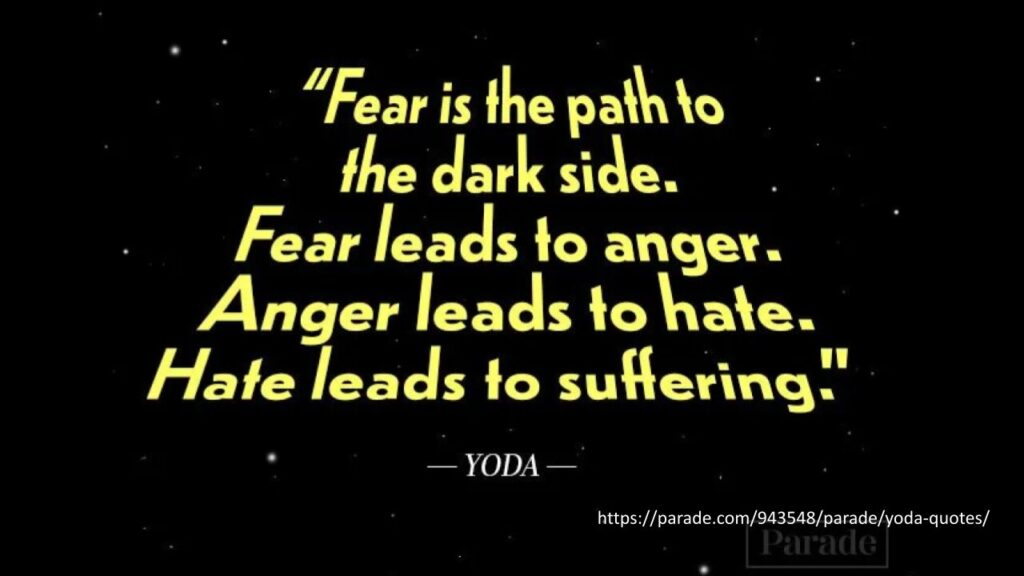
So on this May the fourth, I wanna leave you with the wisdom of Yoda. “Fear is the path to the dark side. Fear leads to anger. Anger leads to hate, and hate leads to suffering.”
It almost sounds like it should have been written in the Bible, but what was written in the Bible in the first letter of John is that there is no fear in love. Perfect love casts out all fear, so the darkness is all around us, but the force of light is also present. We also have that piece that I read from the beginning of John’s gospel, that the light was in the darkness and the darkness did not overcome it. The choice is yours.
Since we are talking about the Freedom to Sing, I had heard some of Dot Lippart’s story, and she is here to today to share a little bit about a story from her life.
Pastor Kathryn had asked me to share a bit about my story, these memories came back to me as I was attending a Flute Day at Millersville University with 70 other flute players. One young man, who graduated from there, was working on a piece called Poem by Griffey’s. That brought back memories of my 9-year-old self.
My mother, who was an amazing musician, was always been my main mentor in my life. She was a church organist and a marvelous pianist, and I heard music all the time. I started taking piano lessons when I was probably seven, and I always enjoyed hearing music.
But when I was 9, she took me to a concert. It was a community concert on Cape Cod in Massachusetts, and this man played the flute. He stood up, and I had no idea who he was, and he said he had one of three platinum flutes in the world. He said he was going to play Poem by Griffey’s, and he started playing that piece. Then, my 9-year-old self said, “That’s what I want to do. I want to play the flute.” I knew that from that moment. It was a spark that this gentleman had no idea that he had set off.
Here I am, many years later, still playing the flute. I’ve taught music and shared music. I’ve moved a lot in my life, but everywhere I have gone, I have made friends in the musical world. Music has been a joy in my life. Sometimes it takes work and is difficult, but I have always loved playing the flute.
When I heard that story, I thought that moment, that concert, gave Dot the Freedom to Sing.
She happens to sing for a flute. But we all have that within us. We all have different ways in which God has gifted us, and maybe it is the challenge of our lives to figure out how we are to sing in this life.
This doesn’t necessarily mean you’re in the choir, but we can sing in so many different ways within our lives. So, I want you to think about how do you bring more beauty and love into this world?
Playing the Flute is how Dot does it. That is how she is more herself, the one God intended her to be through her music, through her flute.
Our tradition is to always read the gospel last, but today I think I should have flipped them because they’re out of chronological order.
The gospel story, John 20:19-31, would’ve taken place first, and then the story from Acts 5:27-32.
After the crucifixion and death, the disciples are scared, right? They don’t know what to do. This story begins on that first Easter day. It is now evening, and the disciples are locked in a room, and they are afraid of the authorities, and Jesus comes to them. But, he doesn’t come to shame them because they deserted him. He comes and offers them peace. He says, peace be with you. And he breathes on them. That is meant to remind us of the Genesis story where God breathed life into humanity. Jesus breathed on the disciples to bring them back to life. To say, don’t keep yourselves locked up in this room, afraid. You are here to live, to enjoy this life, to love, and to share that with everyone. That is such a gift. He was inviting them back into life.
I don’t usually read the part about Thomas, but I read it today because I think that the church has done Thomas a disservice. It says Thomas is also known as the twin. We don’t remember that. He was the twin. We remember that he is doubting Thomas. That’s what we’ve named him. We have renamed him, Doubting Thomas. And don’t be a doubting Thomas. We weaponized it and, we put shame if you doubt. But the reality is that doubt is part of faith. If it were complete certainty, it wouldn’t be faith, it would be what we know.
One of the most freeing sermons I ever heard was that faith is 51% certainty and 49% doubt. You’ve just tipped it towards, I’m more certain today, and that needle moves depending on the day and depending on the moment, right? Depending on what’s going on in life, whether we think God’s listening to us or we feel like our prayers fall on deaf ears, that needle moves, and we can just be honest about that.
But God wants us, and Jesus wants us to build this beloved community that he started to build.
But the writer of this gospel, whether it was John or someone else, put in this verse, too. “Blessed are those who have not seen and yet come to believe” – John 20:29, and I think that verse was there because John’s gospel was written so much later than everything else. He was already writing for people who had not seen Jesus, they could only believe through the stories of others.
It was meant to be an encouragement, but the church has weaponized that, too. If you don’t believe, then obviously we are going to shame you. That’s not the idea. That doesn’t help anyone live more fully into their faith and who God intends for them to be.
I know guilt is powerful, but we need to teach people to love and to be joyful, compassionate, and empathetic. Because the more I question and the more of my doubts there are, the more it helps me and leads me to more belief.
So we went to Acts 5:27-32. This is a story from the very beginning.
I thought I’d lay out Acts for us so we understand where we are. We had the sightings of the resurrected Jesus in Chapter One. The Book of Acts is meant to be a continuation of Luke’s gospel. It was written by the same person, and so it begins with the ascension of Jesus. They watch Jesus Ascend.
Chapter Two is Pentecost. That’s coming up on June 8th. We’ll celebrate Pentecost and the gift of the Holy Spirit. By Chapter Three, Peter starts his ministry in the community, and he begins by healing. That’s what’s getting people’s attention because he can bring healing to people, and by Chapter Four, the religious authorities are onto them again, and they arrest Peter and John. They question them, but they release them. They don’t have anything that they can charge them with.
Chapter Five begins with a story of Ananias and Sapphira, where they try to withhold some things. The community’s been kept holding everything in common living communally, and Ananias and Sapphira decide not to, and it doesn’t work out well for them. Then the apostles start healing again. So the religious leaders get jealous again, and they jail Peter and John a second time. This time, while they’re in jail, an angel comes and releases them.
That’s when Peter had this scripture that we read today. It’s their testament to the other people. When I look at this and I think about what the disciples and those now called apostles. What the apostles lived through, how they continued, they had reasons to be afraid, but they were so strong in their belief that they continued to preach Christ.
They continued to learn and trust in God. And now God empowered them with gifts that no one else had, especially this ability to heal people. They healed a crippled man, and that was one of the things that got Peter and John in trouble at first. But even in this text, Peter answers, we must obey God rather than any human authority.
I lift that because I’m concerned about that verse right now. I’m concerned because there are people who are saying that we need to just follow God’s authority.
It seems like something that we would say absolutely, God is the ultimate authority, except that they want to go back to following all the Levitical laws. Except I don’t think they really mean all Levitical laws. They want to choose which laws we follow.
They wanna say these are important and these are not, because the laws about whether you mix cotton and synthetic. Well, does anybody care if you wear a cotton top in synthetic pants? Or whether you have macaroni and cheese with meat? You can’t put milk and meat together. Those are not the laws they wanted, and they don’t want to lift the laws about leaving the edge of your field unharvested, so those who are poor and the stranger or the alien among you can eat and survive. Those aren’t the verses they wanna lift up.
They have a very definite agenda that I think we need to be paying attention to right now, but later after Acts 5:27-32, there are two more verses that I think are critical. They’re verses 38 and 39. It says “A Pharisee in the council named Galil said to the other leaders, ‘so in the present case, I tell you, keep away from these men and let them alone. Because if this plan or this undertaking is of human origin, it will fail; but if it is of God, you will not be able to overthrow them – in that case you may even be found fighting against God.” – Acts 5:38-39.
That’s what we need to be watching. We need to pay attention. What is God behind, and which of the different voices is God really behind?
The Easter season is about freedom. On Easter, we celebrate that Jesus was free of the tomb, and that we are free from the shame of our faults and our failings.
We are forgiven, loved, and free. Jesus wants us to feel loved and forgiven in our deepest being. That is where our strength will come from. And because hurt people, hurt others. Jesus doesn’t want us to be the hurt people. He wants us to be the loving, empathetic people who look out for the wellbeing of others.
And when we see the well-being of others being hurt, ignored, or blatantly dismissed, then we use our voices. We lift our voices in protest.
Last Saturday, the day before Easter, LIFT UCC and First Reformed UCC downtown held this pop-up choir in Bins Park to sing for justice and declared that immigrants and the LGBTQ+ community are welcome in our midst. I took this picture as I parked at the parking garage.
At that event, there was a Middle Eastern woman who was standing beside me and the whole time we were there, she had tears streaming down her face. They frequently told us to look, turn to your neighbor, and say, “You are loved and you belong here.” We even did a whole chant with “You are fearfully and wonderfully made.”
That’s the message that we are to share. This is Jesus’ love in action during these challenging times.
I want to go back to that first scripture (1 John 4:7-13) about love because a lot of times when we talk about love, I think we’re a little confused about what kind of love are we talking about?
It’s not just the feeling that we have. It’s not a romantic type of love. It is a caring type of love. But more importantly, it’s a verb. It’s an action. It’s love. Love is put into action. Loving someone else means you do something about it. Which is why I talked about the caring cart and what we have done in collecting these personal care items. You love somebody by doing something.
I think it is just that easy and that difficult because we don’t always know what loving someone looks like. What action is a loving action? But I’ve said in the past, and I’m going to repeat that. I want us to hold this question.
What is the most loving thing I can do?
If that is the question that we hold in our being every day. Then when we run into a situation or we encounter someone, we can bring that question to mind. What is the most loving thing I can do right now? We will get an answer. We will know what to do. If we listen to our hearts, God will tell us what the most loving thing to do is.
On Thursday, April 18th, the most loving thing I could do was go to this rally called Justice for Education at J. P. McCaskey.
Because the point of the rally was to help show our legislators that we care about this issue. Now I’m going to give you a little bit more information about the issue if you haven’t been following it in the news.
Our system for funding education in Pennsylvania has us ranked 45th out of 50. Even more importantly, last spring a commonwealth court ruled that it is unconstitutional according to the Pennsylvania Constitution. We have to change the way we fund education in Pennsylvania because not every child in Pennsylvania receives the education that they need. That’s has been proven.
So, now it is dependent on our legislators on how to change that. Last summer, there was a Basic Education Funding Commission that had a series of meetings across the state to understand ideas. It was half Republican, half Democrat. This is bipartisan. They went back to Pennsylvania and they have come out with a new plan.
What we are saying is you need to vote for this plan. The plan is in the 2024-25 budget and you need to vote for it. You need to codify it. You need to make it law so they don’t just do it this year, but they continue to do it because it’s a seven year plan. So doing the first year of a seven year plan and not doing any more isn’t really going to get us far. We got to keep doing the plan until we get to where we should be with that. That’s the education justice issue.
Now you might be thinking, social justice. Do you know what my schedule looks like?
I’ve got enough going on in my life right now. I want to affirm that we do have enough going on in our lives right now. I know that. I know that a lot of us are overwhelmed. That we are filled, we feel like we’re pulled in so many different directions by so many different priorities and we don’t know what to do with that.
In the midst of all of that, I want to say, it’s also matters that we pay attention to what’s happening in our world, to how other people are being treated. We need to do whatever we can. Maybe you can’t go to a rally, but you can be kind to the next person you meet, or act in a loving way.
I also want to name that we talked about the fact that social justice and compassionate justice is part of who God is calling us to be.
When we talk about “what does home look like?”, Home is a place that accepts you, that recognizes you and affirms your humanity. Because at the end of the day, that’s what it’s about.
It’s about looking at another person, regardless if they are like you or not. Regardless if they have the same political position as you or not. That’s really big right now. Recognize their humanity. We all still want to be respected. We all still want to belong and feel that we matter. We all want that.
So here comes our story today from Acts. Philip and the eunuch.
This is a social justice story. Did you know that? It’s a huge social justice story. Philip and the eunuch are both in places they don’t belong. Philip and the disciples have been chased out of Jerusalem because the Pharisees are out for them. They want to squash this Christian thing that’s going on and the Romans want to squash it because they thought if they killed the leader the movement would die and it didn’t. So now they got to go after the next level.
The Apostles have left Jerusalem and Philip is going around all different kinds of places. The spirit, which is what happened at the end of this story, the spirit just picks him up and puts him somewhere else. But for this story, he’s on the road from Jerusalem to Gaza.
Now I want everybody to just take a deep breath, because we know something about the road from Jerusalem to Gaza right now, do we not? I hope you do. I hope you’re paying enough attention to know what’s going on in Gaza and Israel. That’s the road they’re on.
Philip hears this eunuch reading. That means he is emasculated. The question can be asked, “Why is that the feature that is brought out in this scripture?” He’s an Ethiopian. It also tells us that he’s the treasurer. He mines the treasury of the queen. He’s in a chariot. That’s why I chose this picture, this image of it, because he’s in a different class than some others. He has privilege. He has a driver because he is in a chariot, and he may even have a bodyguard. Because he’s that important.
The part that they tell us in this story is that he’s a eunuch. He’s been emasculated. To the Hebrews, that means he is not a man. Because he cannot procreate, because his body has been altered, he is not welcome in the temple. So even though he’s been to Jerusalem, he would not have been welcome. He needed to stay out with all the other people, with their leprosy, their bleeding, and the other things that made them unworthy of walking in.
But he wants to learn. The piece that we need to pay attention to is what Philip does. Philip doesn’t care. Philip doesn’t ask about any of that. He doesn’t talk about the fact that he’s a eunuch. He doesn’t say, “Hey, since you couldn’t get into the temple, I’ll help you out.” He just says, Do you know what you’re reading? The guy says, Essentially, no, I need help, and invites him into the carriage, and Philip goes.
Then they find water, and even more than teaching him, oh my gosh, he baptized him. That means he is part of the body of Christ. He is welcome. Room has been made for him. Even though the religious authorities would have shun him, even though he was everything that they said no to, he was welcomed and baptized into the family and God blessed it.
It’s very interesting. Something else I learned when I was doing my research is there is a verse in Matthew 19:12. You want to read it because it never comes in the lectionary. We never read that verse. We read the verses before it and after it, but we never read that verse, and it’s all about eunuchs. Eunuchs that are born as eunuchs. Eunuchs that are emasculated by someone else’s choice and eunuchs who allow it so that they can be part of the kingdom. You need to think about that in all of our things that we do.
Because we are called, as a congregation, to make sure that everyone feels welcome. That’s what we say. Inclusive refuge, Anyone who is powerless or afraid, Anyone who needs refuge is welcome here.
This isn’t easy. We’re going to make mistakes. I picked this picture on purpose because you see what’s going on in this picture? All the white people are making a demand of the black woman and we’re very good at that. We’re very good at expecting them to fill our expectations without finding out what they need or who they are.
But we are called to compassionate justice. So, what I want to suggest is that I think right now with our congregation, we are at a point where it’s time to set up a justice team. This is what I would like the team to do. I would like the team to interview the congregation. Because I want to know. I want us to know. What keeps you up at night? What wakes you up at three o’clock in the morning? Which issue? Because there are a lot of social justice issues on the table right now. The education justice is just one issue, but there are so many. So I want to find out what is the number one issue in our congregation?
Then we’ll decide how best to work in that area. What difference can we make in our Lancaster community? Because I think we can make a difference in our Lancaster community. But we need to do our research first. I’ve learned from the organizers that you start with research meetings. So we need to do an internal research meeting first and find out what our priorities are. Then I have resources that I can connect us to in the community so that we can work. We’re going to work with people who are already doing the work. So that we can make an impact in this community. Because we want to. This is not just about coming in here to serve us. We want to make a difference with people. I heard that during our discernment process for the vision and mission. It matters why we’re here.
Reverend Roland Forbes, some of you may know Rev. Forbes from Ebenezer Baptist, he always says, “What would happen if your church disappeared? If your church disappeared, would the community notice?” And we want the community to say, don’t disappear. We need you. You are vital in this community. That’s our call to action. So, if you are interested in being on a social justice team, then come talk to me and we’ll put that team together because we make the way by walking.
We’ll make mistakes. We’ll fumble, we’ll stumble, but we can make a better community and we can share love with others.
The story of Philip and the eunuch, in several ways, an outsider, expresses the inclusive love of God for all. All are invited to come home to God because love is simply part of our nature. Love is from God. The invitation is as simple as it is every time we make it. When you endeavor to love your neighbor and live in peace with each other, there’s always room for you, no matter who you are or how you think you don’t fit in.
No matter whether you’ve been coming to church a long time or not a long time. Welcome home.
What does it mean that we call ourselves family in the church?
I’m wondering what ideas you had. The children said they’re people that you love and care for, and who love and care for you. They’re people that you are related to, and we are related through this common story of the Bible. Family is love.
This ability to be together and to support one another. Because the reality is life is hard. We all have really hard moments, and the way that we get through that, the way we can get through our guilt and our grief is by caring for one another. By talking together and reminding each other of this love that we have.
The presence of Christ, which sometimes we feel it and sometimes not as much. We can feel sometimes like God’s not listening. So we need to remind each other that God is listening, even if our prayers don’t get answered the way we wanted them to be answered, or in the time frame we wanted, right?
The other reality about family is sometimes there’s members that you just want to say, “don’t let the door hit you on the way out.” It’s really good when we don’t all think the same, because that’s how we grow in faith. If we all think exactly the same thing, that’s a boring life. We won’t get anywhere. We won’t deepen our faith. We won’t trust more. We need people that challenge our thinking. So it’s good, it’s really good that we don’t all think the same.
But one of the challenges right now of the church is, we have to decide how much of our faith, of the church that we have been, do we want to continue? And how much do we need to break open to be something new?
That’s part of the thing that I think is happening the entire way through the Bible, is that God is inviting us not to have a more closed mind. But to break our hearts open so that we have the ability to love more fully, to love more people, more diverse people, more people that we wouldn’t always love. That’s part of the story.
I do think that, in our culture now, we use that language of “family of origin” and “family of choice.” Because some of us, unfortunately, our families of origin have not always been healthy places. Many of us it was a very healthy place and praise God, but some of us not. So, we can also choose family.
That is what we think we’re doing when we come to the church. Is that this is a family of choice. I want to push us just a little bit to say, “Hey, I wonder how much God influences that choice?” How much are we here because God has called us to be here in this group with these people at this time? We may think that we did wake up and decide to come to church on our own. But I think God is also in there nudging us towards being part of a community of Christ.
These scriptures, when you put John 3:11-19 and Acts 3:1-7 together, it’s a real dichotomy.
Because John’s scripture, the letter of John, is encouraging and it’s about love and light and community. Then you get to hear Peter’s words and Peter feels like he’s shaming us and he wants us to have that guilt.
I want to say, this is Peter. Peter often got it wrong when Jesus was alive. Not to say that this is right or wrong. It’s in the scriptures. It’s there. But I don’t think it’s meant to just guilt us. I think that Peter, at this point in the right, has actually had a come to Jesus moment. He’s had a real one. So in those days leading up to Jesus death, he was the denier. He was the one that said, not me, I don’t know that guy, I’m out. That’s the same guy that we hear today saying, “…but you didn’t stand up for him.” You’re in this too, Peter.
I was frustrated by this text because Peter doesn’t own his own part in it. We all know he had a part. But Peter has also been forgiven. After Jesus’s resurrection, Peter has a meeting with Jesus. Where he has to admit, “Yes, Jesus, I did deny you just like you said I was going to. That was me. And I’m really sorry.” Jesus forgave. Jesus offers all of us forgiveness. That’s why I can say we are all loved and worthy.
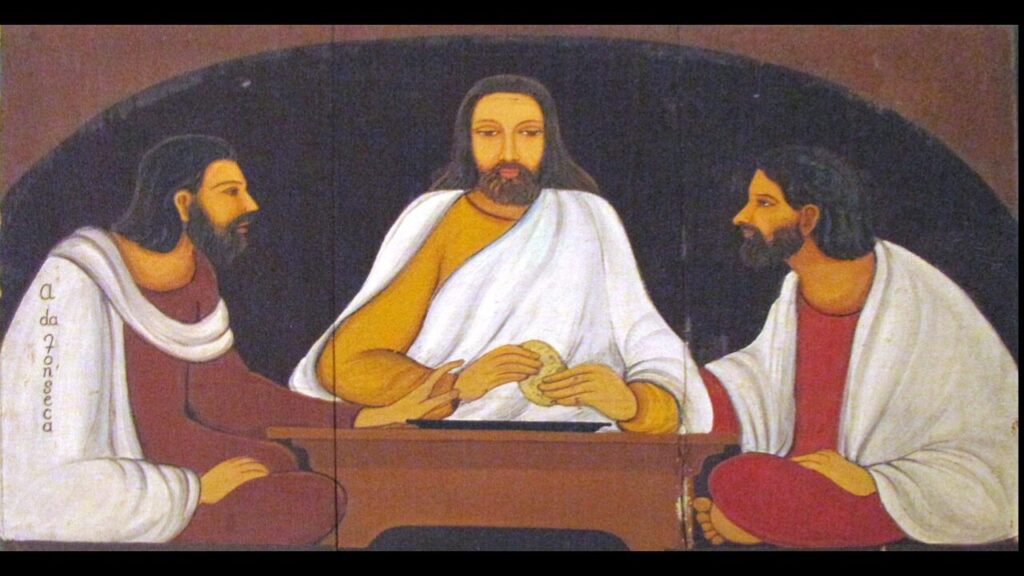
This is the picture of the gospel reading today, which is the two men on the road to Emmaus who encounter this stranger and what they do is they bring him home to have dinner with them and in the breaking of the bread they realize that it’s Jesus.
There is something about the breaking that we all need to experience that opens us up to a better encounter of God. To a better understanding of who Jesus really is and who we are called to be. We need to have our hearts broken. That’s a hard message because none of us like pain. Nobody wants to go through the heartbreak.
And yet, it is through the heartbreak that we find life and joy and love and the abundant life that we didn’t know before.
I want to share a clip with you of the miracle club. It is a movie that’s right now, streaming on Netflix for free. It’s a movie about three women who go looking for a miracle at Lourdes. If you don’t know what Lourdes is, Lourdes is a cathedral in France where the Virgin Mary had made an appearance. At Lourdes there are baths that you can go into and people have had miracles. It’s a good family movie. British humor, but a good family movie.
So that is the challenge are we going to get a miracle?
I don’t know, but we can heal together and we are better together than we are apart. So, I encourage you to think about how we are family. To think about what that means to you. And to really make a commitment to that. To make a commitment with your time, your talents, and your gifts.
Because we say that we offer Inclusive Refuge, that everyone is welcome. Especially if you are afraid or powerless. People are walking in our door and we want to show them the love of Christ that we have received.