Malice Towards None
It is my intent every Sunday morning to give you the best information I have. And last Sunday morning, I talked about the historical markers, and today I have more information.
Or we’ll say better information. I found out that the Stephen Smith marker is that it was erected as part of the Civil War Trails, where markers were installed specifically for the150th anniversary of the Civil War. That’s when the Stephen Smith marker was put on the building beside Mount Zion, since then, that marker had been vandalized and was worn. What I learned from one of our members who contacted the Pennsylvania Historical Marker Program, is that they are in the process of refurbishing markers for our 250th anniversary of the country. They have also taken some down that have to do with race and black history because there was some racist language on some of them. So, some of the language needed to be updated, and they are working on all of that.
It is not my intent to create any ill will with the Pennsylvania Historical Marker program, and I wanna make sure that you have accurate information. So I wanted to start with that.
But in preparing this sermon, I ran across that phrase with malice towards none, and learned that that was the beginning of Abraham Lincoln’s second inaugural address, which I wanna read to you.
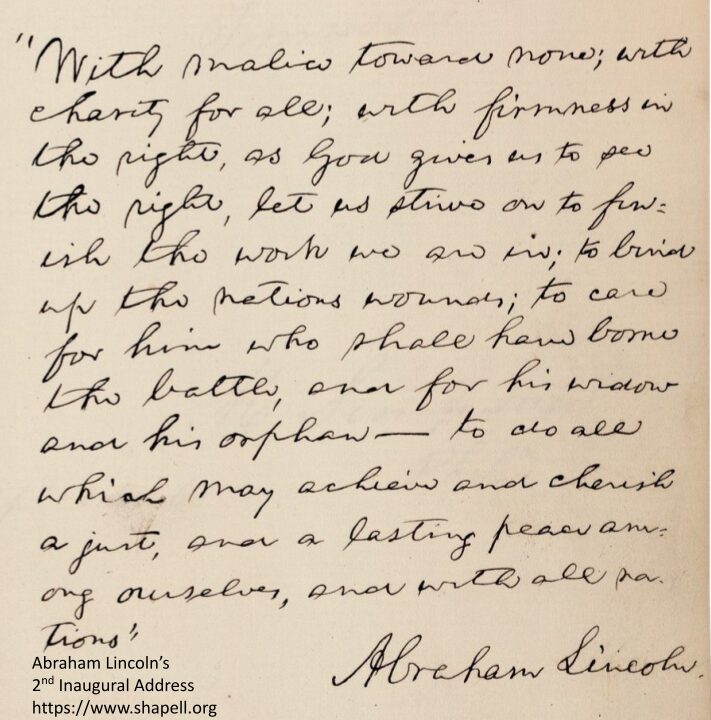
He wrote this in March of 1865, and the Battle of Appomattox was in April of 1865. So, this was written before that battle and before Lee surrendered. He wrote “With malice toward none; with charity for all; with firmness in the rights, as God gives us to see the right, let us strive on to finish the work we are in; to bind up the nation’s wounds; to care for him who shall have borne the battle, and for his widow and his orphan – to do all which may achieve and cherish a just, and lasting peace among ourselves, and with all nations.”
Just and lasting peace among ourselves and with all nations. That sounds profound right now. So at a time when the battle was still raging, when the war was still raging. Lincoln asked specifically the people of the North who were listening to him to have charity, and that charity is based on the Latin form of the verb, which is caritas, which is a concern for others.
Not charity as in just give them something. It’s not about a handout. It is about having love for neighbor. It is caring about the other. That’s what Lincoln was calling us to be about, and I think it’s who we need to call ourselves to be. It’s not easy right now.
Our scripture today is Matthew’s Gospel, and it was written to a Jewish audience.
As far as chronological order in Matthew’s gospel, Jesus has come into Jerusalem for his final stand. He knows that he has come to Jerusalem and he will not leave alive, and he’s running into the Pharisees, the Sadducees, the Herodians. Because they’re all looking for something they can use as a reason to arrest him.
The lawyer says to him, what is the greatest commandment? It’s a trap. Jesus knows it’s a trap. It sets up the same piece that, in Luke’s gospel, leads us into the Parable of the Good Samaritan. But this is Matthew’s piece, and if you read the next chapter, you’ll find out that Jesus is not in a particularly charitable mood with the Pharisees and Sadducees. He’s about to put them in their place.
But for this moment in time, Jesus gives them the right answer. It’s simple, “Love God with all of your being and love your neighbor as yourself” – Mark 12:30-31.
I think we tend to think about the Pharisees and assume they’re always saying inappropriate things and are always challenging Jesus. We never would’ve done that, but I really wonder if we aren’t closer to the Pharisees than we realize. Because if Jesus were here, we might also say, “But Jesus, what is the one thing that I need to do? What’s the one thing that I need to do to be faithful? What’s the one thing that I need to do to secure eternal life?”
And Jesus’s answer is simple: love God and love your neighbor. If you can’t love God with all of your being, then love your neighbor.
The Pharisee was probably saying the same thing because Pharisees are Jewish. It was like, what is the one thing that I need to do to be a good Jew? How can I be a good Jew? Love God. If you can’t do that, then love your neighbor because in Matthew 25, we’re gonna get the parable of the sheep and the goats.
That one always takes us because we so wanna be sheep. If everybody’s gonna get divided into sheep and goats, we wanna be sheep, because it doesn’t go well for the goats, and we don’t wanna be on that side. So what do we have to do to be sheep? In that parable, the king says, “When you do it to the least of these, you have done it to me” -Matthew 25:40.
By loving your neighbor, you are loving God.
It’s that simple, and it’s that hard because we don’t always love our neighbor. We don’t know how to love God. With all of our being, we struggle. We can’t love God with all our being, and God knows that. We can’t love our neighbor as ourselves, because God’s watched us do that. I don’t think we trust in God’s mercy.
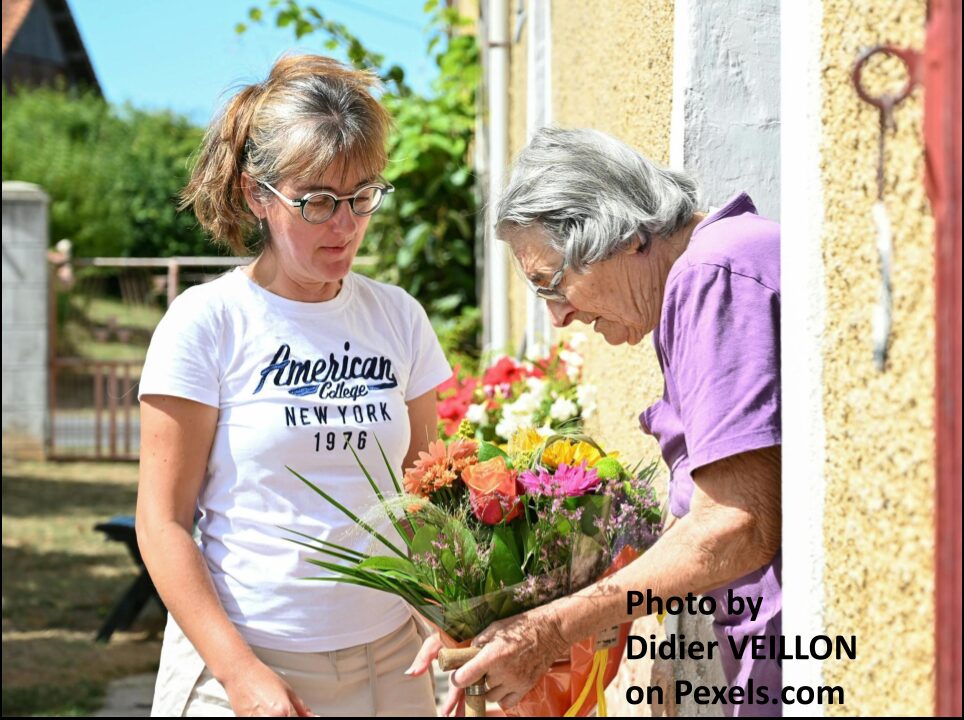
I think that’s a problem. If we can’t make all of our lives about loving God, then God wants us to try and love our neighbor, and if we still fail at that, then the Apostle Paul reminds us that Christ said, “My grace is sufficient for you, for my power is made perfect in weakness” – 2 Corinthians 12:9. We have a hard time with that power being perfect in weakness. That is not the way our society is set up. That is not what we’ve been taught. That’s not how we function. That turns us around
Power in weakness. How much do we trust God to be God?
I said this was a hard week, and I’ve been talking about the fact that I’ve been asking what the world is that we are trying to create.
It matters; our energy that we put out into the world makes a difference. I believe that. I think that’s part of prayer. I was really struck by two people. I don’t know what all you heard around the shooting, but I heard the mayor say, I don’t want your thoughts and prayers. I want something to change. Then, I heard Fletcher’s father. If you didn’t hear his piece, that will take you down. It took me down because he said, I don’t want you to remember my son as a victim of a mass shooting. I want you to remember him for who he was.
What kind of world do we want? What kind of country do we want to raise our children in? Because we have a chance to make a difference. Right now we are living in a time where everything, all the systems are being broken, and we have a chance to build it better. We have a chance to make it just, where every kid has the right and the ability to achieve and become who God created them to be.
I also wrote down in my notes, Jeremiah 31:15, maybe this is a good time, while I might not make it to the end of this sermon. The prophet Jeremiah reminded the people in exile, “This is what the Lord says: A voice is heard in Ramah, mourning and great weeping, Rachel weeping for her children and refusing to be comforted, because they are no more” – Jeremiah 31:15.
As of Friday, it was day 241 in 2025. There had been 286 mass shootings, 1,180 injured.

“How many roads must a man walk down before you call him a man? How many times must the cannonballs fly before they’re forever banned? They’re allowed to be free. Yes. And how many times can a man turn his head and pretend that he just doesn’t see? Yes. And how many ears must one man have before he can hear people cry? How many deaths will it take till he knows that too many people have died?” – Blowin’ in the Wind, Bob Dylan.
That song is one year younger than me, written in 1963, and the sentiment hasn’t changed. How Long, oh Lord, How Long?
May it be so. Amen.
Like this Sermon? Click Here to View More in this Series
Prefer to Listen to this Sermon? Click Here to Listen to our Being Apostles Podcast