Before we get into the three conversations that make up today’s reading, I want to say a bit more about John’s gospel and the location of today’s scripture, John 11:4-37.
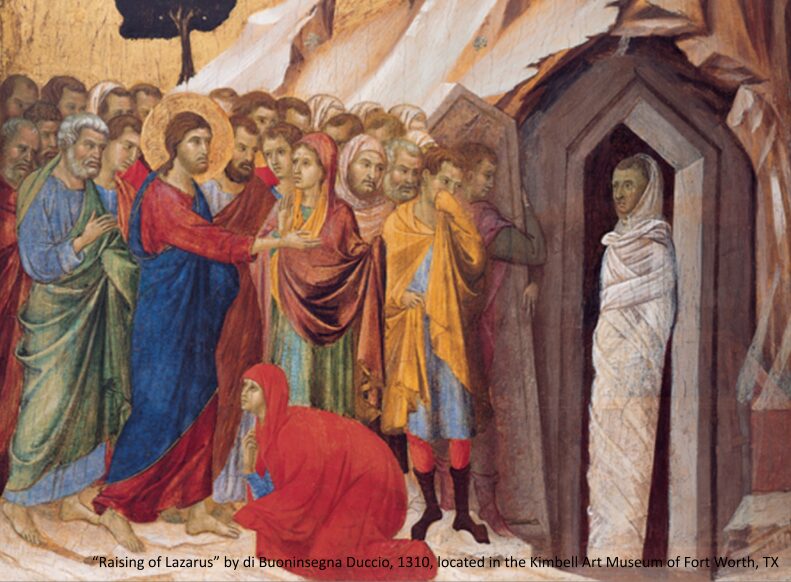
Last week, I talked about the “signs” or miracles John uses to prove his point that Jesus is the Messiah, the Son of God, Savior of the world. And this chapter contains another “sign” – The resuscitation of Lazarus.
I recently read the argument for calling it a resuscitation rather than a resurrection because Lazarus is going to die again. He did not have a resurrection as Jesus did, nor does he ascend to heaven.
In this scripture, we also have the fifth of the seven “I am” statements of Jesus, “I am the resurrection and the life.” – John 11:25. Interestingly, the 11th chapter is the middle of John’s gospel, and is a literary hinge designed to shift our perspective from seeing “signs”. To see “God’s glory so the Son of God may be glorified.”
This story is so empowering for believers because Martha and Mary tell Jesus with their words and actions what they are thinking. They both believe in Jesus – Martha confesses, “Yes, Lord, I believe that you are the Messiah, the Son of God,the one coming into the world.” But Jesus also experiences their pain and grief.
So when life doesn’t go the way we want or the way we have prayed for it to go, we can stand in the assurance that we can also tell God what we think. We can name our pain – our disappointment – our anger and know that Christ will be moved by it. That does not say that we will have our prayer answered – Because we cannot know or understand all the ways of God – But God is listening and will join us in whatever we are feeling.
We, like the sisters, want to avoid uncomfortable outcomes. And in our grief, we are invited to “let go” To let go of our expectations, to let go of our need for control, to let go and accept what is. Like Jesus, we can “feel all the feels” and express them – No matter who we are – this is what makes us human.
As we celebrate the work of women in our congregation, I want to highlight today Nora Beck Smith, whose story connects with the conversations and hard questions raised by today’s scripture.
Underlying Nora’s story and her call was a yearning from within and important questions about who she was and what she was meant to do. Being a member of St. John’s and then Church of the Apostles, she brought her questions to Rev. Glenn Rader, who was honest enough to admit that he didn’t have the answers to her questions. But he took her to Lancaster Theological Seminar, where she could explore her questions in a safe and nurturing environment.
A Jesuit priest taught Christian history during her time and invited them to see themselves in the stories of scripture and to creatively write about their experiences. This helped her to develop her questions and deepen her faith.
Nora was the first minister to join Rev. Schellenberger & Rev. Rader with this congregation, and we give thanks for her curiosity and call, which she shared with us.
As we are one week from Holy Week, there are a three take-aways that I want you to have today.
The first is that John’s gospel is favorable towards women. In this gospel, women are more than just important characters; their words have been preserved. This Jesus engages women in conversations without demeaning them. In this gospel, it is a woman – Martha in our scripture today – who declares who Jesus is, rather than Peter, who does it in the other gospels.
It will also be a woman, Mary Magdalene, who is the first witness to see the risen Christ. For women’s history month, this is worth noting.
Also, as we will be reading John’s gospel through Holy Week, I want to make sure that when you hear the words “the Jews,” you realize it is often referring to the religious leaders. All the characters of John’s gospel are Jewish – The Samaritans are not considered Jewish because they don’t look to Jerusalem as their holy site. But all the others are.
I say this because this can be read as the most anti-Semitic gospel, and that is not helpful or accurate. So as you read the scriptures, I want you to be sensitive to this. Our Jewish brothers and sisters are very scared right now. I will also name those of the Jewish people that I know support the state of Israel, but not the policies and wars of Netanyahu.
Rather, Jesus models and teaches us to care for those around us- whether they are family or strangers. Caring means empathizing with their stories and wanting the best for them. We are to be creating a world based on mutual care and compassion, not about who has the biggest weapons, biggest egos, and forces others to submit to promote their way of living.
In John’s gospel, Jesus says that he came that we may have life and have it abundantly – John 10:10. Let us work towards an abundant life for all!
Today’s scripture, John 9:1-34, was quite involved, and we did not read it to the end.
In the seven verses we didn’t read, Jesus seeks the blind man and asks him if he believes, and the formerly blind man worships him. Then, Jesus has another confrontation with the Pharisees in which he reminds them that because they do not “see” him for who he is, their “blindness” continues.
But I’m wondering what questions you may have after hearing this scripture?
The goal of John’s gospel is to prove the identity of Jesus as the Messiah, Son of God, Savior of the world.
To make that point, the writer employs two strategies which are evident in this scripture – a “sign” of his power and an “I am” statement. In this scripture, Jesus gives sight to a man blind from birth, a sign that Jesus is one who restores our sight and he declares, “I am the light of the world,” naming that he reveals truth.
Jo-Ann Brant, a Johannine scholar at Goshen College, theorizes that this story is a miniature version of the larger story of Jesus.
the crowd questions his identity (9:8-9),
he asserts “I am” (9:9),
he speaks frankly and logically throughout but is treated as an invalid witness (9:18),
he is accused of being a sinner,
he combats the Pharisees with sarcasm and truth (9:34),
This story ends in irony as the one who was blind “sees” who Jesus really is and those who claim to have vision are “blind” to who Jesus is. Jo-Ann A. Brant, John, Paideia Commentaries on the New Testament(Grand Rapids, MI: Baker Academic, 2011), 151-52, 154-59.
As this is Women’s History Month, I want to name the connection I see with this scripture, and it is how the formerly blind men’s and women’s experiences are generally not believed.
Unfortunately, this is also true for people of color and the LGBTQIA community. As the townsfolk questioned if the formerly blind man was even the same person when he told his story, I think of women who were violated, and others failed to believe them.
The popularity of the #MeToo movement the other year was based on that fact. It was finally a way in which women could name the demeaning and violent experiences they had without getting into the details.
Our problem is now complicated by AI, where our images can be used to create stories that did not happen, and because in the 20th century, we learned to trust video and pictures, we are left struggling.
I think we have reached a time when we need to tell our stories in-person and in safe spaces – thus the need for us to provide a safe space for this to happen. AND we need to listen to another’s truth and accept it and whomever they are as true – and here’s the challenge – even when it does not fit into our understandings of the world.
We have to be open enough to accept and respect another’s experience, even if it hasn’t been ours, and it makes us rethink how we understand others.
So where does this leave us?
Well, it may not feel good to hear, but we are like the disciples and Pharisees who want to judge others and point out their failings without looking at our own. And Jesus’ words provide corrections to our thoughts and actions.
We want rewards from God, so we think there needs to be punishments too. But maybe there aren’t. No one was being punished by the man being born blind.
To the Pharisees, just because Jesus healed on the Sabbath does not mean he is not of God. We, like the disciples and Pharisees, focus on the wrong things. Instead of seeing the gift of God, we disqualify it.
This week was a hard week with several attacks within our own country and abroad. We can let our legislators know that this is not the world we want. But we also need to name what we do want. We need to name that we want each person to be valued and respected, no matter who they are. Then we need to practice that too!
We need to be the love we want to see in the world. We need to put ourselves in positions to hear the stories of others –even if it is through documentaries on TV or reading non-fiction biographies of those whose lives are different. We can maintain our hope by reading about the hope and courage of those who have lived through hard times.
This is not the first time our country has experienced hard times. Let us focus on being and building the Beloved Community of God.
The last time I preached here, the topic was Jesus’ baptism. If you were here and you remember that far back, you’ll remember how I proposed that the point of this story was to show us that Jesus was more like us than perhaps we thought he was.
At Jesus’ baptism, the descending dove from heaven was there to affirm to Jesus who he was, God’s Beloved Son. In that story, we can also hear God saying those same things to us, that we are God’s beloved children and we are loved.
Today, we find ourselves back in that continued story. Right after his baptism, Jesus immediately went into the desert and spent 40 days fasting and praying. Have you ever fasted for 40 days? I tried it one time. I attended a charismatic, spirit-filled church more than 10 years ago, and they were big on fasting at least once a year. The pastor there would call the entire congregation to a fast, usually a really specific type of fast, referred to as the Daniel Fast, though it was considered to be a partial fast. Meaning that the person fasting focused on cutting certain food groups out, and they were allowed to eat others because it was called the Daniel Fast. It was considered to be the right kind of fast. It was for the super spiritual people to use this fast as more of a bragging right, or a way to make themselves look and feel more holy than others around them. They would make a big thing of preaching to others about it. They would overemphasize the stomach growls and the digestive issues that result from separating your diet into different groups.
This past week, on Ash Wednesday, we spent time in Isaiah 51, where God was angry at people who would fast for show and at the same time engage in dishonest business practices, abuse their servants, disregard the least among them, and fight with their neighbors. That was very much the culture of the church that I attended. Needless to say, fasting left a bad taste in my mouth. If only for that reason, I’m not gonna call you guys to fast, at least not in that way in our gospel reading.
In our Scripture reading today, Matthew 4:1-11, it said that Jesus fasted for 40 days, and at the end of that, the devil appeared to him, the audacity.
Can you imagine how hungry Jesus was? Remember, Jesus was fully human, so it’s not a stretch to say that he was probably hangry. I know that nobody here can relate to that, but just try to stay with me.
According to the passage, the fast was over, Jesus should have been able to leave the desert, walk into town, and grab himself a burger. But no, this guy shows up and starts his shenanigans. Hey, Jesus, are you hungry? I bet you are. Why not turn those stones into bread? But Jesus doesn’t bite. It isn’t pumpernickel that keeps me going. “Man does not live by bread alone. Rather, he lives on every word that comes from the mouth of the Eternal One” – Matthew 4:4.
Jesus isn’t saying that bread or pizza or ice cream or french fries are bad, or that we should all starve ourselves. What he is saying is that he’s not going to use his privilege as the son of God to satisfy his desire for food. He could have turned the stones into bread or anything he wanted, but why? What would that prove? Maybe the question is, what does not doing it prove?
Perhaps it proves that his relationship with God is what gives him life and the ability to keep going, even when his stomach growls louder than he can speak. The devil didn’t care that he was hungry. He wanted to make him question his identity, to doubt that God really loved him, to lean on his own abilities to satisfy himself, but Jesus didn’t take the bait. If the second and third temptations are more of the same, the devil takes him to the top of the building and tells him to jump. God will send angels to catch you. But Jesus replies by quoting Deuteronomy, don’t you dare test the Lord your God. Why would I cry wolf when there’s no wolf?
Jesus knew that God was protecting him. He didn’t need to run a full experiment to verify that promise. In a last-ditch effort to get Jesus to fold, the devil takes him to the top of a very high mountain and shows him all of the kingdoms of the world, and he says to him, “If You bow down and worship me, I will give You all these kingdoms” – Matthew 4:9. Jesus had had enough at this point. The devil had badly miscalculated, and now Jesus had beaten him. I know who my God is, and you definitely aren’t it. I will only ever worship the one true God, the devil left tail between his legs, defeated. He should have known better if Jesus didn’t fall for the first one.
When I was younger, I used to go to open mic nights and karaoke. If you hadn’t picked up on this yet. I love to sing, I love to play guitar, and I love doing those things for other people’s enjoyment.
Every time I would go out, somebody would inevitably ask me, “Why are you here? Why aren’t you on American Idol?” And I would often reply to them that I didn’t want to be famous. Fame can change people, and I didn’t want to be changed. I remember watching American Idol and noticing how, from the audition to the final performance, the contestants were completely changed. Their look, their sound, and their presence were all shaped and molded by the judges and coaches. A lot of the time, at least from my perspective, it was not for the better.
I felt that if I went on a show like that, I would be selling out. What I had not yet grasped at that point in my life was that I was actually doing that very thing every day. I was presenting to the world in a way that it had molded me and in the way that I thought was most acceptable. Meanwhile, I was hiding and denying who I really felt that I was inside. It was God’s love that broke through and changed me when I finally recognized and allowed myself to come out to myself and the world; no amount of stone sandwiches or rooftop flight experiments or crowns or kingdoms could make me give up my identity, the real me, my soul.
A few years ago, while I was at the beach with my adopted parents, I asked my dad, who is a retired United Methodist minister, if he would baptize me. I had been baptized as a teen, but I wanted to hear the name that I had chosen spoken as I was laid beneath the water. There was no dove, but I heard the same message that Jesus heard from God as I emerged from the salty Atlantic waters. Deklan J. Lewis knows that he is a beloved son of God, and he knows that the love of God is the only thing that truly sustains him.
This month is Black History Month, and we’ve been highlighting a piece of that history each week.
This week, I was looking over the notes that Pastor Kathryn had put together, and I came across this article on the White House Historical Association’s website. I was really surprised to actually find this article. It was amongst the slavery in the President’s neighborhood Initiative materials. This piece was about a woman named Ona Judge.
She was a slave owned by George Washington’s wife, Martha. The article details what is assumed about Ona’s life as Martha’s preferred lady’s maid, stating that she had some kind of status because she had nicer clothes and she got more than one pair of shoes per year. The article seems to assume that she might have been happy as Martha’s personal servant, but it also goes on to tell of Ona’s escape to freedom.
After learning that she was about to be given to another member of the family as a wedding gift, Ona ran away. Later in her life, she shared in an interview, “I was determined never to be her slave.”
I can imagine that, as an enslaved person, personal identity is a complicated struggle. In Ona’s story, we can see her declaring what her identity would not be. Ona lived the rest of her life in freedom. Married, had children, and actually shared her experience in slavery with several newspapers.
Ona could not have done what she did without a strong conviction in her heart. In the same way, Jesus could not have resisted the temptations of the devil or any of the other incredibly difficult things that he did in his life without knowing who he was and who God said he was.
So who are you? Who are you not?
What would you do for a Klondike? Would you turn an iceberg into ice cream? Seriously, what are your non-negotiables? What are the things that you’re not willing to compromise on, and how will you stand up for those things in this season?
I wanted to share a song with you guys, because that’s what I do, that speaks to this idea of knowing who you are and standing firm in your identity. It’s become somewhat of an anthem in the LGBTQ+ community, but I think it really applies to just about everybody.
I am not a stranger to the dark “Hide away, ” they say “‘Cause we don’t want your broken parts” I’ve learned to be ashamed of all my scars “Run away, ” they say “No one’ll love you as you are”
But I won’t let them break me down to dust I know that there’s a place for us For we are glorious
When the sharpest words wanna cut me down I’m gonna send a flood, gonna drown ’em out I am brave, I am bruised I am who I’m meant to be, this is me Look out ’cause here I come And I’m marching on to the beat I drum I’m not scared to be seen I make no apologies, this is me
Another round of bullets hits my skin Well, fire away ’cause today, I won’t let the shame sink in We are bursting through the barricades and Reaching for the sun (we are warriors) Yeah, that’s what we’ve become (yeah, that’s what we’ve become)
I won’t let them break me down to dust I know that there’s a place for us For we are glorious
When the sharpest words wanna cut me down I’m gonna send a flood, gonna drown ’em out I am brave, I am bruised I am who I’m meant to be, this is me Look out ’cause here I come And I’m marching on to the beat I drum I’m not scared to be seen I make no apologies; this is me
In a time where many people want to make who I am and who a lot of my friends are illegal, we have choices to make.
Do I change my name back to the name that was originally on my birth certificate? Do I change the gender marker on my ID? Do I change the way I dress? Do I grow my hair out so that I’m less of a target to gain access to safer spaces in the current climate? Or do I save my soul and stay true to who I am? Would life be easier and less scary? Probably in a lot of ways, the answer is yes.
Maybe it would be easier for you to go to a different church that doesn’t ask you to stick your neck out for the oppressed. Maybe it would be easier if you kept your thoughts and feelings about ICE raids from your neighbors, your coworkers, and your family, but what would you stand to lose? What would you gain if you didn’t compromise?
I encourage you to hold these questions and the questions that are inevitably going to be prompted by these questions in your hearts this week, meditate on them, and press in. See where you’re really standing at the moment. As we move forward, press pause, listen, and know who you are.
With it being Transfiguration Sunday, I wanted to give you sort of an overview of where we are and where we’re headed.
The liturgical calendar is really a beautiful piece, and I love this graphic of it because it makes it a circle, which is what our calendar really is. Every February 14th comes around, and it’s always Valentine’s Day. Christmas comes around, and it’s always December 25th. Other holidays do move, but we don’t think of time as circular. We make a timeline. We don’t make time a circle or spiral.
Between the end of November and December, Advent begins. Starting with the first Sunday in Advent, we begin looking for the light. There’s this promise that the light is coming, that hope is coming, and so we start looking for the light.
On Christmas Eve, the light arrives and we share it. That’s why we have a candlelight service on Christmas Eve, that’s where that comes from. That beautiful ritual that we have every Christmas Eve that we love so much, it comes out of this idea of the light having now arrived in the world, and so we share it, and this light continues to grow.
At Epiphany, outsiders, the Magi, show up and attest to the light and bring gifts. In Luke’s gospel, it says the child grew and became strong, filled with wisdom, and the favor of God was upon him. Next is his baptism. Jesus hears us often, we make it out as if everybody, as if the crowds hear it, but the crowds don’t react. I just read a thing about how it really says that it spoke to him, that Jesus hears “this is my beloved, my son in whom I am well pleased“– Matthew 3:17. Jesus hears that he has his own affirmation and begins his ministry, and through it, he is inviting people to the light. Last week, Jesus said, “You are the light of the world” – Matthew 5:14.
Until this point, this is the biggest light point, and it’s not a coincidence. That the light arrives as our seasonal calendar has its darkest night. That’s not a coincidence. Now that there is more light in our season, the light begins to expose our shadows & our darkness, and this next season that we begin on Wednesday, Lent, is when we start to see the darkness in the people in scripture, but we also are invited to see the darkness and our ability for evil.
That brings us to the end of the Easter season, it’s almost June, and we’re almost going into our longest day. It’s all lined out, and today is about having a bigger vision. That’s what Jesus was giving the disciples, and I wanted you to have a bigger vision of how the liturgical calendar is lined out.
Here we are, Peter, James, and John go up to the mountain. They have this moment. They wanna build shelters.
The Festival of Sukkot is a Jewish festival where they build. Jesus says It’s not about that. That’s not what we’re doing here, but they hear this time, God speaks to them and not just Jesus, and says, “This is my Son, whom I have chosen; listen to him” – Luke 9:35. That’s the piece that is specifically for us, listen to him.
If we haven’t gotten it by this time, when we see him gleaming, we have a cloud, and we have a voice and everything, if we haven’t figured out that this is somebody special, not only are we supposed to recognize that he is the son of God, but we are to listen to him, And what is Jesus’ command to the disciples? “But Jesus came and touched them. “Get up,” he said. “Don’t be afraid” – Matthew 17:7. That’s the commandment, to get up. Jesus says to the disciples, get up, we have work to do. We aren’t staying here on the mountain. It’s not about staying in that mountain moment, but we have to come down from the mountain because there’s work to do. Do not be afraid. It might be scary, but it’ll be okay. Do not be afraid because God’s in this. God’s got this. Do not be afraid. Trust God. Over and over again, we get reminded to trust in God.
This February, we are also looking at African American history I’m trying to pull out specific people who live out Jesus’ commandment.
I wonder if Dr. Alvin Poissant, in his work, had to remind himself many times to get up and do not be afraid. Dr. Alvin Poissant was born in East Harlem as the seventh of eight children. As a child, he had rheumatic fever that put him in the hospital for a long time. When he was in high school, his mother died of cervical cancer.
He had the advantage of going to a primarily white high school, and from there, he was able to get into Brown. He had a bachelor’s degree from Brown. He went to Cornell Medical College and got his MD in 1960, when he was the only black student in his class. Then he went to UCLA, where he did a residency in psychiatry and got a master’s degree in psychopharmacology.
Then he went to Jackson, Mississippi, and there he helped to provide medical care for civil rights workers and helped desegregate hospitals and healthcare facilities. In ’67, he moved to Boston and was directing a psychiatry program in a low-income housing development for Tufts University Medical School.
Eventually he was recruited by Harvard Medical College, and he started as an associate dean of a student affairs and he became a professor of Psych. Psych psychiatry. If I get the all the right syllables, I’ll do it right. In his time at Harvard, he sponsored, which, which was, he was a prof.
He was at Harvard Medical School for 50 years, and he was the voice of diversity. His voice and his work were about improving the public understanding of black children and families, mental health and suicide, school violence, and substance abuse. He wrote and spoke about the importance of nonviolent parenting and advocated for positive imagery of minorities in the media. He also worked to increase diversity in medicine and reduce health disparities by bringing more members of underserved populations into the medical field.
Unfortunately, Dr. Poissant died last February, but I pulled this information from the Harvard Medical School website. Has a huge write-up on his life and work. He was certainly revered and loved. I found this quote by Shirley Chisholm, and I think it fits what he did.
“You don’t make progress by standing on the sidelines, whimpering and complaining. You make progress by implementing ideas”
Unfortunately, we are living in a time when Dr. Poissant’s life’s work is being erased. I mean, he represented diversity, equity, and inclusion. That’s what he worked for within the medical field and specifically at Harvard. We’re living in a time where all of the ways that we understand who we are as a country are called into question, and we have to decide who we are. The future that we want to leave for the children and our grandchildren. Like Peter, James, and John, we are invited into the vision of what could be and permitted to be active in accomplishing God’s vision of justice.
Like the disciples, we are being asked to have the courage, not to be afraid in the face of intimidation, cruelty, and hatred. Like them, we are being asked to be willing to follow, get up, and not be afraid.
We are the children of light. That doesn’t mean that we’re always good. We have the same amount of potential to be good as to be evil. It is within us all. We have to be focused on being good, we have to be focused on doing the loving thing, on loving our God, loving our neighbor, whomever they may be, and loving ourselves as we are, as the people God created us to be. With all of our gifts, foibles, goodness, and weaknesses. We’ve got all those things,
We have to figure out how we can use our voices now to stand for love. What we cannot be is silent. We will not be silent because that means being complicit. If we don’t challenge voices that are hurting others, they think we agree. We can’t let them think that because they want to control us, too.
We cannot be silent when they want to send ICE agents to our voting places this November. We cannot be silent about it. That is intimidation, and it is illegal, and we need to say that loud and clear. We have to say it is not okay to disappear people. We won’t have that. That’s not the way our country operates. You don’t get grabbed off the street and sent to a camp. I heard them called concentration camps because the definition of a concentration camp is a place where there is a concentration of people being held before they’re sent somewhere else. We have them in this country. We’ve done it before. It wasn’t right before, and it’s not right now.
We cannot be silent about the need for checks and balances within our government. They don’t get to choose what’s moral. That’s our job. Jesus tells us what is right. What does the Lord require of you to act justly, love mercy, and walk humbly with our God? That is moral.
So get up and do not be afraid. Let us stand for love.
A Talk with Rev. Kuhn (Black Text) and Rev. Edward Bailey (Blue Text)
Last week, I talked about how in this season of Epiphany, the scriptures are all trying to tell us about who Jesus is.
Although obviously, Isaiah 58:8-12 is trying to tell us about God’s expectations and what God’s vision for us is, we believe that Jesus is God incarnate. Jesus’s words, although they’re very much directed to us again, still point out what is important to Jesus. They’re talking about what Jesus’s priorities are, and what I hear in both of these scriptures is the need for justice.
Isaiah, who is a major Jewish prophet whom we listen to, reminds us about feeding the hungry and caring for those who are sick. It’s all the justice pieces that we hear Jesus repeat later in the gospels. This particular piece reminded us that if we stop arguing among ourselves, we will stop the infighting and pay attention to the needs of those around us. Then we’ll see the needs. We’ll see the hungry person, and we’ll see the person who is mourning, and we’ll see the person who needs clothing or a ride or maybe just a person to listen to them. We can do that because when we do justice, God helps the light of Christ within us to shine.
I saw it written as a sacred quid pro quo. If we do justice, God will bless us. But we have to do our part first, and that means we can’t just be sitting around here thinking we’re great. That’s what the scribes and Pharisees were doing. They had the list of the law. The laws still apply, but they had the list of the law and they thought, as long as we do this, we’re good. But then they had their own ways of applying it and deciding who was in and who was out. That’s not justice.
I think even worse was that the Sadducees and the Pharisees had actually co-opted themselves. They no longer worked for the people of God.
They were working for their own position. When Jesus came on the scene, he was for the people, and I think too often people don’t realize the Jewish people, as well as the other folk in that area, were oppressed by the Romans. They didn’t have their own rights. They didn’t have their own justice system, and they actually were conquered. When Jesus was talking to the people, he was talking on behalf of an oppressed people, not on people who are well off, well-connected, who are rich and famous, but he was speaking for those who had no voice for themselves.
As a matter of fact, I said to somebody upset with me, they said, “Reverend Bailey, you always speak in politics.” I asked him the question, what happened to John the Baptist? Why was he beheaded? Because he took on a justice issue, and too often the church doesn’t take on justice issues. We talk sweetly and nicely. That’s why nobody burns our churches down. So if you really believe the world is against you, the world will be against you.
But we have been so co-opted. That they don’t have any fear of the church or the word of God, because we are just like them. We forget that Jesus started a movement, not a church, a movement. That’s why people were hanged, people were crucified, people were killed, because he had a movement. We can barely move today. That’s not because of our age. We just don’t move.
So when you read these scriptures, they’re counterculture. They’re not for what we normally think that we ought to be. But God didn’t start an organization because he needed another organization for people to sit around and feel good about themselves. He created us to be a light in this world, so we’re supposed to make a difference.
I just recognized this morning that he said that light is supposed to be in the house. “People do not light a lamp and put it under the bushel basket; rather, they put it on the lampstand, and it gives light to all in the house.” – Matthew 5:15. You know, we don’t even show the light in the house. So if you can’t show it in the church, how do you show it outside? How do people see it? The light is supposed to be in the house.
And not only have they co-opted, but the rest of the church is silent. Yes. So, uh, you know, they called a silent majority. That’s the good folk. The people who got the gospel wrong, speaking loudly, and you don’t hear the folk who actually believe that Jesus came to save sinners. Some think that the way they look makes them righteous. Even if you have been convicted of 34 felonies, it doesn’t matter, you know, it doesn’t matter. Politics is more important than morality. When people co-opt themselves and become the church of the state. You don’t teach the gospel. You teach hate, division, and those kinds of things. Jesus came to bring people together and to help us provide for this life so we can go into the next life. I don’t think most of those folk care or are concerned about the next life.
I have one judge that I have to live for. So it doesn’t matter what other people say about me; what does the Lord say? And that’s what this gospel is all about. What is he gonna say to me on that last day? I don’t know about you, but I’m 76, so I’m concerned about that. What is God going to say to me about the life that I’ve lived? Doesn’t matter what other people have done, what’s He gonna say to me? I want to know what God is going to have to say about me, and he’s not gonna ask me about you.
I hear people claiming that they know the will of God and, and that God is blessing them because they have power and influence and money.
But as you said, Rev, that’s not who Jesus came to talk to. That’s not who Jesus brought together. That’s not who Jesus was focused on. Jesus was focused on the people who didn’t have and who were being left out by their state or by the empire that ruled their lives.
So when we are in this time and see that people are being marginalized, their voices. I mean, oh my goodness, people are being kidnapped and disappearing. I just heard of a 10-year-old boy who went to school and did not come home. I can’t make sense of that. That’s not what this gospel says. That’s not what the gospel of Jesus is about.
But the sad thing is, one thing about being retired is that I have a chance to catch up on things that I just had no understanding of. Watching Fox News or MSNBC, they don’t tell everything. I got a chance to listen to some of these podcasts. There’s this thing about policemen and what they’ve been doing. This is not new, where people with a badge have been snatching folk off the street, and doing all kinds of illegal things to folk. It’s not new, and it’s been going on for a while, and you know, people don’t even talk about it. How many women have disappeared in Lancaster County that we don’t talk about? It’s not in the news. Women who are being beaten and abused at home are not in the news. Yet they want to show us some person somewhere else that we can vilify. We wanna show them, but we don’t talk about what’s happening in our own neighborhoods. You need to check the statistics and find out how many young women are being disappeared. We are seeing how the Today Show’s host, Savannah Guthrie’s mother, has been taken; it’s not new, and, amazingly, nobody has talked about it.
We think that crime only happens in certain places. But it’s right where we are. Every time I hear somebody say, “Well, that doesn’t happen here.” Well, it just happened. So it must happen here. We as a people are being stubborn by thinking there’s a difference because of where you live. There is no safe place where there are sinners. Where there are people who will hurt you. Especially us older folk, some of us raised some criminals in our own houses who did not become criminals until we got old, and they wanted what we had. Getting old is scary because you don’t have the strength you had, and now you find out there are people out there who would take what you have. How many of you get calls from people who act like they’re your family, and they’re in trouble, and they want money?
What are we gonna leave behind? That’s what I worry about for my grandchild. Is this the America that I want my grandchild to be raised in? The answer is NO!
I don’t want him to have to worry about walking down the street and being charged with a crime just because of the color of his skin or the clothes that he’s wearing or the way he’s walking. I don’t want that. I don’t want people running with masks, coming into my neighborhood, and terrorizing us.
As a black man, I had the Ku Klux Klan doing that, coming into this community with hoods on, so you couldn’t recognize them. Why? If you are a part of the government, I ought to be able to see who you are. I wanna know who you are. My taxes pay for you. Can you imagine having an employee who comes to work with a mask on? Why are we allowing that? And if we seniors don’t say something, if we are quiet, nothing’s gonna happen unless you and I say something, and that’s letting your light so shine.
We are well into the season of Epiphany, and the season of Epiphany is about revealing who Jesus is.
Since his conception, we’ve been getting signals. This is Matthew’s year, so the angel came, and we heard the story of the angel coming to Joseph and telling Joseph that this baby would be Emmanuel, God with us. Then at his birth, the angels declared, this is our savior, the Messiah, the Lord, and then the magi showed up. They came bearing gifts for this newborn king, this new ruler, this person who would become a shepherd of his people. At his baptism the Holy Spirit came down and declared, this is my beloved, my son.
Since then, we heard John declare who he was and point to him. “He is the one who comes after me, the straps of whose sandals I am not worthy to untie.” – John 1:27. Then we saw how he chose the people to follow him. All he said was, follow me.
Now, we come to the Beatitudes, and I think that we like to approach these as what they tell us about who we are to be, because we have an insatiable desire to be self-absorbed. We love ourselves, so it has to be about us, right? But what does it tell us about who Jesus was? And this may be a different road to get to the same place. But that’s the road I wanna take you on today. Because it’s supposed to reveal something about Jesus.
So who is Jesus? What does this tell us about Jesus?
Well, if we look really carefully. I tried to do a deep dive. I’ve had five weeks to prepare this sermon, not one, five. I don’t usually have that much time, but I did, so I did a deep dive on this, and this sermon contains all of these words that do not appear anywhere else. The words that are translated meek, hungering, merciful, pure peacemakers, having been persecuted, they shall be insulted. Those words aren’t anywhere else. It’s the only time they show up. Well, a couple of them show up in Luke’s Beatitudes, too. Other than that, they’re not in the Bible. So what does that say?
What that says to me is that these words and Jesus are unique, and it means that those first people, remember I told you that you are like those first people hearing it. Those people, I can imagine, said, What did he just say? Did he say what I think he just said? Because these weren’t words that were used all the time. They would have been shocked to hear these words because other people who stood up and professed to know things wanted to talk about power and control. That’s the empire, they’re about telling you what you can do, what you can’t do, and how you’re gonna do it. But that’s not what this says.
The second thing I noticed was this offered hope, both in the short term and the long term. Our scripture says “Blessed are the meek, for they will inherit the earth.“– Matthew 5:5, and they shall inherit the earth today and in the future. It’s both.
If we had read the verses right before this, they talk about how all the people were bringing their sick and infirm friends and relatives and themselves to Jesus because he was healing them. He was providing hope in the moment. Life was changing with him, and he was giving them this. Here’s your big word for the day: eschatological future hope that in the end they will be with God. They’ll be the ones in the kingdom of heaven.
The third thing it tells us is who Jesus cared about. He didn’t talk about the empire. That was the big thing about Jesus. That’s why Judas is scared. I’m frustrated with him when we get to Holy Week because he didn’t challenge Rome the way they wanted him to. Instead, he came to the people. He was there for the people who needed the help and the healing. This tells us that it wasn’t about the influencers of his time, but those who had been forgotten, ignored, and left behind. That’s who Jesus cared about. So, like I said, maybe a different road to the same destination.
That’s who we are to care about. Not necessarily who we are to be, but it’s who we are to care about. Who are the people in our community who are struggling right now, who are afraid? Terrified, even? He cared about those who wanted a different life, even if they didn’t know how to get there. There was hope in what he said, that this life that they had wasn’t the life that God had intended for them. That was good news. That is the good news, my friends, that this life that we live is not the way God intended for us to live. Even today, 2000 years later, we haven’t gotten it right yet. We still have much to learn.
This month is also the month that the inclusive church team wants us to focus on black history. So, I’m gonna try to do that.
Today, I wanna talk to you about someone who I think lived the way Jesus wants us to live, and who cared about others, who cared about her people as a black American. Who cared about the suffering of others. Fannie Lou Hamer was a sharecropper in the early sixties, and she decided that she had every right to vote as everybody else, and so she went to register. She was beaten and imprisoned in terrificly horrible ways. She paid with her body for that. She was not killed, but she paid with her body
Then she continued the struggle. She co-founded in 1964, the Mississippi Freedom Democratic Party, and she went to the Democratic National Convention in 1964. I don’t know how many of you remember that. I was too young to remember that, but I read all about it. I’m gonna read more of this because I wanna make sure I get my facts straight.
She went there demanding integrated nominating committees and delegate committees. Her plea was so compelling, and frightened President Lyndon Johnson so much that he did a press conference. So that she wasn’t on the live tv, but her speech for those who heard it could not be quenched, and it was televised later. In 1968, her vision of racial equality in the delegation became real. Took some time, but became real. She also created the Freedom Farm Cooperative that helped other black farmers have a piece of property. As part of the cooperative, they got a piece of property, and they got a place to live. They got pigs to learn how to breed, raise, butcher, and sell, and become independent.
She was a force to be reckoned with, and you know what she’s most known for? She’s most known for her quote, I’m sick and tired of being sick and tired. That’s how we remember her. I’m glad to learn the rest. I’m glad I went looking for the rest of her story.
I put the picture of communion there because I knew it was communion Sunday. For me, it was the idea of the breaking of the bread, and the cup poured out for us that this is where we get to live our lives to do the hard work, because hard work is here. It’s not coming, it’s here.
We admit that we are all marred, scarred, and imperfect because we’re human. I’m sorry. I was wrong. I don’t know. I need help. Those are four statements that we need to use and own because we are living in a time when we cannot be silent, while those who are poor in spirit, mourning, and meek or those who are hungering and thirsting for justice, the merciful, the pure in heart and the peacemakers are becoming victims of hatred and violence, and we can’t just go along anymore.
So I also created cards for you that are on the high top with each of our congressmen’s names and telephone numbers. They need to hear from you. You need to tell them what you’re thinking and what you’re feeling about what you see in this country.
We need to figure out as a collective what we have to offer. One of the lessons that we got from the clergy in Minnesota was that we need to prepare before they arrive. We need to talk about what assets we have. What assets can our congregation give?
Is it that we can hold a large gathering and bring a lot of people together? We have space for a lot of people to gather. That may be our piece. There’s a prayer vigil that’s gonna start at Lancaster Friends, and maybe we wanna host one of those. Maybe we wanna send additional funds to the churches downtown. I’m thinking about St. John’s Episcopal because I know they do so much with the immigrant community in Lancaster. What is our peace to do? That’s something for us to, to really sit with and discern, but this is a time when we cannot be silent anymore. The white church cannot be silent now.
Next week I have invited Reverend Edward Bailey, who is retired, and he’s coming to have a conversation with us next week, because we’re gonna talk about. What do white people need to know about the black community in Lancaster? Because we don’t have the answers. We need to be listening, but this table makes all the difference. When we receive the bread and the cup, it gives us the strength, the comfort, the determination, the chutzpah, even to do what we didn’t think we could do.
We know that we couldn’t hang on that cross. We couldn’t pour out our blood, and we probably have a hard time or should drink the cup of forgiveness because we have not forgiven ourselves, let alone anyone else, but that is our challenge.
We come here and we gather because we need Jesus Christ. We need each other. And right now we need to be the beloved community.
Last year I had wrote and preached from the Gospel of Luke on the Baptism of Christ.
Luckily, Luke & Matthew are not too different from each other. I am going to read the passage from Luke, though, just because it provides a slightly different context. This is from Luke 3:15-17 & 3:21-22.
“As the people were filled with expectation and all were questioning in their hearts concerning John, whether he might be the Messiah, John answered all of them by saying, I baptize you with water, but one who is more powerful than I is coming. I am not worthy to untie the strap of his sandals. He will baptize you in the Holy Spirit and fire…Now, when all the people were baptized and Jesus had also been baptized and was praying, the heaven was opened and the Holy Spirit descended on him in bodily form like a dove and a voice came from heaven. You are my son, the beloved, with whom I am well pleased.”
Last year, when I studied this passage from Luke, I was in a slightly different place on my journey at that point, and I was feeling very skeptical of the scripture. One of my professors suggested to me that I, instead of looking at passages of the Bible for the things that I didn’t agree with, or the things that frustrated me to look for the things that did make sense, and dig into those. Rather than being distracted by what I didn’t believe, I could find the things that I did believe.
I came upon something really interesting in the commentary that I was reading. In discussing Jesus’ baptism, the commentator observed that Jesus approaches his baptism with humility, and one can imagine with faith and trust. He comes to the place where John is preaching a message of repentance and forgiveness of sins, of turning back to the selfless ways of caring for the weak and the marginalized. In response, Jesus submits himself to the cleansing ritual. Jesus’ thoughts and motivations in offering himself for baptism remain a mystery to us for now, but we have his example to follow. Those observations struck a chord, and I found myself stuck on this question.
Why was Jesus baptized? Why did he have to be baptized?
If he was perfect, there wouldn’t have been a reason for him to be baptized. Perhaps he wasn’t perfect in the way that we’ve always been taught. I know that’s maybe an unpopular opinion, but stick with me. Maybe Jesus made mistakes. Maybe he did things he shouldn’t have done. I think that leaving his parents to stay in the synagogue might have been an example of this. But because he’s Jesus, we brush it under the rug and say that he was supposed to be there because he was God and not a normal 12-year-old sneaking off and disobeying his parents, because obviously, the son of God is never late.
Another thing, do we really think that all that time he spent as a carpenter, Jesus never smashed his thumb and let out an expletive? I’ve only been whittling for like a month, and I have done it at least 10 times. The Bible says that he had siblings. Are we supposed to imagine that he never got upset with him, that he never got into a fist fight over who got to sit up front on the camel?
I am probably gonna ruffle a couple of feathers here. To be honest, my own were a bit ruffled when I was going through this, but what if Jesus was just like us? I mean, it does say that he put on flesh so that he could sympathize with us, but how could he sympathize if he was perfect and never sinned?
I am not sure if this will resonate with you or not, but for me, for a long time, if I screwed up, that was the end of the world.
I was terrible, and no one could possibly love me. Then, because I thought that they would be disappointed and not love me, I resented them and would go unintentionally doing the things that I knew they would not approve of to further separate myself from them. Many of us learn these patterns of behavior at a young age, and they are reinforced over and over again by our families of origin, school teachers, and the churches that we grew up in. For me, the pattern began young and before I was conscious of it, I had developed some nasty habits and coping mechanisms that had become quite addictive by the time I reached adulthood.
By the time I realized I had problems, the cycle seemed impossible to break. No amount of trying or praying or repenting and swearing I would never do it again seemed to work. I can relate to those people lining the banks of the Jordan waiting to be baptized by this charismatic, borderline crazy, religious figure named John. I’ve been in that line thinking that if this guy touched me, I’d be free of all of my habits and hang-ups. Maybe if I were baptized at this church and I was fully immersed as opposed to being sprinkled, it would finally actually wash off all the dirt, and when it didn’t work, and I walked away feeling more broken than before, believing God must really be done with me this time, and there was nothing I could do about it. I’d go right back to whatever the destructive habit was at the time.
What was it that made Jesus go down to the river that day?
Was it Holy Spirit intuition? Like the day at the synagogue? Was it on his checklist from God that day? What if it was a deep nagging, the thing that he kept returning to, the feeling of failure, of disappointment to his parents, earthly and heavenly. What if that day, he knew something had to change, so he strapped on his sandals, trekked down to the river to see his cousin, just to get his mom to stop nagging him.
But with secret hope in his heart, he waited in line just like everybody else. He didn’t push to the front or demand special treatment. At least that’s what the account in Luke tells us. In fact, it says that Jesus was last. It said when everyone was baptized and Jesus was baptized,
I wonder if he thought about leaving. Maybe he got out of line and headed toward home only to feel that pull. Turn back around and get in line at the end. Maybe he hoped that some of the crowd would go away so that he could get a few moments alone with his cousin.
I once went to a healing and deliverance service to see what all the hype was about this particular so-called prophet. There were hundreds of people there. I waited in line forever. People were being slain in the spirit, speaking in tongues, breaking their canes, stomping on glasses. I thought, this must be my day. This guy has gotta be the real deal. I stood in line, I looked around, and I saw this woman whom I knew. We had gone to several such services together in the past, but had lost touch when I did what I always did, and she chastised me for wasting God’s time. She had said that it was useless for me to keep getting in prayer lines and taking time away from other people who really needed prayer, that my problem was that I didn’t want to be free because if I did, all I had to do was walk in it, whatever that meant. Seeing her was it for me. I was out. I didn’t need that type of negativity.
I wonder if there was anybody that day in the crowd with Jesus whose opinions really got his goat. Or maybe he was afraid that John, who seemed to know things about Jesus that others didn’t, would turn him away. In the story of Matthew, John says, You are the one who should be baptizing me. But Jesus was like, Nope, it’s gotta be the other way around. He was pretty adamant. Which further reinforces my wondering about why. It could have been because he knew that it was to be a sign or a fulfillment of ancient prophecy, or perhaps because he needed to be baptized. Maybe he had things he needed to turn from so that he could turn towards other things.
One thing I noted is that Jesus was praying after he was baptized. Did he not get what he was expecting when John baptized him?
I can imagine him exclaiming, directing his frustration toward God. I’m wet, I’m cold, and there’s seaweed in my epic hair, but I feel the same. I’m supposed to be your son, but I just feel like some guy, and I can’t stop. Are you even up there? Are you even listening? Continuing from the gospel account, it says, “And as he was praying, heaven was openedand the Holy Spirit descended on him in bodily form like a dove. And a voice came from heaven: “You are my Son, whom I love; with you I am well pleased.”
Well, gee, that was worth the weight and some seaweed. I don’t know about you, but those are words that I have wanted to hear my entire life. The desire for those words has caused me to go to crazy lengths and to put myself in some less-than-desirable situations. To hear that I am loved, chosen, the pride of someone’s life, I wanted to hear that from my parents. As long as I can remember, those words should be a given from our parents at least. No child should have to wonder about the love of their mother or father, but many of us do. It is no wonder then that many of us struggle to believe in the unconditional love of God.
I wonder if this was part of Jesus’ struggle. At least in the Luke telling of the story. There’s no fanfare from the crowd after this heavenly announcement. There’s no article in the Jordan Times “Dove descends and names Jesus the carpenter as God’s son.” In fact, it could be the case that nobody other than Jesus even knew that this happened.
What if Jesus were or is just like us? What if he wondered about the nature of God’s love for him? What if he wondered if he’d missed the mark or been replaced by some other kid, a few villages away, who really never did fight with his siblings? What if he came to the river that day needing an epiphany?
To hear the voice of a parent speaking the words, You are my son. You are the one I want. You are special. You are loved. You make me proud. Now, that would be worth any price. Waiting all day in the hot sun with a bunch of sweaty sinners. Any amount of seaweed, fish swimming around my ankles, and slimy river sand and stones between my toes.
At the beginning of the next chapter of Luke, it says that immediately, Jesus, full of the Holy Spirit and probably some newly found confidence in his identity, left the Jordan and was led by the Spirit into the wild.
We know how the story goes. The devil comes and tests Jesus, and he gets all the answers right. How do you think he could do that? Here’s what I think. When you hear God, or even someone whom you respect and whose love you desire, when you hear them claim you as their own, when they show you how much you are loved. When you know, then you know that no matter what, their love for you could never & would never change. You can do anything. You can give up whatever’s holding you back. You can face any challenge. You can look the devil in the eye and say, I don’t need what you’ve got.
Even if you mess up and pick some questionable friends or call a lady a dog or flip over some tables out of righteous anger, you can still know that they love you, and you can know that God will work it all out.
The other thing that I think is that once you hear that voice, you are free to live into who God has called you to be, who God calls all of us to be in the community. There was this thought that had never occurred to me. Jesus comes to this place where John is preaching a message of repentance and forgiveness of sins, of turning back to the selfless ways of caring for the weak and the marginalized. It’s not just about what we turn from, but also what we turn to. The selfless, caring for the weak and the marginalized. He turned from whatever he needed to leave behind so that he could turn toward what God had for him.
I think that’s how it is for us too. It doesn’t end with accepting Jesus and being baptized. We’re called to more.
Where are you this morning? Do you need an epiphany? Do you need to be baptized? Are you waiting in line for the prophet to heal you?
I believe that God is saying to everyone, Here you are, my child. You are chosen. You are special. I am proud of you. Just think on that for a minute. Let it soak in, let it wash over you, like the water of the Jordan River and don’t mind the seaweed or the thing that just brushed your ankles.
The heavenly parent loves you. The heavenly parent looks at you and smiles. You make God happy. Maybe this week is a good time for you to spend some time in the unconditional love of God and get to know how freedom feels.
Or maybe you’ve already had that experience. Maybe you’re living in the freedom of knowing what it is to be loved, but still, something is missing. What’s next? You may wonder. Maybe it’s time to take another turn. A turn toward the work that God calls us toward. The work of justice and building community. Maybe for you, this week is about seeking opportunities to join God in the work of restoring shalom to this war-torn earth that we live on.
Either way, it’s good news. And I think we could all use a little bit of that these days.
As I was preparing this week, the last couple of weeks, really, and thinking about what should be said about the magi and about this story, kind of racking my brain honestly.
Because a lot of sermons for a very long time have been preached on all of these texts. But specifically this one, you know, we talk about the magi, the wise men, every year. I thought I knew, uh, from the beginning that I wanted to do something a little different and that I wanted to make it about sharing our gifts. I had every intention of sitting down last night and writing an amazing sermon. Then I had an anxiety attack at work, so my night ended up being blown out.
I thought we were just gonna share gifts. So I’m going to share some of my gifts with you this morning and talk about the gifts that we all have that we can share with the world and with one another.
One of the things that popped into my head this week was that the Magi were not people that Mary and Joseph would’ve ever met under any other circumstances.
Adoration of the Kings Sir Edward Burne Jones, 1887
They were from a distant land. They were these mysterious figures. We have all kinds of theories about who they are, but I’m not sure anybody is 100% sure who these people were. From the very beginning of Jesus’ story, it was about drawing in people who weren’t already included.
We talked the other week about the shepherds and how they were people who were ostracized by society, and this week we’re looking at these foreigners who are mysterious and strange. Probably didn’t have the same religious beliefs as Jesus’ family did. To me, that says a lot. Even in the Old Testament, when Abraham initially received God’s covenant, it was about becoming a blessing to the whole world, and how Jesus was sent to be that blessing to the whole world, to include those who hadn’t been included.
Which also had me thinking about my own journey and my own experience of not being included, and finding places where I am included and where my gifts can be used and expressed. Most of the time when I step up to this microphone, I’m talking about those things, but they’re very important to me, and I know that they’re important to you. In the sense that they were important enough for you to take a vote. One of the questions that we had during our Q&A session was, “Why is it such a big deal that we make a public statement? Why is it such a big deal that we become official and make this statement about being open and affirming?”
One of the things that I talked about was that for a lot of people, we have been publicly excluded. So, we’re unsure whether we’re welcome or not. Even if we feel welcome when we walk through the doors, we don’t know if we’re 100% welcome. I can walk in, and I can sit in your pew, and you can all be super nice to me, and we could even have dinner together, or I could join a small group, or any of these things. But if I want to go the next step and use my gifts for the service of the church, if I wanna serve on a ministry team, or if I wanna serve on the board, or if I want to be a pastor, that’s a whole other level of whether or not I’m included. To be in a place where I know that I can use all of my gifts, where I can bring my gifts, is a really amazing thing. I wanted to say thank you to you for that gift.
It’s all tied together. When I was struggling to find a place where I could use my gifts, it made me feel like I didn’t have any because they weren’t acceptable.
That reminded me of a song, and I’m gonna play that song, and I’m hoping you guys will sing along with me.
Come, they told me, pa rum pum pum pum A newborn King to see, pa rum pum pum pum Our finest gifts we bring, pa rum pum pum pum To lay before the King, pa rum pum pum pum So to honour Him, pa rum pum pum pum When we come. Little baby, pa rum pum pum pum I am a poor boy too, pa rum pum pum pum I have no gift to bring, pa rum pum pum pum That’s fit to give a King, pa rum pum pum pum Shall I play for you, pa rum pum pum pum On my drum? Mary nodded, pa rum pum pum pum The ox and lamb kept time, pa rum pum pum pum I played my drum for Him, pa rum pum pum pum I played my best for Him, pa rum pum pum pum Then He smiled at me,
That was one of the songs that popped into my head this week as I was thinking about gifts. How the gifts that we bring all look very different. Another part of the story is that Mary was very much the one who brought the gift. She carried the ultimate gift for nine months and brought it, and the world has been ever blessed by it.
Earlier in the season, when we were on Mary’s Sunday, as Pastor Kathryn called it, there was a song that I was reminded of that I have fallen in love with. I had asked her if we were planning to do it, and she said, No, because the congregation doesn’t know it so well. We will reserve it for another time. I think this Sunday is the time, because it’s another gift that I can share with you, and I hope that you will be blessed by it as well. It’s called the Canticle of the Turning, and I put the words up, not so you feel like you have to sing, but so you can see them.
My soul cries out with a joyful shout That the God of my heart is great And my spirit sings of the Wondrous things That you bring to the ones who wait You fixed your sight on your servant’s plight And my weakness you did not spurn So from east to west shall my name be blest Could the world be about to turn? My heart shall sing of the day you bring Let the fires of your justice burn Wipe away all tears for the dawn draws near And the world is about to turn!
Though I am small, my God, my all, you Work great things in me And your mercy will last from the Depths Of the past to the end of the age to be Your very name puts the proud to shame And to those who would for you yearn You will show your might Put the strong to flight For the world is about to turn My heart shall sing of the day you bring Let the fires of your justice burn Wipe away all tears For the dawn draws near And the world is about to turn!
From the halls of power to the fortress tower Not a stone will be left on stone Let the king beware for your Justice tears ev’ry tyrant from his throne The hungry poor shall weep no more For the food they can never ears There are tables spread, ev’ry Mouth be fed For the world is about to turn My heart shall sing of the day you bring Let the fires of your justice burn Wipe away all tears For the dawn draws near And the world is about to turn!
Though the nations rage from age to age We remember Who holds us fast God’s mercy must deliver us from the conqueror’s crushing grasp This saving word that out forebears Heard is the promise which holds us bound ‘Til the spear and rod can be Crushed by God Who is turning the world around My heart shall sing of the day you bring Let the fires of your justice burn Wipe away all tears For the dawn draws near And the world is about to turn!
My heart shall sing of the day you bring Let the fires of your justice burn Wipe away all tears For the dawn draws near And the world is about to turn!
We all have gifts. I think I’ve said that probably a hundred times in this sermon.
I can sing, I play guitar, I make little people out of wooden pieces, and I do some art. I like to think that my presence can be a gift sometimes, depending on the situation. You all have gifts, whether it’s a smile, whether it’s a hug, whether it’s the amazing cookies that you bake. Anything that you do, the crocheting or knitting, the patches that you make for your quilts, the garden that you grow out back, we all have them. The world needs them. The world needs all of the gifts. We need diversity. We need difference. Because without it, there are things that are missing.
I have one more song to share with you, and it’s a different kind of song. It’s called Hey Moon, and it’s sung from the perspective of the Star. I heard it a couple of years ago, and it actually made me choke up. It talks about how we’re here for a reason.
Hey, hey Moon It’s funny how time just flies Yesterday we were just kids Hanging in the sky Staying up all night
Hey, hey Moon Do you ever get tear in your eye? When you think about the time that God came down I couldn’t help myself I had to shine so bright
I remember that newborn baby? And the wise men that traveled so far That’s when I knew I was made for a reason I feel like the luckiest star Hey Moon
Hey, hey Moon It’s funny how things have changed I wish they could see the things we’ve seen Before the colored lights And Christmas trees
Hey, hey Moon So many people are searching for signs God is stirring in their hearts They will lift their wandering eyes And see us shine
Then they’ll remember that newborn baby? And the wise men that traveled so far Then they’ll that they were made for a reason I feel like the luckiest star Hey Moon
Silent night Holy night All is calm All is bright
I hope that you’ll all take your gifts and let them shine. I hope that you remember that you were made for a reason, and I hope you feel like the luckiest star.
Love is our theme for this fourth Sunday in Advent, and that seems like something we shouldn’t have to define, but right now I feel like we do.
I decided to define love by saying what it is not. It is called a negative argument. Love is not violence against someone who has different beliefs or values from us. Love is not violence against when we see our brothers and sisters of any faith or no faith hurt. That is not love. When we see it, and we remain silent, that is not love. Love is not cruel words meant to create hardship or pain for another; that is not love.
Then the scripture from 1 Corinthians came back to me, because we need a little bit of positivity here. “Love is patient; love is kind; love is not envious or boastful or arrogant or rude. It does not insist on its own way; it is not irritable; it keeps no record of wrongs; it does not rejoice in wrongdoing but rejoices in the truth.” – 1 Corinthians 13:4-6
Our God has made it quite clear that the expectation of us is that we love. We are to love our God. We are to love our neighbor as ourselves. We are to love the stranger among us. We are to love our enemy, and we are to love ourselves. That is the commandment of God. We are to be people of love doing loving acts for others.
The Isaiah scripture today, Isaiah 7:10-16, was written 3,000 years ago and was written in Hebrew. Then in about the third century BCE, it was translated into Greek.
A lot of people didn’t speak Hebrew; the religious leaders spoke Hebrew, the scholars spoke Hebrew, but the people spoke Greek because that was the language of business at that time. There was a translation of the Old Testament from Hebrew into Greek. That was called the Septuagint translation. Sep meaning seven, it was the translation of the 70 because it was translated by 72 translators, six from each of the 12 tribes of Israel. So remember, like that’s still important. The 12 tribes of Israel were still important, so six people from each tribe got to come in, and they translated it, and when they translated it, they wrote, “Behold, a virgin shall conceive and bear a son and shall call his name Emmanuel.”
However, it wasn’t really accurate to the Hebrew. Fortunately, the NRSV, which is the Bible that you have in your pews, instead of using the Septuagint, went back to the original Hebrew. This is also a whole lot closer to what I have. “Look, the young woman is with child and shall bear a son.” – Matthew 1:23.
Do you see the differences? One, she’s a virgin. It’s just she’s young. One place, she shall conceive, future tense. The other one, she’s already pregnant a thousand years before Jesus is born. I just told you all of that to say that this is one of the scriptures that Christians, particularly some Jewish people, feel that we have co-opted to make it fit Jesus. Because Matthew used the Septuagint when he wrote, so that is what was in Matthew’s gospel, and they like that to match. People want you to read it in Matthew and then go back to Isaiah and find it.
Scripture’s messy, folks, it’s not clean. It’s precise. But today is Joseph’s day, and I don’t wanna take time away from Joseph. I want you to think for a moment what you know about Joseph.
I’m going to guess that you know Joseph as the one who did what the angel told him to do. He gets lifted as that he gets celebrated. The angel told him not to be afraid, take Mary, and that’s what he did. But let’s give Joseph a little bit more credit. Not that, you know, if an angel shows up, listen to him, but we don’t all get angels. We can all sit and think about what the right thing to do is.
Joseph and Mary were not two teenagers who fell in love, and this was all wonderful. That’s not what marriage was in the first century. Mary was a liability to her family, especially when she was pregnant without being married. But Mary was a liability even before she was pregnant. She was a drain on the family system, so she needed to go. She needed to be married off. Where’s the dowry? Where’s the money for her? Let’s get her out. She’s of marrying age. Let’s get this woman married.
Joseph is portrayed as such a nice, innocent young man. What was good about that was that they did not portray the harshness of how the people lived under Roman oppression. I tell you that, but they depicted it well because the people were really struggling with poverty under Roman oppression.
But I think Joseph really struggled with this as he followed the angel. He looked at this situation, and he said, “What does Mary need?” Mary needs to be protected, and she needs security. She needs safety and security. He realized he could provide that. Joseph knew that he could do that. If Mary were pregnant out of wedlock, she would have been killed. That punishment is stoning. She would not have survived. So whether the baby was God’s or not, he was saving a life by taking her as his wife.
I think he just needs credit. Joseph needs credit for being the kind of man who is willing to stand up and say, I choose family. I can choose to be the earthly father of Jesus, and he accepted that choice.
They chose love. In the midst of fear, they chose love against all odds, and they knew that being together was better than being apart.
We are called to choose love.
As I sat with that, what came to me was how I love the church calendar because it is circular or maybe a spiral. We come around to the same stories, and hopefully we grow a little bit. I read the first verses of John’s Gospel on Christmas Eve and on Good Friday. I know that you probably didn’t pick up on that, so I’ll clue you in to that.
But I went back to see how I was closing my sermons in Lent, and this is what I said in Lent. One of the pieces that I love about the church year is that Lent and Holy Week tie to Advent and Christmas. So to complete the circle, how we treat others matters. What is the most loving thing to do now?
To quote Stephen Sills, love the ones you’re with, and remember from the wisdom of Stephen Sondheim, and maybe this will come back to you. Careful. The things you say. Children will listen. Careful the things you do, children will see. Learn. Children may not obey, but children will listen. Children will look to you for which way to turn, to learn what to be careful before you say, listen to me, children will listen.
Has anybody told you that this is the first Sunday of Advent? Advent is all about watching and waiting.
The gospel reading, Matthew 24:36-44, this morning dealt with that topic almost exclusively. I don’t know about you, but I don’t like waiting and watching for whatever I’m waiting for. Makes the waiting even worse. I can still hear my grandmother from the kitchen while I was making dinner, “A watched pot never boils.” But what Jesus is saying in this passage runs in contrast to my perception of waiting. It isn’t watching a pot until it boils, or that will never boil. It isn’t twiddling my thumbs while I wait for my child to get ready for Sunday morning church. No, no, no, no. This waiting and watching is active.
If there’s one thing I’ve learned in seminary about reading the Bible, it is to put scripture into its proper context. That can mean learning the historical context or using literary criticism to study the structure or rhetorical devices at play. It can mean checking out what surrounds a particular passage to track down the bigger picture of what the writer’s trying to communicate. In the case of this morning’s scripture, the sections before this passage seemed to follow along the theme of being ready, and the ones that follow, particularly in Matthew 25, seem to deal with what is done with the waiting time. This says something about verses 36 through 44 that might not be obvious when the passage is read in isolation. I think that it says that this passage is about being ready and being active while we’re waiting.
Dr. O Wesley Allen, Jr., of the working preacher, shares this view. He says, “Living faithfully in the already not yet of Christian discipleship does not mean that we can just rest in God’s grace. It means that God gives us all the more responsibility for doing God’s will on Earth as it is done in heaven.” And he says that this is a gift from God. We don’t have to be bored while we’re waiting.
Alan goes on to say, “Having already been transformed by the Christ event, the church is invited to participate in the transformation of the world, yet still in process. There are places where justice and equality have not yet been found. Places where hunger and thirst have not yet been alleviated. Places where school children die in senseless acts of violence. Places where the planet is not yet being treated with respect. These are the kinds of things that we are called to work on while we wait. This is what we do with our talents, how we steward the gifts that God has given us. And if we’re engaged in the work, chances are we won’t be caught sleeping.”
This Sunday, we lit a candle for hope. This year it seems more important than some others that we spend some time thinking about and looking at hope.
I’m not sure who said it, and I couldn’t track down the source of the quote, but it strikes me as true that it is often in the dark that the light shines its brightest.
Two weeks ago, I had the honor of preaching for a chapel service at the seminary. I was asked to share that particular week because Thursday, the 20th, was Transgender Day of Remembrance. I asked Pastor Kathryn if I could share with you a little from that sermon. A few weeks ago, I was confronted with a situation in which someone connected to Apostles had learned something about me that upset them and made them uncomfortable. They shared this with Pastor Kathryn, and she shared it with me, along with many other feelings that I had. When I learned of this, I was most concerned that this situation would negatively impact the congregation’s vote to become open and affirming.
I know this congregation has been working on this for quite some time, and I did not want to be the cause of its rejection. The world is a scary place right now for a lot of people. For some of us, I think it feels maybe a bit like what it felt like to be a Christian in the early days of the church. We are seen as a threat to the establishment. Our very existence is a rejection of everything the old guard has fought tooth and nail to maintain. We see on the news almost every day the disappearance of those who dare to dream of a better world and future for themselves and their families. We have watched as history has been scrubbed from sidewalks and libraries, though it seems new to some of us, as it is the first time we are seeing this with our own eyes.
To many of us, it is just more of the same. The LGBTQIA+ community has lived with violence and censorship for as long as anyone can remember. Every year on November 20th, we gather to remember specifically transgender lives who have been lost over the past few years. I have been involved in planning and leading such remembrance services. Last year, as part of an outdoor service, we lit candles and read the names of people who had lost their lives since the previous year. It was cold and windy, and the candles were having a lot of trouble staying lit without prompting. People began relighting candles from one another and moving close to closer to each other, to close the circle and block the wind. It was a beautiful demonstration of the power of community, and it gave many of us hope. Not only did the candles stay lit, but the light grew larger, and the bodies huddled close together provided warmth to all who were present.
I wanna share part of a song with you that I wrote about that experience, um, and that I shared recently in chapel.
“Live in harmony. Money is with both the rich and the poor. Don’t despise the outcast, or so journey be humble, meek, and gentle folk seek justice in an unjust world. It is good for whom? Mourn and those who have gone ahead. We must gather around the weaker ones and take up the banners of our dead. So gather around the flames and protect them. Though they may be small. And gently rise and softly call goodnight and hope be with you all. As the night grows dark and the winds blow wild, we cannot despair. Vulner one is free until all are free until justice rolls like a mighty way and sin. It fell into my mind that I should rise, and you should not. I’ll gently rise and softly call goodnight and hope be with you all. So gather around the flicking flames and protect them, though they may be small. And gently rise and softly call goodnight and hope be with you all. And gently rise and softly call goodnight and hope be with you.”
Two weeks ago, here in this church, you all lit a candle.
You declared your commitment to be an inclusive refuge, just like your mission statement says. Instead of watching for the pot to see if it would boil, you turned up the heat and got to work. Still watching. Still waiting, but actively joining in God’s work rather than twiddling your thumbs.
God is here. God is at work. God is still speaking in the already not yet. Are you listening? Are you watching? And will you join God in the work of waiting?