For our youth and young adults, expanding your vocabulary is a lifelong skill. For those of you who think I’ve gone “batty,” This is a real word – not just one I made up because I’m from Lancaster County – and I learned it this week. Its definition is: “to be utterly overwhelmed by fatigue, exhausted, or drained of all energy”
If you are like me, this describes me more recently than in a very long time, and I’m unwilling to say it is just “age-related”. This is why this season, we are inviting you to “press pause & listen.” There is currently an attempt to overwhelm us with chaos so that we will either opt to check out of the news completely or reduce our consumption to that with which we agree, that which makes us feel safe and comfortable.
I am saying something different. I want you to look at how you are consuming news and choose a less reactive mode – a different station, listening rather than viewing, reading rather than listening or viewing, and spending less time with it. And with the time you aren’t watching news or the chaos of the moment, sit in silence – pray – talk or connect with those that matter most to you. Practice being the love you want to see in the world!
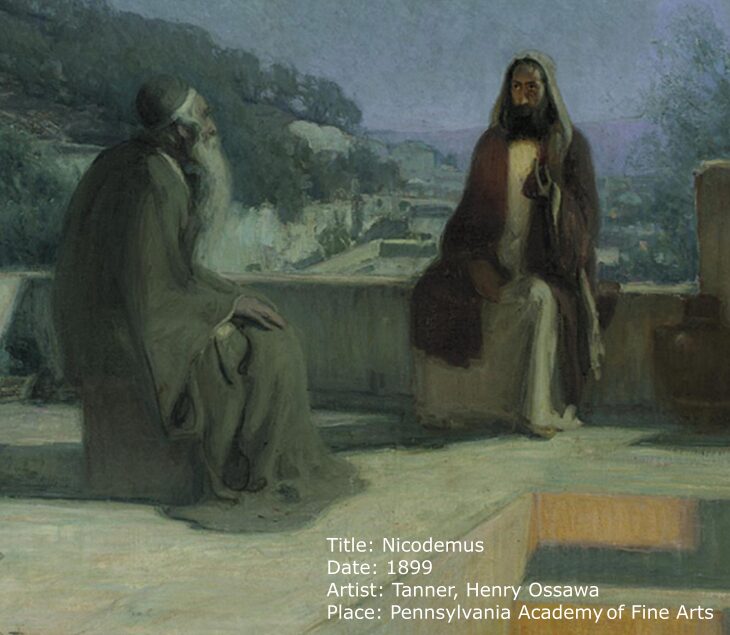
Based on today’s scripture, John 3:1-17, I’m not sure I can argue that Nicodemus is quanked.
But he’s upset enough to risk going to meet Jesus, even if it is in the dark, where he’s less apt to be seen. Nicodemus is trying to understand who Jesus is and what to believe, as he is not like any other teacher Nicodemus has ever met. The conversation with Jesus raises even more questions.
Nicodemus was a Pharisee, well-versed in the law, such that he even held a place on the Sanhedrin, which was the Jewish legislative and judicial body that ruled over the people. They will be the group later who tries Jesus before sending him to Pilate.
But for now, Nicodemus wants more information, and in this scripture, we have the very famous verse John 3:16. But with all the talk lately about the power & might of Jesus, and depictions of him coming with the “armor of God” to avenge those perceived as God’s enemies, I think we often forget verse 17
“Indeed, God did not send the Son into the world to condemn the worldbut in order that the world might be saved through him.”
This month is Women’s History month and we are lifting up some women and their work within our congregation.
Today, I want to lift the Rev. Jacquie Church-Young. Pastor Jacquie was the Youth & Family Ministries pastor in the early 2000’s, and based on my conversations with those who were youth at the time, she was very beloved. One of the reasons she was beloved was that she appreciated the act of questioning, understanding that it led to growth.
During Pastor Jacquie’s work with you, I was leading the youth at Salem UCC, and we both took our youth to a retreat at Hartman Center, where I observed her, and unfortunately, my first impression was not as positive. Then when I became a Member in Discernment of the Lancaster Association, they assigned Pastor Jacquie to be my mentor for the process. To be clear in our descriptions, she was just out of seminary and starting a family, and I was the mother of three teenagers. This is where I was reminded that God has a great sense of humor and works out situations for us to grow.
To start the relationship off well, Pastor Jacquie invited me to lunch, and at that lunch, I had to be honest with her. During the course of that conversation, I learned about the challenges she had been facing, of which I was unaware during our first encounter at the retreat. She talked about the internal turmoil within the church at that time and the shenanigans the youth were doing at the retreat. This is when we both learned lessons.
When I messaged her about including her in today’s sermon, I named that by her telling her story, I was able to have compassion for her. She named that I helped change her for the better, not just as a pastor, but truly – as a person.
All of that learning and growth came from an honest, heartfelt conversation. Which is what I think happened for Nicodemus in his conversation with Jesus.
So, where does all of this leave us?
I think it highlights the value of conversation and its ability to help lessen our feeling of being quanked and increases our ability to be compassionate.
Within the scripture, I have two takeaways for today: ~ God is always wrapped in mystery ~ The Divine always give second chances
Which leads us perfectly to Holy Communion. Which I think is also wrapped in mystery & about endless chances. We are not bound by past mistakes, missteps, or failures. Every time the feast is served, we are welcomed. May we come to the table seeking the mystery and find another chance to live and love better!
I think for most of my life, Lent was about giving something up.
Back in the day, the Catholic church told folks that we needed to give up meat on Fridays and eat fish, and that was great for the fishing industry. Actually, it is a healthier option, and it’s better for the planet. More recently, I hear people talk about giving up chocolate, wine, or some other special thing that they prefer. Maybe it’s desserts or something like that.
I want us to look at this a little differently this year. I am going to ask you to give up something, but I’m hoping that what you’ll choose to give up is the noise or the busyness. Maybe if you’re one of those people who are very busy and do not have a lot of downtime, choose more music than news.
Let’s tone down the rhetoric by just choosing a different option. This year, we’re asking you to slow down.
I’m calling it, “Press Pause & Listen”. Press pause on whatever noise is around you. Press pause on that. Churning chaos that seems to surround our lives right now. We all need a little bit of a break, and what I want you to think about is what are the priorities in your life? What really is most important to you? Is it family? Is it your faith? Friends, money, our neighbors?
Then, in these moments when you pause, I want you to think about how you spend your time. What do you spend the most time doing? Are you focused on the things that matter to you the most, and if not, what could you do differently? That’s something to think about this season.
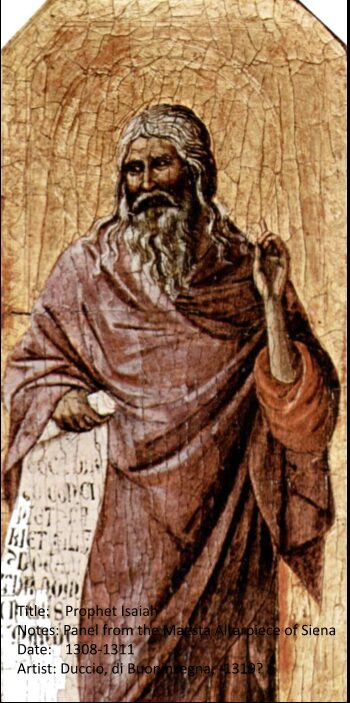
In our Scripture today, Isaiah 58:1-11, God speaks through Isaiah, calling to the people.
Mainly to the people who had all the things they needed, and he says your fasts are meaningless because you’re not giving anything up. You’re still focused on yourself. You’re not looking at the needs of others.
I think that’s the other part of the listen. When you’re pausing and listening, I hope that you’ll listen for the still small voice of God within you. The voice of your better angel, and I hope you will stop and listen to those around you. That’s where conversations are gonna come in. Our scriptures for Lent have a lot of conversation, people asking questions of Jesus.
I’m gonna invite us to explore some questions, and I’m gonna invite you to sit and think about some of those questions to share with one another, because the way we build community is by knowing the people around us, and we do that by listening better. So often when we get in a conversation, we think about what we wanna say, and we’re not paying attention to what is being said, or maybe the feelings and emotions that are being shared in that moment.
But if we have to do that, we have to notice others, so that we can have compassion and we can understand others better. Right now, we need to have a better understanding. For a lot of us, it’s not easy, and it’s really hard. I’m not gonna sugarcoat this. It’s hard to hear someone say something that is enough to make your blood boil, but what does the Lord require of us?
I usually quote Micah 6:8, “To act justly and to love mercy and to walk humbly with your God.” Isaiah actually has a little bit of a different answer. Actually, it’s not different as much as it defines what justice and mercy and walking humbly with God look like in this scripture from Isaiah,
“Remove the chains of injustice! Undo the ropes of the yoke! Let those who are oppressed go free, and break every yoke you encounter! your bread with those who are hungry, And shelter homeless poor people! Clothe those who are naked, and don’t hide from the needs of your own flesh and blood!“
It is about looking at the other. It’s not about saying, “What do I need?”, it’s about saying my neighbor doesn’t have food. Or I haven’t seen my neighbor come out of the house in a while. I wonder if they’re okay, and it can be as easy as picking up the phone. It can be as simple as just expressing care.
Are you all right? Is there anything I can do for you? They may say no, and that’s okay. You can ask other questions, more open questions. What’s happening in your life? What’s on your heart or your mind?
We are to love our neighbors and ourselves. That’s the command we’re gonna get again on Maundy Thursday. It’s the new command.
This week, I’m inviting you to Pause & Listen. We all have ears to hear and a voice to speak, to offer compassion. We can also listen to one another to help each other better understand.
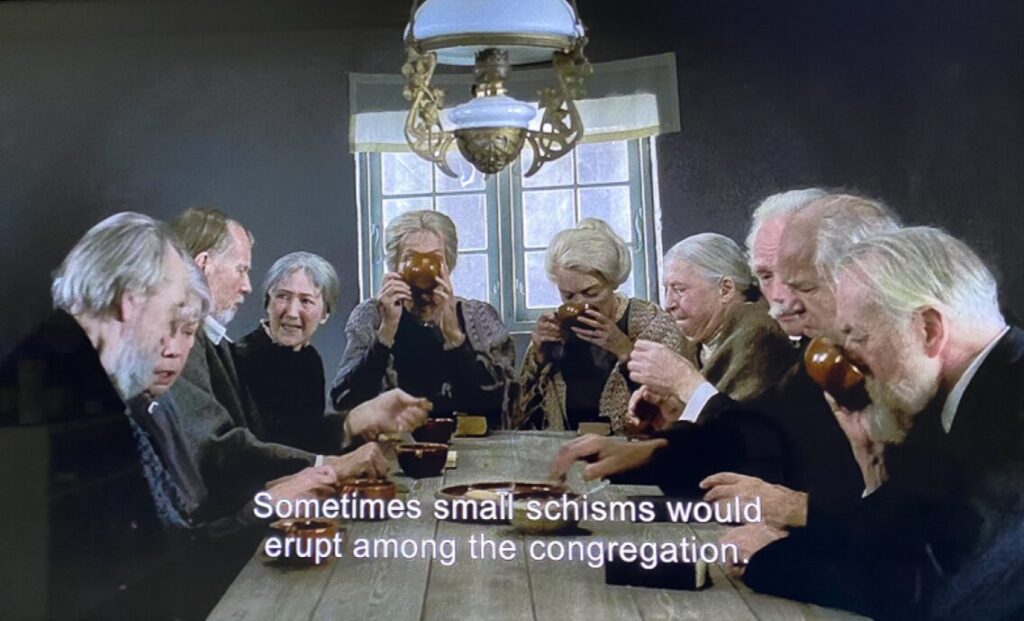
As I was thinking about our theme for today, which is, cultivating a life of self-giving, I was reminded of a film I saw in seminary called Bette’s Feast.
This comes from the eighties. It is a French film about a village in Denmark, a small village that was started by a pastor. He was very much about a life of piety and he taught them to live with the most modest means.
This is the village people that are left at this point in the story. They always dress in black. There is no color in the village. They have gruel, or oatmeal would be a nicer way to put it, for most meals and maybe a piece of bread. They’re very careful about living a life of poverty. They do not allow themselves any luxuries. At this point in time, the pastor has died. His two daughters, who are sitting at the far end by the windows, have continued on his legacy.
They get together and sing for their worship, but there is quite a bit of disagreement within the village. They’re just getting to be grumpy old people. They don’t have anything that brings them joy or happiness.
And a stranger comes a stranger named Bette Babe. This is set in the 18th century. Bette is a refugee coming from Paris, fleeing the war. She’s sent to the sisters by someone who had been courting one of the sisters years back, and she’s there to be their housekeeper. They say, well, we can’t pay you, but we can offer you room and board. What she does in her time with them, she slowly starts cooking for them and adding spice to their food.
As the story goes, she also has a lottery ticket from Paris and at this point she wins 10,000 francs in the Paris Lottery. With her winnings, she decides to throw them a French banquet. She spends all of her money on one dinner to celebrate the pastor’s 100th birthday. There’s quite a difference from this scene with their very modest bowls and their simple tablecloth to the beautiful China and they have a glass for each different kind of wine. All of the candelabras and dishes, it’s quite a change.
What happens after they have this meal, it was like the joy within them started to awaken and they remembered the pleasures of life. Not that they would be that way always, or have those things always. But that life that God gives is a good life. That all came about because of Bette’s willingness to give of herself, to give of everything that she had, knowing that it was okay. She was okay giving a meal, just one meal with everything that she had.
We are at the this point in the Holy Week story where Jesus is also about to give all that he has.
Jesus is coming into Jerusalem. Jesus is on the donkey and his followers are putting cloaks down, and palm branches are coming in on one side of Jerusalem. On the other side of Jerusalem is Pilate and the military.
What we have is like a poor people’s protest and a military parade. The question is, which parade will you attend? Where will you go? Jesus said “No one has greater love than this to lay down one’s life for one’s friends” – John 15:13. But when people are willing to serve our country’s military, we celebrate them because they are willing to give their life to defend our freedom. We are grateful because not all of us can do that. But how willing are we really to lay down our life for a friend?
I know of parents who will lay down their life for their children. Partners who will lay down their life for a spouse. Those will give up everything to see that one survive and thrive. But a friend, would you do it for a friend? Would you do it for someone you don’t even know? That’s what this week is about.
There’s this scripture when Jesus got to Jerusalem, he wept and said, “If you, yes you, had only known on this day the things that would bring peace to you“- Luke 19:42.
What are those things that make for peace? Well, I think one of those things is gratitude, recognizing that who we are and what we have is not because of our efforts. We are who we are today and have what we have today because of who our families were, who our friends are, the teachers that we’ve had, our life struggles, and the gifts that God has blessed us with.
Because we have all that we need to be the people God intended us to be. The question is, do we live it? Is that who we are in life? Do we recognize all of that and do we use our gifts that we have for the benefit of others?
I think the other part of it is that we have to recognize that the needs of others may be more important than our needs. We have to put the needs of the many over the needs of the one, and that’s a hard thing. Our self-interest, our egos, everything in us wants to preserve us, and we have to fight against that to say, no, the whole is more important than me.
That’s what Jesus does. That’s who Martin Luther King was. That’s who Bonhoeffer was. That’s who Oscar Romero was. They said that their lives were not as important as the rest of us.
Let me go to a lighter place. I watched Moana 2 yesterday.
Her story is that she’s willing to go where no one else has gone and risk herself for her community. That’s the storyline. I’m not giving anything away. It’s worth watching.
I want you to pray for Jonathan Paredes this week. Jonathan, Lucy and the boys, because Jonathan got a call to go back to El Salvador. He has been going back every holy week for quite a few years to a camp where he has helped to run. He told them last year that that was his last year because he’s in his first pastorate and holy week is kind of a big week to not be there. But, he got the church’s permission to go. They called him and they usually have like three or four thousand kids at this camp that he goes to, and this year they have 10,000 kids going to this camp. They asked him, can you please come back? The whole family’s getting on a plane this afternoon to go to El Salvador.
That is not the problem. The problem is will he get back? He has a passport. They all have passports, but will he get back? That remains to be seen. He’s coming back on Easter, so we’re going to pray that everything works. But I’m nervous and I’ll name that he’s nervous too, but he’s going because it’s the right thing to do.
I think life can be frightening and overwhelming. Right now, we don’t have all the same resources, we don’t have all the same gifts, but we come to this table and to this space with the gifts that we have. By sharing our gifts, everybody has what they need. That’s the beloved community of Christ.
So the question is, can you give yourself away in this moment? Do you have compassion, the gift of being present? The gift of your attention, your empathy, that you can share with someone who’s struggling right now, and are you seeing them? Do you see them in our community, at the grocery store you shop at, or the places that you travel to?
Who needs someone that’s near you that you can just give them a bit of your time? Because it matters what we do right now.
I’ve been ending every sermon in Lent with this. It matters what we do because we are teaching our children how to survive in these difficult times. I’ve been reading this piece by Steven Sondheim.
“Careful the things you say. Children will listen. Careful the things you do. Children will see. Children may not obey, but children will listen. Children will look to you for which way to turn, to learn, what to be. Careful before you say, listen to me.”
Our theme today is “Cultivating a Life of Curiosity.“
As much as I thought about that, I could not get myself past the show, Ted Lasso on Apple TV. I will play a clip so you have a better idea of what I’m talking about. To set up the clip, Ted was a soccer coach in America who was hired to coach an English football team. In this scene there are two of the main characters, Rupert, who used to own the team, and his ex-wife. Rupert has just acquired significant ownership of the team and he has just announced that his new wife will be joining him and his ex-wife in the owner’s box every game. He bought enough stock in the team that he could set the line up if he wanted to, because he doesn’t like the way Ted’s coaching the team. They ended up making this wager that if Rupert wins, he gets to set the lineup for the rest of the season. But if Ted wins, Rupert doesn’t go near the owner’s box and he lets his ex-wife alone.
Are we curious? Do we ask the questions?
The point that Ted was making is that too quickly we become judgmental just as Rupert was, but unless we ask the questions, we will never truly understand one another. It is far easier to judge, to make snide remarks, and to write people off than it is to get to know them and try to understand them,
That’s not how Jesus lived. Jesus went to people and he asked questions. He asks Zacchaeus, why are you in the tree? He asked the Samaritan woman at the well, why are you at the well at this time of the day? He asked the questions of people because he wanted to get to know those people. He wanted to hear their story because when we hear each other’s stories we understand each other so much more and can have more grace for one another. That’s where our empathy comes from, our compassion.
We have these Proverbs, these wisdom teachings of Jesus in Matthew 7:7-14. Remember I said context matters. This is what Jesus was saying to those who believed in him, who followed him, and for them this was his expectation. They were to do unto others as they would want to be treated. We have to remember that.
Jesus is Jewish, he’s talking to a Jewish audience, and it’s about how they are different from the rest of the community. That’s a huge part of Judaism. What makes them distinct? That may be harder for us to know in this context. If you don’t know a lot of people who are Jewish, we might be able to answer the question of how Amish people make themselves different in our community. That might be an easier question for us to answer because they do the same thing. They have ways about them that make them distinct.
Christ was calling us to be distinct. In our world, we should live differently. We shouldn’t blend with society. Here are some things that we are to do.
Ask, Seek, and Knock. We have to be looking for God, asking for God’s help. But this scripture gets taken advantage of. I think it’s because of the descriptions that he gave because it sounds like we should just ask for material things. I don’t believe that God is some type of ultimate Santa Claus. That if we ask for a beautiful house, somebody’s just gonna call us up and give us a beautiful house. I don’t think it works that way.
This is where people sometimes lose their faith when there’s a diagnosis and they ask for healing, but they don’t get a cure. I wanna say that we don’t know what healing looks like and sometimes maybe being whole is joining eternity. That’s a hard one and I know that.
But I do think if we ask for the gifts of God, think back to our last season with “The Economy of Jesus.” The gifts of God, are love, grace, compassion, empathy, self-control, and patience. Those gifts, if we ask for them, God will help us find them. If we look for a way forward, if we ask God, to help us to figure out where we are to go or what we are to do, the path will become clear to us. It may not be where we wanna go or it may not be what we wanna do because God doesn’t work like that.
I think that leads us down to the narrow gate. So the easy road is the wide gate. Do you remember where it said? it leads to destruction. It’s the narrow gate and the hard road that leads to life. That’s not what we wanna hear. We wanna hear that we can just ask God for a nice, easy life and it will all be roses and sunshine, and everything’s going to work the way we want it to. We’re always gonna be happy and we’re never gonna experience sorrow or pain, but that isn’t it. That’s not the story of Jesus. Jesus was the one who was willing to die on the cross for us because of his love. That is not an easy road.
But in order to do all of this, I think that there is a level of humility that Jesus is also calling us to.
It didn’t say that in the scriptures. It did not say, you must be humble. But, I think that there’s a humility and a vulnerability that is also needed. We don’t like either of those words. Our society says when people are vulnerable, then they’re weak, or they’re losers.
I disagree and I think that Jesus modeled for us letting go, and being vulnerable to meet people where they are. I think that we are called to meet each other, to get to know each other, and to ask questions.
We have to be willing to acknowledge that we don’t know everything. We don’t know everything that we think we know. We have to own that. We don’t know everything and we don’t have everything that we need. Not really. You may have the physical comforts that you need, but if you look within yourself, do you have all of the love, grace, compassion, patience, and peace that you need? My guess is if we’re honest, none of us do.
That’s where we can be more curious. We can be curious within ourselves, what is that within me that drives me to act like that? What is it within me that makes me think that I’m not loved? Maybe that’s an old story you need to reexamine.
Meister Eckhart’s quote invites us to approach life as a child because they haven’t lost their curiosity yet, and we can work on building our curiosity muscle. We can work on being more curious and asking more questions.
That’s actually how we’re going to bring ourselves together because none of us holds the real truth. But the truth is in the midst of our stories. With humility and a sense of curiosity, we can seek to understand and have more empathy.
This past week on Thursday night, we had the Clatterbucks here for Mocktails & Meaning.
The Clatterbucks lost their transgender son to suicide almost a year ago. They named the pain and sorrow that they still carry around. He was surrounded by people who loved and affirmed him for being who he was. But the rhetoric in our county, state, and country was so hard. It told him that he was not welcome. It wanted to erase him, and so he did.
How we treat others matters.
What we are called to do is to love. What are the two commandments? Love God with all of our being and love our neighbor as ourselves. There’s a third because that means you have to love yourself.
The next thing to do in every moment is the most loving. What is the most loving thing I can do in this moment? That’s what God wants us to do. And I told you I was going to end every sermon with these words because I think we need to be thinking about this right now. We need to be thinking about what we are telling the children by our actions and our words. What are we teaching them that they are learning for when they are adults? The wisdom of Stephen Sondheim.
“Careful the things you say, children will listen. Careful the things you do, children will see and learn. Children may not obey, but children will listen. Children will look to you for which way to turn, to learn. Be careful before you say, listen to me, children will listen.”
As we start to talk about meaning, meaning answers the why.
As I was thinking about this and the fact that it’s Lent, I’m wondering if any of you gave something up for Lent. You don’t have to raise your hands, this can be internal. I’m not going to put anybody on the spot, but if you did, my question is why? Why did you choose to give something up for Lent? Because I think the why is important.
Is the why, because it’s something that you always do? Does it give you something to talk about with friends? Do you wanna prove to yourself that you have some self-control so that when it comes to Easter you can pat yourself on the back? Why? Or is it because that’s what the church used to tell you to do? I remember those days.
As I told the children, we assign meaning to things, to people, and even to experiences. If I asked what was your first car, you probably remember it, because that was a significant point in your life. I know some of you are just getting there. You’ll remember it.
Our parents are important in our lives and their words and how we experience them affect us deeply. Because they’re an important person to us.
Seeing a spectacular sight. That’s what’s different for each of us.
The Northern Lights is on my bucket list. I went to Maryland for a trip and Pennsylvania saw the Northern Lights. I have lived in this county all my life and I go to Maryland once and you all see the Northern Lights. That’s an experience that once you’ve done it, you remember that.
It might be a smile or a hug from a child that we deem priceless.
Now, I’m wondering how many of you looked at the picture to the left and what meaning you assigned to that picture. That is the oldest slave shack to still exist in the United States. It is in the Virginia Chipokes Plantation State Park. Now that you know that, that might change what you were thinking about that picture.
As we begin to get into these parables today, there’s a few things that I want to name before we go there.
The first thing that we need to remember with all scripture is, that it doesn’t matter what scripture you open to and read, all scripture was written for a specific time and a specific audience. In fact, the reality is those writers had no idea we would still be reading their works 2,500 years later. If you think about the Hebrew Bible, and placing so much value on everything they said. They didn’t know at the time that they would become part of the number one bestseller of all time. That’s good to remember that it wasn’t written specifically with us in mind.
It’s also good to remember that, for that time, they understood what a kingdom was. There are all of these parables that refer to the kingdom of heaven. They were reminded of their history when the kingdom of God was under King David, and that was a wonderful time for the Jewish people. That was a time under David and Solomon. Life was good. But they also know that there are bad kingdoms, the Babylonians, the Assyrians, and now the Romans.
The Romans, we call it an empire, but it’s the same idea. That there is one leader and he’s deciding exactly how life is going to be. The good, bad, and the indifferent. Being part of God’s kingdom or the kingdom of heaven was a good thing. Good things came out of that because God’s not the same as the kings or the emperors. God is a different kind of king. But, that kingdom language today is associated in our country with Christian nationalism, which has a very definite political position that I do not support.
So, I’m not going to use the language of the kingdom of heaven when I talk about the scripture. I’m just naming that for you the meaning behind that.
It’s also good to know that the Greek word that is used for the kingdom is Basilea. Basilea means the spiritual reign. The future physical manifestation of God’s rule, and it encompasses the authority, sovereignty, and royal power of God, as well as the community of believers who acknowledge his lordship. I’m going to refer to it as the beloved community. I’m just explaining my language and why I’m doing it that way.
I know this is a lot of unpacking before we get there, but I’m going to leave a lot of unpacking of the parables to you. The other part is we have to remember that in a parable, there is always a surprise factor. Parables were their stories meant to tell the truth about God and about the way God would want life to be oriented. But they’re also meant to shock us and make us go, well, that’s ridiculous.
Last week I had said to you that it’s good to ask questions of the scripture.
If there’s a scripture that doesn’t sound right, sit with it and pray about it. Look it up, look at other places, look for other words. You can do a Google search on a particular word and it’ll tell you other passages that that word is used in and you can go a little deeper because it’s in the questions that we get to the meaning. After all, this is about meaning today.
What we want to know is what truth does this name about the beloved community of God? The actual scripture says the kingdom of heaven. So it begins with the kingdom of heaven is like a mustard seed. So what is this trying to tell us? Or we could say, what is the surprise that something that small can have a huge impact? We know that seeds are small, and some seeds will grow into a tree eventually such as an acorn will grow an oak tree. But the tiniest of seeds don’t usually grow us the largest of plants, shrubs, or trees. But it does remind us of the potential.
The potential for every small thing. Whether it’s a small thing you do. Whether you feel like you are a small person, what can you do in this situation? You might be able to do quite a lot just by doing small things that can have a larger impact. The yeast. I considered bringing in my sourdough starter and sitting here working with bread in front of you today. But, you know, what’s the point of the yeast? Why would you hide, and we always hide, yeast in the flour? Because it helps it to rise. It helps it to become more than just flour. Put too much yeast in it and I’ve blown the top off my sourdough starter. That’s a thing, a little bit can transform it.
The hidden treasure. This is a great one. Do you remember what I said about that? That’s where the man goes and he finds a treasure. Then he re-buries it, sells everything he has, and buys the plot. Buys that that piece of land. Do you have any questions about that? Don’t you wonder why he reburied it? If you found it, why would you put it back in the ground? Why not keep it? Go sell it. Display it. Do something with it. Give it to somebody. But he didn’t. He put it back in the ground. Why did he buy the rest of the land? My thinking is he thought that there was more. What does it teach us?
There is this sense that once you find a little bit, you want more of it and you’ll do whatever you can to get more of the beloved community.
How about the merchant who finds the pearl and sells everything he has for one pearl? Does that bother you? Would you do that? Would you sell everything that you have? Maybe not for a pearl, but what would you do to know that you are part of the beloved community of God? Because that’s what the pearl is. That’s what the pearl represents. What would you do for that assurance that you are part of the kingdom?
Then we have the net that they cast and a fish of every kind is brought in. The beloved community of God is inclusive. Later, we’ll figure out who’s the righteous and who’s the evil. But first, God wants everyone to be invited. Everyone comes into the beloved community of God and we’ll figure it out later.
Then, there’s the scribe that says that there is old wisdom and that there is new wisdom.
I look at that and hear there’s the law and the prophets and there is Jesus. Jesus says, I did not come to abolish the law and the prophets, but to fulfill it. There’s the old wisdom and the new wisdom and they exist together. There is the way we’ve always done it and the new things that we can do. They can exist together and we can determine what is the best wisdom for this time.
It is with Jesus. So the law still stands, but Jesus brought in all these Gentiles with the Jewish community, those who the Jewish community had thought were outcasts. Jesus says, no, they’re not, they’re part of the community. Everybody, it’s that inclusive net. Everybody’s coming in.
Because at the end of the day, love wins.
I think that’s the biggest piece that I want you to focus on. The parables can be confusing, but no matter what happens, our focus needs to be on doing the most loving thing. I do believe that love wins. By doing what we can, we make meaning of it. Meaning is not something you can buy at the store. It’s what you do. It’s how it affects you.
The other thing this tells us is that we’re not responsible for the outcomes. God takes care of that. God takes care of it and God will judge.
So at this moment, what are we learning? What are we learning right now in our lives? I’m not going to answer that question. That’s a question for us to sit with. What are we learning? What is the meaning that we want to make of this time in our lives? This time we are living through together. What do we want this to be? What meaning do we want to give to this?
I know there’s a lot of people that are scared. There’s a lot of chaos, and it can feel like every day is a new day in many ways depending on what else is going on in our lives. We are called to let love win, we need to be reminded that we are resurrection people and that before you get to rise, there has to be a death. We’re anxious as we see systems breaking. But a just system, which we don’t have, we don’t have just systems. A just system cannot come in until the systems that are in place are broken. I know that’s not good news. But remember, we go through the pain.
We go through the dark night, and in the end, love wins. There is resurrection, there is new life, there is justice, love, hope, and peace. We don’t know when that’s going to happen, or how it’s going to happen. But I’m going to read this to you every week. Because everything is meaningful. This time that we’re living through, not only do we need to think about what it is for us, but we need to be thinking about what we are telling and teaching our children in this moment.
Because they’ll need to remember this. So this is, these are the first couple of verses to the finale of Steven Sondheim’s musical, “Into the Woods”. “Careful the things you say, children will listen. Careful the things you do, children will see and learn. Children may not obey, but children will listen. Children will look to you for which way to turn, to learn what to be, careful before you say “listen to me”, children will listen.“
As I was thinking about that, the idea of beauty and the beauty of God, a line came to me from out of our culture that says, beauty is in the eye of the beholder.
That comes from a 70s song by Ray Stevens. So, in this season, I am inviting us to be the beholders, to be the ones looking for the beauty around us, noticing what is happening in nature and in the people around us. Beautiful things happen if that is what we are looking for.
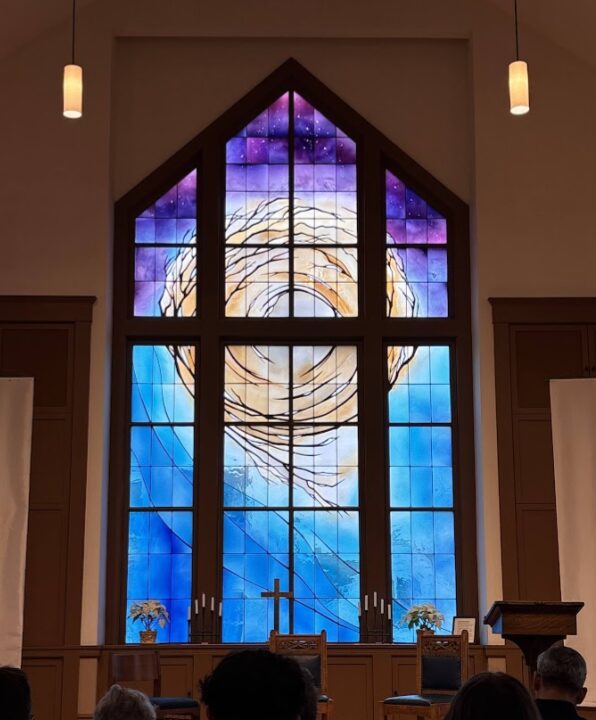
This picture was sent to me by Jonathan Paredes. He went to a conference in San Francisco, and this was the window in a church where they had a worship. He sent it to me because he said this reminded him of me and my theology because this was meant to be a depiction of creation. Just these swirling colors coming together.
The season of Lent is meant to be a thoughtful reflection of seeing things as more than they may initially appear. There’s looking with our eyes, just glancing, and there’s looking more in-depth. Then there’s looking with our hearts, and I invite us into that journey to look with more than just our eyes, to look with more than just a glance, but to see the beauty in the world, the beauty in one another, the beauty in each person.
This is a great time to remember that we are all made up of the same matter.
The same matter that made up the palms. I have the dried palms on the table because I thought you might not even realize that they’re the dried palms from one year that get burned to become the ashes I just put on your forehead.
This is a very purposeful thing that we do. We take the leftover palm branches and burn them and have them for the next year’s ashes. And all of that, the palm branches, the ash, our bodies, stars in the sky, and the trees, everything has the same matter that was created by God and everything has a little bit of the divine within it.
Today, we gather to begin this journey with Jesus towards his death and resurrection as we work to become better people.
We call this the cultivators of awe and wonder. Tonight, it’s about being cultivators of beauty. That’s why you see farm implements in the Sanctuary. Those corners will grow as we go through lent.
Because we’re in a season of working, right? Soon, the farmers will begin to plant. As I was thinking about tonight’s theme of beauty of the world, I want to remind you, that we’re to see that as God sees it. It’s the beauty that God sees. Sometimes we miss it.
We tend to look at ourselves and think that we are not beautiful enough. So, we adorn ourselves with clothing, fancy nails, and all kinds of things to make ourselves look more beautiful to the world. Where God believes that we are beautiful in our natural state and doesn’t want us to worry anymore about all of those other things.
Jesus’ message to us is to relax. Don’t worry. Things may look bad, but the spirit of God is alive and well and working in this world. We will learn new things through the challenges that we face.
This picture is from my cross-country trip in 2017 when we were on sabbatical. This is a sunset on the Oregon coast. I have seen sunrises on the east coast, the Atlantic. I have seen sunsets on the bay, but I decided since I was on the west coast and I wanted to see a sunset on the Pacific. A sunset on the Pacific to me meant when the sun touched the water.
About an hour before sunset, we started walking because I needed to find the perfect place where I was going to see this, and as time was going, so was the sun. I realized that I was tired, and I was getting grumpy and frustrated. If you look carefully at this picture, you will notice that the sun is about to go down into a cloud bank. So, it didn’t matter where I was on that beach. I was not going to see the sun meet the water.
Fortunately, I took this picture. It’s a beautiful picture of a sunset, but it wasn’t what I wanted because I wanted something more. Because I wanted something more, I caused so much grief and argument for nothing. All I needed to do was say, “Wow, I’m watching the sunset on the Pacific” instead of complaining about this rock that was in my way or the fact that there’s a cloud and I’m not going to see the sun meet the water.
It all depends on your definition of beauty, right? What is it that is beautiful? So what is the beauty of God?
Look around and be amazed. Be amazed at what you can see. Creation is the perfect beauty of God. We just need to stop and look.
You might be looking at this picture and thinking, she’s lost her mind now. Because that is not the most beautiful picture I’ve ever seen. Yet, I will say the picture does not do it justice. If you could see close enough, there are hundreds of snowdrop blooms ready to open when they get to the right temperature.
If you can see lots of little white dots, every one of those little white dots on top of the decaying leaves, grass, and branches are little flowers, which will open one of these days. It will be beautiful, and it’s beautiful in this moment as it’s getting ready to be born.
What do we call beautiful? Can we expand our understanding of what beautiful really is? So that we can embrace all of God’s creation. All of the different varieties of people and animals and plants that God has created for us.
The women go to the tomb with expectations. They expect to find a dead body. They expect to do what they feel called to do. They want to anoint this body. This is a gift that they want to give to Jesus. To have his body anointed, even though we know he was anointed. We had that scripture a couple weeks ago. With the woman who broke the bottle and poured the gnar all over his head. He was anointed for burial, but they needed to do something. So they go to the tomb and they have expectations.
They’re already thinking, how are we going to move the stone? But interestingly, they don’t bring anyone with them to do that. Probably because the ones that they know best are hiding, remember? Because they didn’t want to be picked up by the Romans. They didn’t want this to end the same way for them. So those guys are in a locked room, but they go because the Romans aren’t looking at them, and what they find does not meet their expectations.
Have you ever had one of those moments when you expected something to play out a certain way, and it didn’t?
It can be frustrating and confusing. Especially when you meet someone that you don’t know who they are or what they are. Maybe they’re an angel.
Somebody dressed in a white robe sitting in a cave by themselves saying his body was there but not anymore. The grave was not robbed. He has been raised. Can you imagine how scared they probably were?
But, I wonder if it isn’t in those moments when our expectations are thrown off, that we actually can have a God moment. A moment where we realize that God is present.
Then he says something very interesting, He says, Jesus goes ahead of you to Galilee. I think that that’s important because the Bible gives us little phrases and asks us to think deeper about them.
“He goes ahead of you.” It’s like a throwaway phrase. But it also means that he has already done everything that we would do. He has lived this life. He was born as a human. He experienced birth, growing up in this world, in his world, not ours. It’d be interesting to see what he would be like today, but he grew up in that world, and he experienced all the heartaches.
He knew what it would have been like to cut his finger or to touch something hot. And he has already died. He knows what it’s like.
Even worse, He knows what it’s like to have his best friends betray him, deny him, all of that, be hurt by those closest to us. I’m guessing some of us know what that’s like. But so does Jesus. And Jesus goes ahead.
That’s a clue. Galilee is where Mark’s gospel started with John the Baptizer. It’s like, go back to the beginning. This is typical for the Jewish people. Jewish people read through the Torah, what we call the first five books of the Old Testament, and when they read Deuteronomy, where Moses dies, then they go back to the beginning, and they start with Genesis 1 again.
So Mark is saying to us, it’s time to go back to the beginning and work through the story again, because you’ll hear things differently this time.
We are not the same people that we were last year. We haven’t read Mark since 2021. Are you different than you were on Easter of 2021? Do you remember Easter of 2021? I remember Easter of 2021. We were in the parking lot, and I ordered 200 cupcakes because I said we are going to come together and we are going to eat.
We have changed since 2021. We are a different people. Thanks be to God. Right? I don’t know how many of us want to relive ’20 and ’21.
We are called to be witnesses.
That’s what the people are. That’s what the women are called to be. And yes, Mark’s gospel doesn’t leave us feeling all warm and snuggly because it says they ran home and told no one.
But we know eventually they told somebody. Because we have the stories. We wouldn’t have the stories if they hadn’t. Right? They did eventually tell someone, but they didn’t tell that someone right away, and that’s okay.
If you’ve ever had an experience of a loved one coming back to let you know that they’re okay, most of us don’t talk about it, but you all tell me. So I know lots of those stories. You don’t want to admit it to each other, but I know lots of those stories.
We’re called to be the witnesses.
So how do we witness to Jesus? Life? We live it. We work for justice. We feed the person who’s hungry. We give water to the person who’s thirsty. We visit the person who’s imprisoned and we work to change systems so that when people are sick they don’t go unpaid. When people need medical care they get the care they need. That’s how we witness.
We recognize that we are meant to be the love and mercy of God present in this world.
This is one of those days that I think everybody really likes. It’s Palm Sunday.
This is the celebration. This is a high point of the church year. Jesus is coming in. He is in charge of this scene. He tells them exactly what to do. He’s not the large and in charge Jesus that we hear in John’s gospel, but he still is orchestrating the events.
He knows, tells them exactly what to do. It appears from the scholar’s point of view, looking back at this, that he’s completing the prophesy from Zechariah 9:9-10.
Jesus is coming in riding a donkey from the east side of Jerusalem from Bethany and Bethesh. At the same time, Pilate and a whole. legion of Roman soldiers are coming into Jerusalem from the west. Because they also know it’s Passover. And there is a history that during Passover there have been riots. So Pilate is bringing extra soldiers in to keep the Roman peace. They don’t want any trouble. They don’t want any uprisings.
So here, you’ve got this humble man coming from the east and you’ve got Pilate and the war horses coming from the west.
If you’ve read Zechariah 9, you’ll understand how that is all part of that scripture. We are called to sit up and take notice. We are called to pay attention to what’s happening in this scene.
Look at the difference, and notice it. Look at where the love and the compassion is.
So, Jesus comes in during the day, and at night, he goes back to Bethany. He goes back to the house of Simon the leper. This story of his anointing, Takes place in all four Gospels. It is worth noting when they happen and how they happen. And who. Because, in some situations it becomes a character. The woman is named as Mary. Most times the woman is not named.
So what I find interesting when I have a passage like this that occurs in four different gospels, number one, sit up and take notice. It must be an important story or it wouldn’t be in all four gospels.
Then I look at what’s different about Mark. What’s different in this story? Matthew and Mark’s versions are the closest. Now, remember, and I actually put them in that order, because Luke’s is so different, and even John’s is different. But Mark’s would have come first. Mark’s gospel was written first. Matthew definitely used Mark when he was writing his gospel. So those are the closest.
Both of those accounts, the woman, it’s an unnamed woman, and she anoints his head. Now, you have to stop and think about what does that mean? What does it mean to be anointed on the head? Well, anointing is an ancient Jewish practice. It was done to the kings. This is also important. It was done to David and to Solomon. They were anointed as the kings of Israel.
So, it’s meant to make us think, is Jesus a king?
It is also done when something is marked for holy purpose or that the holy is there. Think about Jacob anointing a pillar of stones because he encountered God.
So, there’s something holy and divine about Jesus. This is recognizing that also. She breaks open this jar, Mark is the only one in which she breaks the jar.
It is Nard, and Mark has Jesus tell us it’s because she’s anointing me for burial, which also is foreshadowing that he knows he’s going to die, according to Mark. He knows he’s going to die, and I even think you could go as far as to say she’s anointing him because she knows they’re not going to be able to anoint his body after his death.
But I kept sitting with this, but why did she break the bottle?
It only happens in Mark. I went looking for other scholars to say something about that, and I didn’t find them. Not that they’re not out there, but I didn’t find them. So I had to sit with it myself. Why was it important?
Because that’s the thing about Mark. Mark uses the least number of words he has to. It’s the shortest gospel. Things are explained briefly. So for him to use that word, and it’s the same word that they use in the story about the Gerasean, sometimes they call him the demoniac in different versions. The crazy man who’s out and he breaks his chains. There is this breaking. It’s definitely breaking. She specifically breaks the bottle.
But what I came up with were two things. If you break the bottle, that means you’re using all of it. You’re going to use the whole bottle at once. Which means Jesus is going to be overwhelmed by that oil and that smell. Both for himself, he’s going to smell that for the next few days. Because remember, they didn’t take showers every day like we do. So that smell is going to be with him, reminding him, reminding others as they encounter him. I think it is also part of this foreshadowing that not only was the bottle broken, but he will be broken. His body and his heart will be broken by the events of this week.
We need to sit up and take notice. We need to notice this.
We need to notice where we are in the story. We know this isn’t the end of the story, that we’re coming back next week for an ending that we could not see at this point. But this is the point in the service where we shift from palm to passion. I do hope that some of you come on Thursday and come on Friday to experience the rest of the story before we get to Easter. That I’m giving you a little bit of this passion because we do need to sit up and take notice.
In that scripture, the one that I read, Mark lines out three groups of people. The first group identified are the scribes and the Pharisees who want to get rid of Jesus and Judas Iscariot joins them. There’s the group of people that includes the woman with the ointment who loved Jesus and whose love is extravagant. Right? This was a very expensive ointment. This is an extravagant love of someone. Then there’s a third group that just doesn’t understand. Which is probably where the rest of the disciples are. That’s a running theme in Mark’s gospel. That the disciples don’t get it. And maybe that’s where we are too.
But without saying it, Mark is asking us to think about which group are we in? Do we want to get rid of Jesus too? Will we be the ones part of the crowd yelling for Barabbas on Friday night? Are we part of the group that loves Jesus enough that we will be able to stand and watch and allow our hearts to be broken? Or are we just part of the group that doesn’t understand?
Now, I’m going to say it’s time folks to sit up and take notice what is happening in our community.
This has been a hard week and there are other churches that are celebrating that God’s will was done yesterday. But this week was not about love and was not about compassion. I heard more hate, violent speech, and threats this week than I have in a very long time.
We are called to be about love. I have to find within myself a way to be merciful, because we are to be about compassion, not violence.
Today is a very unique day because it’s St. Patrick’s Day and Sunday.
As I was putting this sermon together, I also heard a short lecture by a very famous Celtic theologian named John Philip Newell. He was talking specifically about the Celtic cross. They are different than our cross. Celtic spirituality is a bit different than Western spirituality.
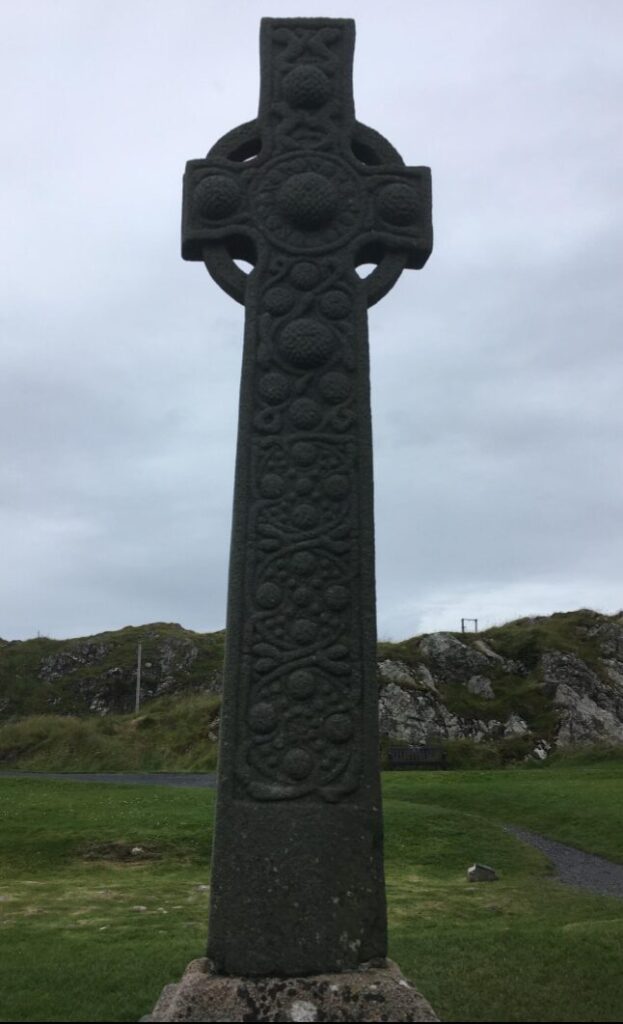
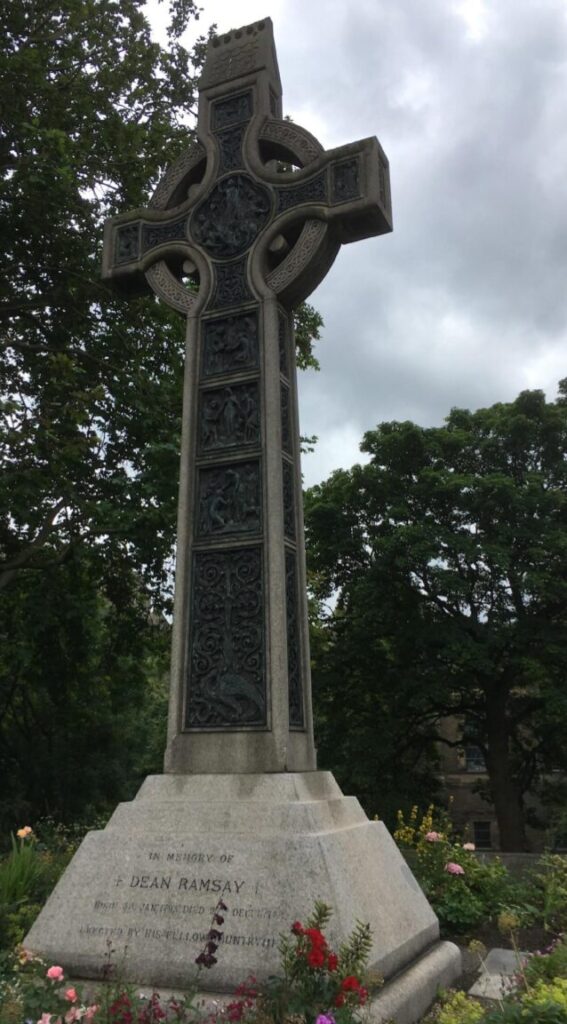
The Celtic spirituality dates back to the very beginning days of Christianity. The cross that I’m showing on the right side is from the Isle of Iona. Iona is one of the birthplaces of Christianity in the UK and parts of Europe. So, that cross has been standing there since at least a 1000 A.D, if not before.
Here’s the difference between our cross and the Celtic cross.
The most obvious difference that you will be able to see is the cross, which represents what what Christ died on. We’re not actually sure if that crossbar’s there. It may have been a single stake that Jesus was hung on, but we have the cross. Then, on the Celtic cross there is the circle or the orb that goes right around that intersection. The circle or the orb, stands for God being known in the universe.
The cross itself is God being known through Christ. They look at the cross in three ways. They believe that when you look at the cross, you see the love of God, and it connects with the divine within us.
The one side of a Celtic cross has images from creation. It’s full of orbs and it looks like snakes that intermingle and it’s because it’s showing you the universe. They believe that God is found and known through the universe, the natural world.
But on the other side, which is better seen on the one on the left, there are Biblical stories. So God is known through nature, the natural world. God is known through what they call the small book. We don’t usually think of the Bible as a small book, but when you compare it to the universe, it is a small book.
Then they look at how we are affected when we encounter the cross. In Western Christianity, it was in the words to “Lord, I Lift your Name on High.” We sang about the debt you paid, “You came to heaven to earth to show the way, from the earth to the cross, my debt to pay”.
Celtic spirituality doesn’t believe that Jesus went to the cross for us to take away our sin. He went to the cross because he challenged the rulers of the time. He challenged the religious leaders. The high priests wanted to get rid of him because he was saying things and doing things that they could not do. He raised somebody from the dead. Caiaphas and the high priests never raised anybody from the dead. He was doing things that were challenging their authority, and he was challenging the Roman authority because he was suggesting that the people should live in a different way. Jesus was very much about getting rid of the oppression on the people.
Our cross and this idea of it is substitutionary atonement. That means that Christ died in our place.
There’s a hymn that we sing about seeing my sins hanging on the cross or nailed to the cross. It’s in “It Is Well With My Soul”. I don’t agree with it, it’s not my theology. So I don’t sing it anymore, because I don’t believe that my sins hung on that cross.
I do believe I’m forgiven through Jesus. I believe that Jesus went to the cross because Jesus loved humanity more than life itself. Do you see that distinction? This theology works so much better for me. It feels right in my body.
Maybe that’s because I do connect to God in nature a lot.
My experience in Iona was very eye opening because I do have an Irish-Scotch background. When I was in Iona, I was at home. I felt connected to the earth and everything. Then we did some research and the Irish surname that I have, it’s Nordic.
That means I was part of the Vikings. I’ve got Viking heritage. So, although I may have had linkage somehow to those first Celtic spirituality people on Iona, in the 800s, the Vikings conquered Iona and burned everything to the ground. Now it was rebuilt, and Roman Christianity came in. But the point that our cross and substitutionary atonement both tell you that you are wrong, that you are unworthy of God’s love, which aligns with the empire.
That’s what the empire wants you to think. The Empire wants you to think that you are not good enough. In the 4th century when the Empire and Christianity went together, then Christianity claimed all the same things that the Empire did. They wanted to control people. They knew that they could control people with shame and guilt, and have done it for a long time.
In Celtic spirituality, when they look at the cross, they don’t see guilt and shame. They don’t feel that their sins were forgiven on that cross. What they feel is love. For them, the cross is revelatory. It is almost like an icon, and it helps them experience God. Because those who love God, will do God’s will, which is to love others. Which is to lay down one’s life for one’s friends. Which is how it ties into the scripture. That was part of the scripture for today.
I had the privilege of going to see this movie yesterday, and I’m going to recommend it to you.
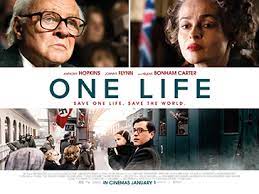
It’s called One Life.
It does star Anthony Hopkins as Sir Nicholas Winton. I’d never heard of him before, but he’s a very famous Brit, who in 1938, he was a broker, and he had connections who went to Prague.
I think they were doing banking in Prague, and they got involved with the Jewish refugees in Prague. He decided that even though he was an ordinary man, he could make a difference. He could lay down his life. This is my words. This isn’t in the movie. He would tell you he’s an ordinary man and he could save at least one life.
But what he and his three other companions did was they got 669 children out of Prague and to England. That meant getting them the 50 pounds it cost to get a visa. He had to find foster families in England who were willing to take all these children, and he had to have all the information on the children.
It is a powerful movie. It is a wonderful story. It is based on the true story. He was knighted by the queen. So he is Sir Anthony and he has passed. He lived to be 106. But he always had guilt that he could have gotten more children out.
When we think about our lives, if we think that we just have one ordinary life.
Think of how you as one ordinary person can make a difference in the world.
If you came today for a feel good sermon, you picked the wrong day.
If you came hoping that there would be a lot of images, because I usually use a lot of images, there’s only one. This is a very different sermon. It almost looks like it’s very black and white. Because there’s a lot of words, white words on black backgrounds. I don’t mean it to be quite that black and white, because I believe in a lot of grey in this world.
I want to start by defining some terms.
One of the things that we need to know is definitions on what is sin or trespasses.
In the Ephesians text, the word trespasses is used. So sin and trespasses are essentially the same thing, both of which are in opposition to God’s benevolent purposes for the world.
It’s something that opposes God. Not trespasses as in our contemporary, meaning you stepped on my property and I didn’t want you to. Trespasses as in something that is going in against what God wants, or in opposition to God, or even away from God.
Salvation, or being saved, means being reconciled with God again.
That’s the whole journey of the Bible, is that we started with God, somehow we broke off from God, we stopped following God, we tend to follow with our free will, we tend to go our own ways, and we forget about God, and we need to be reconciled with God. That is being saved or that is what salvation is.
Grace is God’s favor that is given to us.
Mercy is also used and mercy means compassion or the word also can mean pity. So God can have compassion on us or grant us favor when we don’t deserve it.
We’ve done nothing to deserve it. Those are important points that you just need to remember when you look at these scriptures.
I’m going to focus on John 3:16-17. Then, a couple verses out of the Ephesians text.
This is probably, at least by John 3:16, the most recognized scripture of all. I don’t know that everybody knows what it says, but we paint it on our barns and we make signs and take them to ball games.
John 3:16. “For God so loved the world that He gave His only Son, that whoever believes in Him should not perish, but have eternal life.”
But there’s a piece of that that I think we forget or we gloss over. That is that word “Whoever” or the old language was “Whosoever”. Some of the more contemporary ones use everyone, but that everyone believes in him.
I lift that because that’s not what we’ve practiced. That’s what it says, but then we said, “You don’t look like us, you don’t talk like us and you don’t act like us. So, sorry, that doesn’t apply to you.” How dare we? Who do we think we are?
That’s not me saying that to just you. That is the church, Big C. We’ve been doing this for years. Saying who’s in and who’s out. Who’s really saved and who’s not. Because they don’t follow or believe the way we do or think the way we do or look like us.
Whoever believes in him means we don’t get to choose.
I found a beautiful quote by Mary McLeod Bethune. She was a black woman who grew up in the Jim Crow South. She has been described by Alan Dwight Callahan as an educator, activist, and presidential advisor. She was born in 1875 and died in 1955. Here’s her whole quote:
“….Did you hear that word, ‘whosoever’? That whosoever means you. Not just white people. Not just rich people. You! This is where your human dignity comes from- from God, our creator and savior.” – Mary McLeod Bethune
There are no qualifications. Whosoever. That means inclusiveness that we have been talking about. That everyone is invited in. Everyone is invited to the table. Everyone.
Now, I want to look at John 3:17 because I think we often forget this one too. We stop at 3:16 and we forget to read the rest of it. “God did not send the Son into the world to condemn the world, but in order that the world might be saved through him.”
It’s not about judgment and condemnation.
In fact, we are the ones who by our choices create consequences. God’s not condemning us. We’ve lived with that for a long time.
The church, Big C. has made a lot of money, gained a lot of power and influence over making people feel guilty, feel ashamed, and by scaring them. That’s not what John 3:17 says. What this says is that God loves us first and foremost, and that because of God’s love, we’re not condemned, but saved.
But that didn’t suit us. So we’ve manipulated this. That’s where we’ve been wrong.
Christ is our experience of God. Emmanuel, God with us.
We have had an experience of God in Jesus Christ, and we have been reconciled. That’s the story of the cross.
Our sinfulness, it exists, but it does not define who we are. We are broken and whole at the same time. We hold that. We do not understand it. That is the mystery. We don’t know how we can be broken and whole at the same time. But those are the words. That’s what’s there.
We are created not to be perfect, but to be whole and to have an abundant life. Created to be saved, to be reconciled, in spite of ourselves.
That’s where the Ephesians text comes in.
“But God who is rich in mercy…” Let’s say rich in compassion “…he loved us, that even when we were dead through our trespasses, sins, and transgressions, he made us alive together with Christ. By grace you have been saved.” – Ephesians 2:4-6
I want you to read this and I want you to think about it. When we read these passages, what do we learn? Did you catch anything that was the same out of both John 3:16-17 and Ephesians 2:4-6?
Here are some of the things that I saw. I see that both of those passages lead with God’s love. God’s love is where it starts and ends. That’s the most important thing. We are saved by love. The love that we have, that we did nothing to earn, except that we are God’s creatures. We are part of God’s creation. And we are loved just as we are. We don’t have to prove our worthiness. We all fall short, but God loves us anyway. It’s not about having to be worthy. We are good just as we are, with our brokenness, with our frailties, our sins, our trespasses. We are loved.
Everyone is loved, regardless. Christ came to help us understand that we’ve had this reconciliation.
That was Christ’s message. If you look at the stories over and over, Jesus goes out and meets people where they are, and reminds them that they are loved and forgiven. Their faith is what drives it. Their sins are forgiven. “Your faith has made you well.” – Luke 18:42
Someone asked me, after a sermon the other week, if I believe that everybody’s saved. And I do. Because of these verses. It’s right there. I do believe that everyone’s saved, except that we still have a choice from the very beginning. We have a choice to say, “No thanks, God. I’m doing it on my own.”
Right now the church is frustrated and struggling because so many people are out on their own or asking God, “Where were you? I needed you. You told me I was out. You told me you didn’t have love for me. You’ve already lied to me once, I don’t know if I can trust you again. Even if the world’s falling apart.”
That’s where we are today. That the world is falling apart.
People are looking for where they can find answers. Where are they loved and safe? And the question is, is that us?
Our vision and mission says yes! Our vision and mission that we discerned says that God expects us to love everyone, to welcome everyone, and to help everyone know that they are okay.
That doesn’t mean that everything works out beautifully.
For those who say, “No thanks, don’t need you, God”, there are consequences when we do that. Just as I think that there’s consequences when we look at, look at God and say “You told us that we’re supposed to love everybody, but we’re not.”
When we choose to do that, I think there are consequences.
We have had three people who identified as trans commit suicide in the last three to six months. I think some of that was in the fall of 2023, so I don’t think it was just in 2024. We just had another suicide, Ash Clatterbuck.
In my work in the community, I’ve had several people talk to me about it. Different people in different places that just brought up the subject. What are we doing? Who are we as a community?
Ash was loved and supported fully by their family, was loved and supported fully by the church, and yet they couldn’t handle the pressure of the community.
What does that say about us as a community? That’s bigger, right? That’s Lancaster. Lancaster City and County. What does that say about who we are?
We need to look at who we are, because it matters. It matters a lot.