There once was a man who was very devout in his faith.
He read the scriptures and studied the laws, so he knew them by heart. He practiced his faith in his personal and social life. He defended God to all he met, and he challenged anyone who opposed his understanding of God and how God works in the world. Until one day, when he lost his sight. This is the beginning of a character development and every good story – like life – has a problem or challenge with which to deal.
Whether you recognized it or not, I was thinking about Saul, who became Paul, after his eyes were literally opened by God. Because it is in the challenges and struggles of our lives that we receive an invitation to a deeper, more genuine faith. It is also true that every life encounters some challenges or problems through which we must find our way – whether we do it well or not, whether we learn that we need others or not, whether we take the help offered along the way or not.
Our scriptures for today were written by Paul in an effort to unite the Jewish and Greek Christian communities.
Do you know what unites a community? A common goal or a common enemy. Paul actually begins his argument in the verses right before today’s scripture.
“I’m not ashamed of the gospel: it is God’s own power for salvationto all who have faith in God, to the Jew first and also to the Greek.God’s righteousness is being revealed in the gospel, from faithfulness for faith,as it is written, the righteous person will live by faith.” – Romans 1:16-17
This is the heart of Paul’s letter to the Romans. God’s salvation is a common goal the people seek. And is given because of God’s righteousness. Our failure to be God’s people as fully as God hopes is our common problem, and this is outlined in our scripture.
Paul reminds us that although we could learn about God through creation, God is God and creation is not God. Creation is a “mirror dimly,” to borrow from Paul’s letter to the Corinthians, through which we can learn about who God is.
“Ever since the creation of the world God’s eternal power and divine nature,invisible though they are, have been seen and understoodthrough the things God has made.” – Romans 1:20
But we tend to worship creation rather than the creator. We tell lies and say they are truth. We commit injustices and say they are God’s will. This is where change has to happen!
This was true of the Jews and the Greeks! This is where we, too, have to change!
But the Good News is that in Christ there is a new creation emerging.
Romans 8 is a scripture of hope in the face of all that is wrong with the world. Paul was VERY aware that he was writing to people who were expected to name Caesar as Lord and the grantor of salvation. Paul was preaching that role belonged to Jesus Christ, Son of the only true God. To Paul the hope he offered was that Jesus Christ was the beginning of the new creation and therefore, God’s redemption of the world.
In this passage those who follow the Spirit, are the children of God – adopted by God – and as such we are to inherit eternal life through Christ.
For context, it is important to understand that adoption in the Roman world was done by fathers who adopted sons to have an heir for their inheritance. Remember, women could not do anything with an inheritance without a male legal guardian.
Although the adoption of God’s children has a divine reward, like the life of Christ, there will be hardship and suffering in the process, too. And so we live with faith and hope. We make mistakes, and we learn from them so we can do better. We live and love one another with all our faults and foibles.
And we give thanks for Jesus Christ for God’s grace and the inheritance of eternal life.
Last weekend I graduated from the Foundations Training Course for Gestalt Pastoral Care that I have been taking this past year, and as part of that work we looked at our ancestry.
Many of my ancestors, both Celtic and German, were farmers. So, I shouldn’t be surprised that working the land, getting my fingers in the dirt and watching things grow, is “in my blood.” I know that both sets of my grandparents always had gardens and fresh produce was a normal part of life with them.
Today, I want to focus on the soil and what it means to work with it. Our scriptures for today reminded us that God created the earth.
This means it is sacred! It is holy! And when I work the earth, particularly when my hands are in the soil, I recognize that I am just a small piece in the ongoing story of God, the land, and humanity.
The Bible is rich with agricultural stories as the first peoples relied on the ground for all their food. Even in Jesus’ time, he used so many agricultural metaphors because that was what the people knew –that was what made sense to them.
When I work the land, I am also often barefoot. Yes, it means my feet get dirty – but there is something about being that close – that close to what is real and that close to what touches the inner parts of my being. You see, I am a panentheist, which is a big word that means that I believe God is in or with everything.
The land is not God, and God is not the land,but God is with the land, and the land is with God.
So when we work with the land, when we touch the ground with any part of our body, we are connecting with God through our bodies and the land.
A farmer, Forrest Pritchard, in his book Gaining Ground1, described it this way: The soil…was soft and dark.I slid my fingers into the dirt, cupping a handful of earth to my nose.The aroma of the broken ground was profoundly rich,at once mysterious and inviting.In the depths of winter – with the pastures grazed low,the sycamores stark and leafless,the creek banks rimmed with ice, and the sky a gray blanket spread from mountaintop to mountaintop – here the earth abided.The soft warmth spoke to me saying, “I’m waiting now, but I will be ready.We are mutual participants, you and I, intertwined.” Indeed, the ground was waiting and now it is beginning to share it bounty.
The definition of soil is: the loose, dynamic layer of Earth’s surface consisting of a living, complex mixture of minerals, organic matter, gases, water, and microorganisms.
The living matter is a combination of worms and bacteria decaying plant and animal matter or humus – “of the ground or lowly.” Humus is where we get our spiritual discipline of humility – not thinking more highly of ourselves – recognizing that we are a small part in God’s great creation.
Humility is also a trait exhibited and valued by Jesus, who was known to lift up those considered to be “lowly” – who said, “But many who are first will be last, and the last will be first.” (Mark 10:31) He also said, “Blessed are the meek, for they will inherit the earth.” (Matthew 5:5)
Humility is not self-deprecation, but rather it is acknowledging what is real and true – as human beings, we are selfish and make many mistakes. In Paul’s words, “For I do not do what I want, but I do the very thing I hate.” (Romans 7:15) So we acknowledge this and ask for God to remove our failings. Because the reality is: “It’s not about me!”
In April, the Board invited the Rev. Dr. Matt Lenahan to speak with us from The Wittel Farm Project in Elizabethtown which is part of The Lutheran Camping Corporation.
In his presentation, he encouraged us to create a land management program for Rader Park and the area around the main building. He also asked us a profound question: What does the land need? Which changes the conversation.
We have been looking at the ground, the land, and what could happen here as if it were ours. And yes, from a political position, we own the deed to it. But this is bigger than that conversation. This is about remembering that the land is God’s – it always has been and always will be – it is just ours to care for during this time. Before us the Brubaker family tended it. Before them, Native Americans tended it. And someone will tend it after us as those of us in the room will not be here forever.
So what does the “long view” look like? Remembering what it has been over the last centuries and what it could be over the next century. What does the land need so that it not only meets our needs but will meet the needs of generations to come?
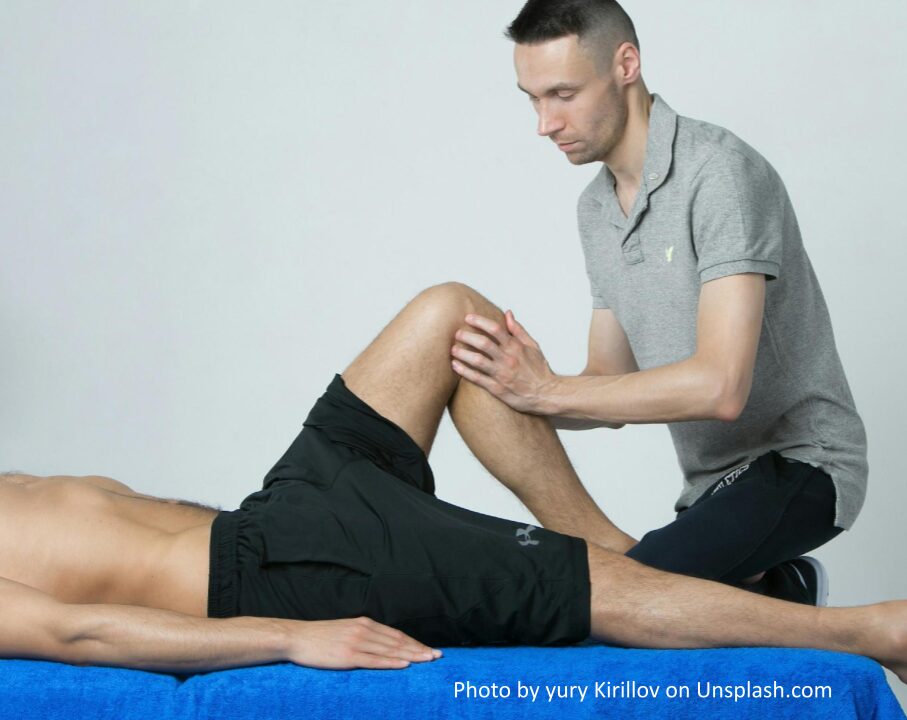
I’m gonna start in a different way by letting this be the announcement where I tell you that I’m getting a new knee, that’s my Christmas present to myself.
After Christmas, I’ll get a new knee, and I’ll be gone the month of January. You’ll have other people filling in for me, but I actually bring that up because I think it applies to these scriptures. There is nothing like physical therapy to burst your illusion that you are in good shape,
I actually think that’s what these scriptures are meant to do. They are to burst our illusion that we are spiritually mature. They’re a reminder that we all have growth and the ability to grow if we’re just pushed a little bit. That’s the position that I wanna take from these scriptures.
The first one was Romans 15:4-6, and I read this with the John the Baptist piece from Matthew 3:1-12. And I’m not sure how these pieces fit together.
I thought the Romans text was really affirming and uplifting until I looked at it again, and it is still affirming and uplifting, but I broke it down. It talks about what God wants. The combination of his steady constant calling and the warm personal counsel in scripture to come to characterize us. Do you notice something about what that says? I mean, it is uplifting and affirming. It’s also future tense. It’s not now. So it’s not describing the people as they are.
It’s describing how the people can become, just like I can become stronger and ready for my surgery, we can become more mature in our faith. We can stretch and grow ourselves into a closer relationship with Jesus, God, the Spirit, or whatever word you wanna use. Even this Roman scripture, although I think I hear it in a better light, it’s still pushing us. Maybe it’s a gentle push.
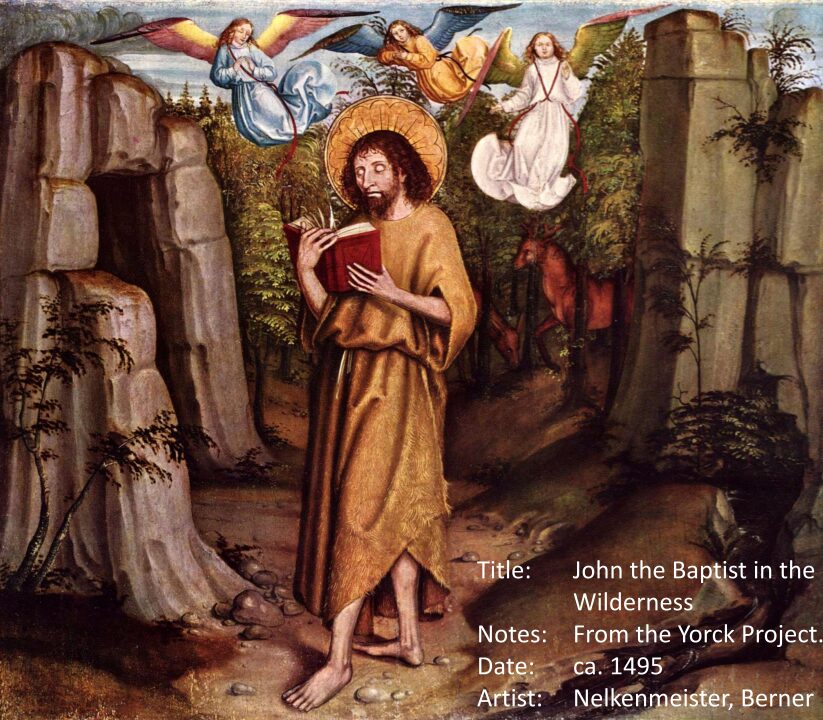
Then we have this scripture from John the Baptist. I’m going to do part of a deep dive with you, and hopefully I don’t go too far down this well, and we don’t lose anybody in the process. But, I have struggled, not with the whole scripture, I’m fine with the character of John the Baptist. It’s a story we read about on the second Sunday of Advent every year. I don’t have an issue with who he is or what he does, but when he starts calling people brood of vipers and talking about cutting down trees and unquenchable fire, well, you know, that just makes me uncomfortable.
I figured I had to make peace with this scripture. I had to wrestle with it because that’s the thing about scripture. The scripture that makes us uncomfortable is probably the scripture we need to spend more time with because there’s something there that we didn’t see the first time, and what I’ve learned is that this is so full of symbolism.
It starts with the words “in those days.” Why that is important is because that’s what the prophets, Jeremiah and Joel, used to use in those days. It’s a reminder of the prophets. Then, in the days of the prophets, the people were not following God the way they were meant to. The role of the prophet is to bring the people back to God. So right away, we hear that John is gonna be a type of prophet. He’s gonna try to bring the people back into a relationship with God. Then we hear that it happens in the wilderness.
Do you remember the wilderness? Do you remember what happened in the wilderness? People are uncomfortable. We don’t like the wilderness. We don’t wanna go there because the wilderness invites us to grow. Because in the wilderness, that’s where God meets us. Not always in the ways that we expect, but in ways that ultimately help us, and even as uncomfortable as the wilderness is, God provides in the wilderness. Remember God providing water and manna. God is there. God is close in the wilderness. When we are feeling most uncomfortable, God is closest to us.
Then we get John’s clothing. This is one of the only times that we get someone’s outfit described to us in this detail. We hear exactly what he’s wearing and exactly what he’s eating. That’s not normal, but it connects us. It connects John with another particular prophet, and that is Elijah. Elijah also wore the skin of a camel and had a belt around his waist. So that is a clue. All of this, these are things that we just read, and we go right past because we don’t have that Jewish perspective that the first listeners had. They hear this described about John, and they’re like, oh, that’s like Elijah. This is the new Elijah. Again, a prophet is coming to help the people, saying that the kingdom of heaven is coming near and that God is about to do something big.
Are we paying attention? Last week it was Stay awake, and are you watching? Are you looking at what’s happening around you? Are you watching for what God is doing?
I think that’s a good question for us today because some of us may feel like we’re in a bit of a wilderness, but that means God is closer, and what is God doing in this time?
Do you remember the Jordan River? Do you know what the significance of the Jordan River is? Well, that was the river that Joshua brought the people out of the desert and into the Promised Land. So when you cross the Jordan, you were to encounter the promised land.
There’s a new land coming. No, not literally. This is all symbolic. There’s a new time coming. There’s a new way of living that is coming, and we are being invited into it, and then we get to the brood of vipers because it’s there. As much as I would like to take it out, I can’t. But the brood of vipers is the Pharisees and Sadducees. Do you remember who they are? They’re the religious leaders. They’re the ones who are saying, “That’s not how we do church. We do church like this. We always do this, and you have to do it this way.” They took the laws of Moses, but they also created some rules for people to follow. There’s a temple tax, but they charged 10% more, because they wanted to be paid too. They knew better, but they took advantage of the people. That’s why they were a brood of vipers. Because they didn’t really encourage people into relationships with God. They were too busy minding the rules.
I’ve heard them in preaching class, called a park bench that if you need to get off the trail, you can sit down here for a minute. So, here’s your park bench. Last night after I put the Christmas tree up and put the lights on it. I sent my son a text and said, “How does it look?” He lives across the street, and he could see it. He said it looks great. I said, “But I broke the rule. I put white lights up, and then it didn’t have enough. So I put a string of colored lights with the white lights.” Crazy, right? That teenage thing in me, it’s still there. And you know what he said back to me, “Mom, there are no rules.” I almost said, are you an anarchist?
But does it matter? And that was the point with the Pharisees. The Pharisees were making up insignificant rules that actually caused harm to people. When they charge them more than what the temple tax was meant to be, then that caused suffering. They were not helping the people. They were hurting their own people, and that’s why they got called a brute of vipers because they knew better, but that’s not what they did.
Then we get into the acts, and at that very end, we hear about how Jesus is coming with his winnowing fork to separate the wheat from the chaff, and the wheat’s gonna go in the granary, and the chaff is gonna go in the unquenchable fire.
That is an illusion that Matthew likes a lot. He is dualistic. You’re either in, or you’re out, and there’s nothing in between. For him, it’s the same dualism that he uses in Matthew 25, where he says there’s gonna be sheep who will go into the kingdom, and there will be goats, and do you remember where the goats go? Uncle Fire. Do you see how things are coming together? When we look at scripture like that, it just puts it all in a different perspective, at least for me.
It helped me to get to the point with this scripture that I wasn’t angry at Matthew for writing it this way anymore. It’s this idea that God has come. We’re in this time where God has already done all these wonderful things, and God is also still working and something more, something different, something else. is still calling to us.
Are we paying attention? Are we paying attention to the edges of society? Are we paying attention to those who are struggling?
This month for our inclusive church, we are looking at the people for whom Christmas is not the same, because there are people who are struggling.
They may be grieving the loss of a loved one, but they may also be grieving the loss of an income, an identity, a relationship at home at Christmas in particular, more than any other time of the year.
You may love your Hallmark movies, and they have a place as long as we lift up the people who aren’t living in a Hallmark movie so they don’t feel pushed out or like they don’t belong. Coming home to the family at Christmas may not be a great reconciliation and forgiveness. That’s not true for everybody.
So how do we make room for everybody? How do we say it’s okay not to be all excited about the season and all of the parties and festivities that our culture really says you have to participate in, and if you’re not, what’s wrong with you? You didn’t put a tree up this year? Instead of making that sound like a judgment, can we say, “Oh, you didn’t. How are you? Do you wanna talk?”
Listening to what’s going on in people’s lives, that’s our Compassion Team, and we’re starting a new thing in January where we’re gonna have regular sessions that you can just come in, check in, and find out about what’s going on in other people’s lives, too. Not from the gossipy kind of place, but just to hold them in your prayers. That’s the idea.
So I think John’s point is that we can be on the wrong side of the issue. We can be thinking about whether you put all white or colored lights on the tree, or we can be thinking about how many parties are on your calendar and how busy you are this season. Or we can just step back and take some quiet time to watch and see what God’s up to this year, because God is moving.
We can be better than what we were yesterday. We can be a better version of ourselves. All of us can experience that Spiritual stretching that comes with a little spiritual therapy from John. Or maybe to use a symbol from our contemporary culture, a little Ebenezer Scrooge, right? We can all have a reminder of who we have been and who we can be, and all we have a chance to change.
So at this time, stay awake because being awake is the resistance against the empire. Because John was resisting the empire at that time. He was outside, not dealing with them up close, but reminding people that there is another way of living. Slowly, day by day, we can take our souls through the exhaustion, complicity, or disengagement, and allow ourselves to be stretched.
Watch what is happening, see more clearly, speak more truthfully, and tend to and welcome those who are being pushed aside, frightened, or taken away. This is who we are called to be.
On this second Sunday of Advent, we’re talking about waiting. I’m wondering, how well do you wait?
Think of the places and times you’ve had to wait. How good are you at that? At waiting in long lines? Waiting for news about a test? Waiting for something to happen? I know there’s quite a few young people among us who are waiting for a special day this month.
We all wait differently, but I think our ability to wait has a lot to do with how much patience we have. When I was thinking about patience, I realized that patience is directly correlated with peace. It’s very difficult to find peace if one is not patient. They go together.
One of the paradoxes of Christianity is that we believe Christ has been born and is the Messiah, and yet we don’t fully realize what that means.
Because we haven’t as a world found peace. We’re in this in between space. This paradox is actually the tension between Christianity and Judaism, because we say the Messiah has come. They say, if the Messiah had come, there would not be injustice anymore. There would not be hatred. There would be peace on earth. We have this tension there. What does this peace on earth look like? How do we make that come about?
One of the scriptures that is used this Sunday is about John and the Baptist. One of the pieces that he talks about with the messiah coming is that is that “Every valley shall be lifted up and every mountain and hill made low; the uneven ground shall become level and the rough places a plane” – Isaiah 40:4.
It’s this evening out that is supposed to happen with the messianic age. We don’t have that yet. We’re still on our way towards that.
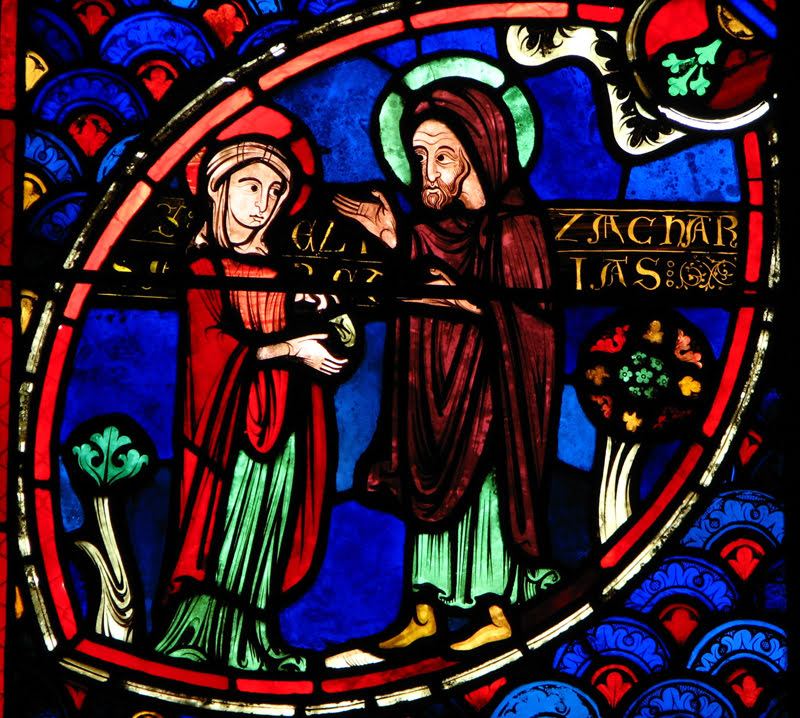
While we are in this time of waiting, let’s talk about Zachariah a little bit. I think Zachariah and Elizabeth can be a model for us on how it is to wait.
When I think about Zachariah and Elizabeth, for me, it brings up Abraham and Sarah, an older couple who thought that they were beyond childbearing, who suddenly are going to bear a child, because of what God is doing. God is in the midst of this. And he can’t even talk about it. He has to wait in silence, so to speak.
He is able to write, because I wondered about that. I thought, well, can’t he just write this all down? It appears that he doesn’t write anything down until John is born. He writes down his name will be John and then his speech is returned.
But can you imagine having that kind of wonderful news? Maybe a little scary too, right? Could be a little fear in there. Some of us in here are beyond childbearing years. How about if somebody told you you were going to have a child? I enjoy having that grandson that I love to death and then I give him back to his mother.
That’s where they were. They were in this expectancy. Imagine it. This almost but not yet. The paradox.
Then we have Romans 12:18-27. ‘Let love be genuine; hate what is evil; hold fast to what is good; 10 love one another with mutual affection; outdo one another in showing honor. 11 Do not lag in zeal; be ardent in spirit; serve the Lord. 12 Rejoice in hope; be patient in affliction; persevere in prayer. 13 Contribute to the needs of the saints; pursue hospitality to strangers. 14 Bless those who persecute you; bless and do not curse them. 15 Rejoice with those who rejoice; weep with those who weep. 16 Live in harmony with one another; do not be arrogant, but associate with the lowly; do not claim to be wiser than you are. 17 Do not repay anyone evil for evil, but take thought for what is noble in the sight of all. 18 If it is possible, so far as it depends on you, live peaceably with all.”
It’s so important that I would challenge you to read it every single day this week. Just keep reading it every day because it is the heart of Christianity. It’s about focusing on love and how can we love others in a better way.
How do we do that? It starts with let love be genuine. It’s not about putting on a mask and being kind. It’s about really being kind, wanting to do that from your heart and reminding yourself each day, what that’s about.
The part we didn’t read the next verse, Romans 12:19, goes into “vengeance is mine, I will repay, says the Lord.” God will take care of all the other stuff. Our role is to love others, to not get caught up in our stuff, so that we can see the needs of others.
The words we used in raising our children were helpful, thoughtful, and kind. That was their goal. Every day you needed to be helpful, thoughtful, and kind. If we just took that to heart, we would be closer. But I want to encourage you to sit with that.
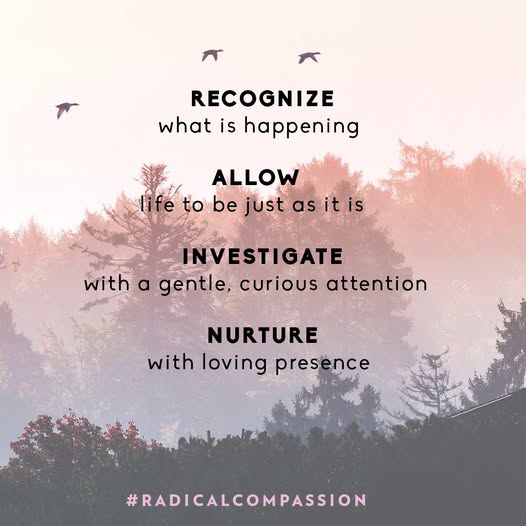
I know that right now life is difficult. There’s a lot of us that are grieving for many different reasons that life just feels overwhelming. So, I want to share with you this meditation practice. It’s called RAIN.
RAIN is an acronym and it was created by Tara Brock. These are the four steps.
Recognize: What’s going on? Recognize the situation and how you are reacting to it. Recognize, look at your feelings. When something happens, notice your body. Are you clenching up? Do you feel all jittery? What’s happening? Just notice it because in noticing it, it gives you some space to then allow it.
Allow: This is the let it be and let God by allowing it, noticing it and allowing it. We give room for the spirit and the spirit has space and time to work with us. There’s another phrase that says, what we resist persists. So don’t resist it.
Investigate: Be curious, go for it. That will take you from a place of maybe anger or frustration. Be curious, go into that wonder. What’s this about? Why am I feeling like this? What’s going on here?
Nurture: Be kind to yourself too. Give yourself grace. Forgive yourself. Allow God to speak to your heart. Listen to your heart. Because that divine, I often talk about the little bit of the divine that is in each of us. We can learn to hear it. When we practice listening to it. Let’s practice that. Let’s work on those muscles.
When I was preparing last week’s sermon, there was a lot about the muscle of hope. Well, I think there’s a muscle here too, because we only experience peace when we practice peace. We will only find it elsewhere when we have it first within us. If we go looking for peace outside of us. We’re not going to find it.
It has to start here.
So I encourage you to think about that this week. Pay attention to how you’re feeling in the different situations. Allow God and the spirit within you to take care of you so that you can be there for others.
This is our week to begin this period of waiting and watching.
This period is where we look for what new thing is God doing in this world. How is God breaking into our world today? What hope, peace, love, and joy is God bringing?
The thing I was sitting with was this idea of what are we longing for right now? And as I was writing this sermon, my dog came up and pestered me. I thought, I know what she wants. She wants fewer people. It’s been a busy week. She wants fewer people in the house, fewer dogs in the house, and a little bit less noise. Let’s go back to normal, right? Let’s have that normal life again, that simpler life.
But the reality of normal is that we’re using those rose-colored glasses. What we think is normal is more of a dream that probably never existed anyway. We paint everything and smooth out all the edges so that we only remember the good parts and forget all the hard parts. But life is hard. That’s a reality.
We need to remember that the point of coming together is so that we support one another in all of the hard stuff. It can be nice to support one another in the fun stuff and the good stuff. We all like that. But we need one another in the hard stuff and when life gets real.
So, I was thinking about, based on our vision and mission, what are we longing for?
What came to me was compassionate care for creation. Our scripture today (Luke 2:1-3 & Romans 8:18-25) is about creation, and we’re looking to give that compassionate care and to share that with one another, with the world, and with our community.
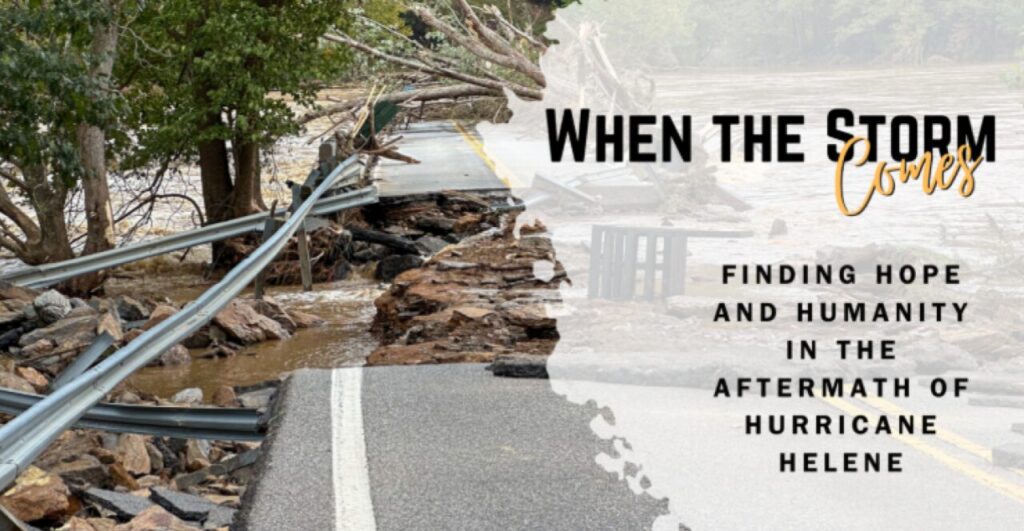
To try to be there for one another. What does that look like? Well, back in early November, I read this article by Guy Sayles, who is a pastor in Western North Carolina. He wrote about the experience of Hurricane Helene, where the mountains of North Carolina never experienced anything like that before.
What he talked about first was a quote from Mr. Rogers that Mr. Roger’s mother always told him when things were going wrong, “Look for the helpers. There are always helpers.”
Who are the helpers and what are they doing? He started looking around at what was happening in his community, which was devastated. Hurricane Helene was a leveler or an equalizer of sorts. I don’t mean that in a good way. But, it brought the helpers. It brought the religious and the other non-profit volunteers to help. It brought FEMA and the Army Corps of Engineers. It brought the North Carolina National Guard and the state and local agencies.
But more than that. It brought neighbors out to help one another. A woman who had rain barrels started tapping off the water so that people had water to flush their toilets. Another neighbor who had a generator put it in their driveway and set it up as a charging station so everybody could come and charge their phones or other devices. Neighbors who had freezers that no longer had electricity started handing out the food because it was going to thaw and go bad.
Guy said people would sit around the generator as their devices were charging and they got to know one another. They learned to trust one another. They became a community. They gave each other hope in the middle of this disaster. They were there for each other. That’s where our hope can come from.
So today we have this letter from Paul.
If you are a regular attendee, you know that I struggle with Paul because he has this circular logic that he uses and you can get very confused. But before I get to that, I do want to talk about the fact that this is Paul’s letter to the Christians in Rome. I usually say to the churches in Rome, and I’m afraid that I might be misrepresenting that to you. They didn’t have cathedrals and the Vatican didn’t exist, this was before that.
At the time of Paul’s letters people were gathered in homes and they were of all ages and all economic groups. They were the merchants, the slaves, and even the destitute. They all came together, just like in Acts. They talk about everyone came together and shared as there was need. Kind of like that story about the hurricane. Same idea. These communities would come together and the message of Jesus’s love, the available salvation, and this equalizing love. Everybody was included. It was this inclusiveness that attracted the people and the reason Christianity grew.
So to them, Paul is saying the difficult times of pain throughout the world are simply birth pangs. Some of us know what it’s like to be pregnant. It’s uncomfortable and it’s challenging, but it’s not only around us, it’s within us. I think right now, when I look at the world and I look at us, we want something new. We want something new to come out. We want more justice for people. Not less. We want more inclusivity. We want more freedom, not less. We want more liberty, not less.
Imagine a pregnant person, how we get larger. We, of course, don’t see what is enlarging us, but that is our hope. That is this thing that God is building among us. But, the longer we wait, the larger we become and the more joyful our expectancy. So something is coming. A real justice with peace that we don’t know what that looks like yet.
But it’s going to be hard to get there. It’s going to involve pain and it’s going to mean that we have to come together and work together to survive it.
As I was walking the dogs yesterday morning, another dog walker had lost his gentle leader.
So this morning I brought him a gentle leader and handed it to him. He said I feel like other dog owners are supporting me. And I said, well, isn’t that what we’re supposed to do? That’s being community. I have something that I no longer need and you need it. Why would I not give it to you? I don’t need anything. You don’t need to buy it from me. I can just give it to you.
Our materialistic consumeristic culture starts to program us where we think that we have to pay for everything and we think that if we own it then it’s worth something and we ought to get something for it. Maybe we can just share this idea of justice.
So do we really long for a better world? Do we really want to figure out more of what this hope that’s coming is about?
Advent is a reflective season where we’re called to think. It’s not by chance that this hits in December as the trees have now let go of their leaves. They’re going into this dormant time. The nights are getting longer. We’re to rest more and take more time to slow down.
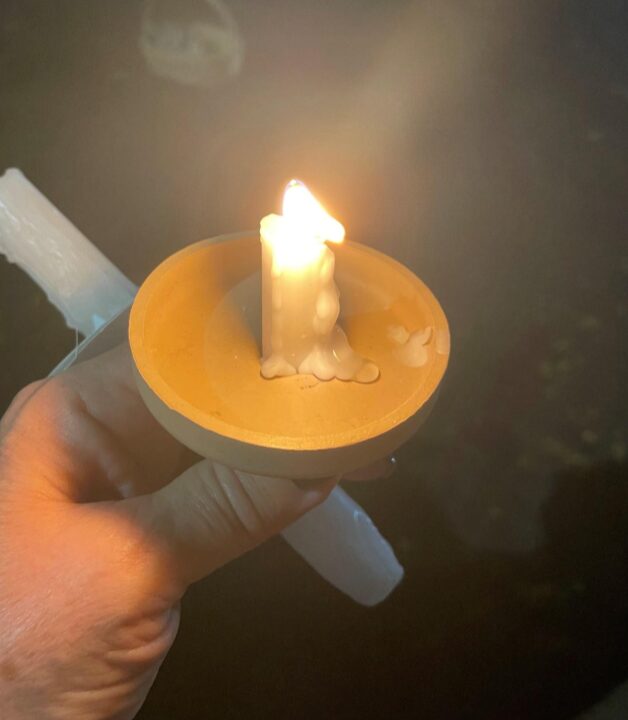
And what do we do instead? Fill everything with lights, loud music, and bright colors as we try to ward off the darkness. But if we can accept some of the darkness, we can light a candle. We don’t have to be in the pitch dark, but if we can take the time to stop and to give thanks to God, then to think, to reflect on our days.
Where was I merciful? Where was I loving and where did I fail? Because we all have those moments that aren’t our best.
It’s good for us to think about these and then to listen to our hearts because that’s where the still small voice of God is speaking. That’s where Christ meets us, in the quiet and the listening.
Can we give ourselves some time to do that? To listen deeply for what Christ is calling us to hope and long for. Then watch and wait with patience.