Yesterday morning, our Compassion Team met so that we could talk about how we could be more helpful to you as a congregation.
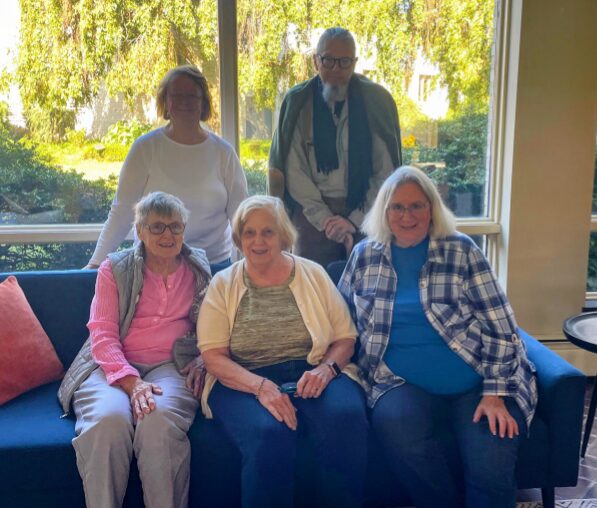
We realize that one of the hurdles for you is in trusting us with your stories. Confidentiality is something that this group takes seriously. You may look at these people and think, ‘these people talk to people.” Yes, we do talk to people, but we do not share your story with people. Your story is only for you to share. And yes, I’m saying that, but I know that that’s how the group feels also, and we do have some other ideas that we are praying about that may be helpful to you.
I think that another piece of this is that we as people do not like to allow our needs to be known. We have prided ourselves on being self-dependent, self-reliant, and figuring out things for ourselves. I don’t need any help, but the reality of life is that it is too hard. Things happen that make us realize that we need one another to comfort each other and to hold us accountable to being the people that God has created us to be. That’s the beauty of the community.
That’s where the Compassion team can be a help to you. To both comfort and to hold you accountable. If that’s what you need and if that’s what you want, because we are to forgive.
We talk about forgiveness a lot. That was in today’s scripture, Colossians 3:12-17, but we are not so good at it.
Even though we talk about it, we talk a good game, but we’ve got a lot to practice. As a survivor of abuse, forgiving is not about removing any type of accountability. That is not what forgiving is. Forgiving is letting go of the anger and the hurt, which, as long as we hold that, that person continues to control us. But when we can let go of that, then we are truly free. That’s where we find peace.
That scripture lesson from Paul today reminds us of the important things in life: compassion, kindness, humility, meekness, and patience. It almost reads like the spiritual gifts that align with Galatians. These are the traits of a Christian. This is who we are to be.
And that phrase “bear with one another” – Colossians 3:13, that means when we don’t agree, we don’t attack each other. We continue to stay in the conversation. We bear with one another, and if one has a complaint against another. We forgive. This is what it means to choose life rather than death.
In our other scripture today, Luke 17:11-19, we read of the 10 lepers.
I know I have heard many sermons on and I have preached many sermons on this, and this time I was surprised. I love it when I get surprised in reading a scripture because I had missed something that I saw this time, and that is that the one who came back.
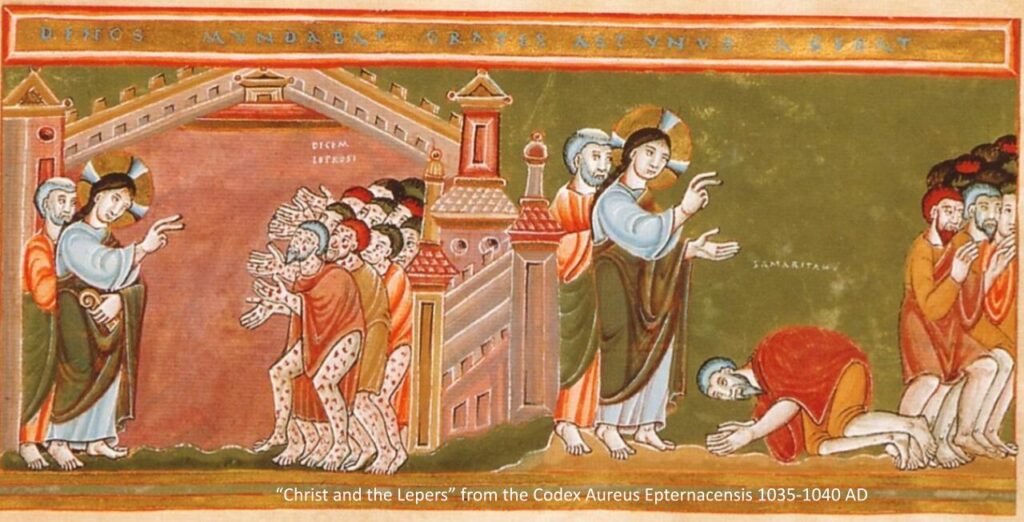
The first side of this piece of art is them calling to Jesus. The second side is after he has sent them to the priest. You see, most of them are walking away, but one comes back and is on the ground kneeling in front of Jesus, and above it it says Samaritan. And I’ve overlooked that detail in the past.
We’ve always praised the one who came back because he was grateful. But there’s more to it than that. There’s more to that story. Because he was a Samaritan. Jesus told them to go to the priests and, that would be the end; they would be announced as clean so that they could rejoin the community.
He couldn’t go to the priests because he wasn’t welcomed by the priests in the temple. They don’t consider him Jewish, even though by ancestry he was, you see, the Samaritans were in the northern Kingdom of Israel. And when the Babylonians came in, and probably when the Assyrians came in too, when they took away the leaders from Jerusalem, they didn’t take them. They left them and they mixed with the invaders. So they weren’t considered Jewish anymore. They didn’t worship in Jerusalem. They worshiped at Mount Hob, and so they were considered less than. Maybe a contemporary context for our political situation is almost like being an undocumented immigrant in the US right now. Or a Palestinian in Israel. They were not welcome. They were considered other. They were considered an enemy.
So as long as he had his skin disease, which separated him from his people. He had to leave Samaria, and he found this group of other people with the same disease, and so he found community, but when he was healed, he lost his community.
So, where’s the priest that he went to? Show that he was healed. Jesus was the priest who could show himself and be proclaimed clean because Jesus welcomed him. Jesus received him not as a foreigner, not as an outcast, not as an enemy, but as one to welcome. To bring into the kingdom of God. That is not to minimize his gratitude; that is to put context around his gratitude.
But I know that I never looked at it that way. I never saw him as truly a Samaritan with few options looking for community, and we don’t know what happened after this. He may have stayed with Jesus and the disciples from then on out. We don’t know. More people traveled with Jesus than just the disciples.
We are reminded that Jesus wants us to be his hands and feet in this world, and to be the ones who welcome and accept people as they are, and help them have a relationship with Jesus. That’s who we’re called to be.
So today we have communion, and when we come to this table, we come because we’re hoping to meet Christ here. After all, I encounter Christ in the sacrament, in the ritual, in the bread, and in the cup. I hope that you find Christ who is the host of this table, in the bread, placed in your hand, in the cup offered to you, in the eyes of our servers, in the music that will be played, and in the faces of each other. Christ is here. May we see it and be healed?
This week, I was reminded that this year is the 40th anniversary of the We Are the World Campaign. At a time when it feels like we are isolating ourselves from the rest of the world. I’m struck by the way we came together, led by 40 incredible musicians with 40 incredible egos that probably would not have even fit in this room, but they managed to be in a small recording studio from midnight till 7 AM. To do their part, to raise money for starving people in Africa.
And these are the words, “We are the world. We are the children. We are the ones who make a brighter day. So let’s start giving. There’s a choice we are making. We are saving our own lives. It’s true. We’ll make a better day. Just you and me” – We Are the World by U.S.A for Africa (1985).
It wasn’t about saving them. It’s the same concept that I said last week. What hurts you, hurts me. And what blesses me, blesses you. Let us learn to be in the world with compassion and to be in the world with forgiveness.
May it be so. Amen.
Like this Sermon? Click Here to View More in this Series
Prefer to Listen to this Sermon? Click Here to Listen to our Being Apostles Podcast

