

Before we get into the three conversations that make up today’s reading, I want to say a bit more about John’s gospel and the location of today’s scripture, John 11:4-37.
Last week, I talked about the “signs” or miracles John uses to prove his point that Jesus is the Messiah, the Son of God, Savior of the world. And this chapter contains another “sign” – The resuscitation of Lazarus.
I recently read the argument for calling it a resuscitation rather than a resurrection because Lazarus is going to die again. He did not have a resurrection as Jesus did, nor does he ascend to heaven.
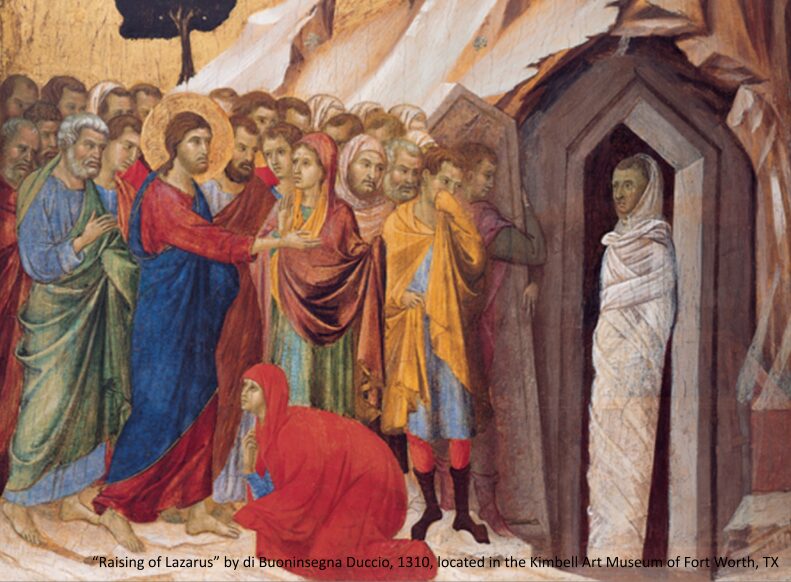
In this scripture, we also have the fifth of the seven “I am” statements of Jesus, “I am the resurrection and the life.” – John 11:25. Interestingly, the 11th chapter is the middle of John’s gospel, and is a literary hinge designed to shift our perspective from seeing “signs”. To see “God’s glory so the Son of God may be glorified.”
This story is so empowering for believers because Martha and Mary tell Jesus with their words and actions what they are thinking. They both believe in Jesus – Martha confesses, “Yes, Lord, I believe that you are the Messiah, the Son of God, the one coming into the world.” But Jesus also experiences their pain and grief.
So when life doesn’t go the way we want or the way we have prayed for it to go, we can stand in the assurance that we can also tell God what we think. We can name our pain – our disappointment – our anger and know that Christ will be moved by it. That does not say that we will have our prayer answered – Because we cannot know or understand all the ways of God – But God is listening and will join us in whatever we are feeling.
We, like the sisters, want to avoid uncomfortable outcomes. And in our grief, we are invited to “let go” To let go of our expectations, to let go of our need for control, to let go and accept what is. Like Jesus, we can “feel all the feels” and express them – No matter who we are – this is what makes us human.
As we celebrate the work of women in our congregation, I want to highlight today Nora Beck Smith, whose story connects with the conversations and hard questions raised by today’s scripture.

Underlying Nora’s story and her call was a yearning from within and important questions about who she was and what she was meant to do. Being a member of St. John’s and then Church of the Apostles, she brought her questions to Rev. Glenn Rader, who was honest enough to admit that he didn’t have the answers to her questions. But he took her to Lancaster Theological Seminar, where she could explore her questions in a safe and nurturing environment.
A Jesuit priest taught Christian history during her time and invited them to see themselves in the stories of scripture and to creatively write about their experiences. This helped her to develop her questions and deepen her faith.
Nora was the first minister to join Rev. Schellenberger & Rev. Rader with this congregation, and we give thanks for her curiosity and call, which she shared with us.
As we are one week from Holy Week, there are a three take-aways that I want you to have today.
The first is that John’s gospel is favorable towards women. In this gospel, women are more than just important characters; their words have been preserved. This Jesus engages women in conversations without demeaning them. In this gospel, it is a woman – Martha in our scripture today – who declares who Jesus is, rather than Peter, who does it in the other gospels.
It will also be a woman, Mary Magdalene, who is the first witness to see the risen Christ. For women’s history month, this is worth noting.
Also, as we will be reading John’s gospel through Holy Week, I want to make sure that when you hear the words “the Jews,” you realize it is often referring to the religious leaders. All the characters of John’s gospel are Jewish – The Samaritans are not considered Jewish because they don’t look to Jerusalem as their holy site. But all the others are.
I say this because this can be read as the most anti-Semitic gospel, and that is not helpful or accurate. So as you read the scriptures, I want you to be sensitive to this. Our Jewish brothers and sisters are very scared right now. I will also name those of the Jewish people that I know support the state of Israel, but not the policies and wars of Netanyahu.
Rather, Jesus models and teaches us to care for those around us- whether they are family or strangers. Caring means empathizing with their stories and wanting the best for them. We are to be creating a world based on mutual care and compassion, not about who has the biggest weapons, biggest egos, and forces others to submit to promote their way of living.
In John’s gospel, Jesus says that he came that we may have life and have it abundantly – John 10:10. Let us work towards an abundant life for all!
May it be so. Amen.
Like this Sermon? Click Here to View More in this Series
Prefer to Listen to this Sermon? Click Here to Listen to the Being Apostles Podcast

