
I want you to take a look at this picture and think about what you see. How do you interpret this picture?

What you see and what you feel when you look at this picture is based on your perspective. When you look at these children, do you think that they need anything? Do these children have what they need? Do we need to do anything for these children? Think about what perceptions you have just based on that picture.
You might see children who don’t have a lot and who live in a house that hasn’t been painted lately. We don’t know how well fed they are. They’re all huddled up, so you can’t tell, but they look like they’re thin. They don’t look like they’re overeating.
But if you look carefully at their faces, which are harder to see, they’re actually all smiling, and the dogs look very relaxed beside them. I would actually say that these kids don’t need anything. They’ve got what they need. They have each other, and they have comfort.
I saw another picture this week that I won’t show you, but it was of a person on the street holding a sign. A person on the street with a sign, and this is what the sign said, “Homeless but Hopeful. Broke, not Broken. Everything helps.” That picture was in an email from Cameron Trimble, who’s another UCC pastor that I appreciate and follow. She added these two questions, which are the ones we need to focus on because they are profound for this moment in time in which we’re living. Can we meet this moment with kindness, creativity, and fierce love without pretending that we’re above all the mess of it? Can we stay grounded in the humility that we are not saviors, even as we long to heal what’s breaking?
That’s big. We see things breaking. Things are being broken, and that can be a good thing because if something’s broken, then we have to fix it, and we can do so in a better way. In a more loving way, in a more just way, and in a way that brings more peace in the world. That might be hard to hear, but just sit with it.
The scripture today is Deuteronomy 35:15-20, and it’s Moses talking to the people.
This is a scripture that I love, but this scripture is also problematic. So, let’s take it apart. I don’t want anybody to leave this sanctuary without knowing. Moses did not write this. There’s a stream of thought out there that says Moses wrote it, but Moses did not write it. It includes his death and burial. He couldn’t have written it. Nobody has written about their own funeral yet. Not from an after perspective. We haven’t figured that one out yet.

This scripture is the basis for the prosperity gospel. The idea that if you love the Lord your God with all your heart, soul, mind, and strength, you follow all the laws, you do everything right in your life, then your life will be good. You will have good health and riches, and all the possessions you desire; you’ll have it all.
But if anything in your life goes wrong, that’s because you are not living right. I was raised on that kind of theology, and I will even tell you, I’ve looked at my own life and said, “I wasn’t living right. I needed to get back on track.” There’s some internal stuff with that, but it’s not a God thing.
You know why? Because there’s truth to the statement. Bad things happen to good people. And when that happens, we don’t know what to do. If you are of the Prosperity Gospel, you don’t know what to do with that. What we’ve done, churches, clergy, and congregations have looked at people who are broken or have terrible health issues, and they’ve told them it’s their fault. That’s where we’ve been wrong so many times. Life happens. Accidents happen. Disease happens. It’s not because you’re not following God, nor is it because you’re not faithful enough. We need to feel that in our bodies. We need to know the truth of that.
Now, here’s the good part of this scripture, because I really do love this scripture. This reminds us that God is a covenant maker and a covenant keeper. God made covenants from the very beginning with Abram and God kept those covenants. That did not mean that anybody had an easy life, but it did mean that God was there with them through it. That’s the difference. That’s where the good news is. God, through Moses, lays this out.
What is your choice? Curses and death or blessings in life. The choice is yours. It’s called free will from the beginning because some things are our choice.
What came back to me in my head was a car accident I had years ago, and you know what? It was my fault. I forgot. I was so focused on the traffic coming one way. I forgot to look the other way, and I was close to a light, and I pulled out right into somebody. That was something I could have avoided. That was on me. That’s not on God. That was on me, but God was with me in that moment.
I felt alone. I thought I could have crawled into a hole and covered myself, but God was with me then, just as God was with the people in the car that I hit. We choose blessing or curse.
I’m using this book as the basis for this series, and it’s called Leading Causes of Life. A long, long time ago, I did a series on this, probably longer than you remember, and I knew that I had the book. I don’t know what I said the first time around. This time around, they challenge us. Saying for every issue, there’s a way to look at it as a curse, and there’s a way to look at it as a blessing, and part of what God wants us to do is look more at our blessings than our curses.
So the first issue I put up there is aging. So what are the curses of aging? Yes. I only had room for one, or you wouldn’t have been able to read them. So I put dependency because that’s what I hear. People don’t want to lose their independence. That feels like the curse of aging. But there’s a blessing of aging, and I feel like I’m old enough that I can start claiming some of it. I’m not the same person. I will never pull out without looking the other way again.
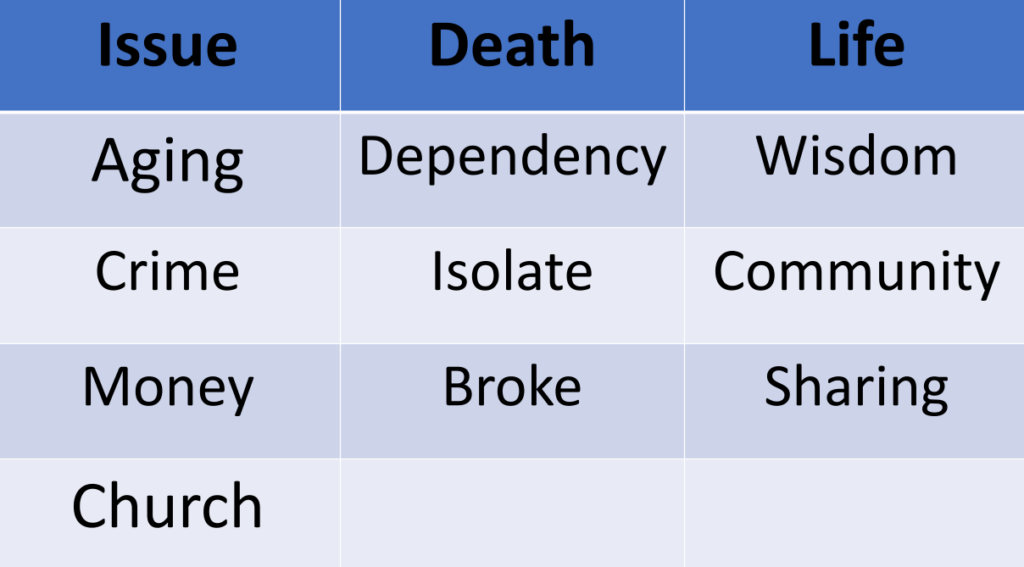
I think Crime keeps coming up a lot in the news cycle. The curse of hearing about all the crime in our country is that we wanna isolate, we wanna pull back, when actually the answer to crime is developing community. The places that have lower crime rates have a good sense of community. They have police presence where people know the police, they trust the police, and they know each other.
I remember the day I got a call from my neighbor who said, I just watched a pair of legs go into your house. And I freaked, but my neighbor called me and went and knocked on the door, which made those legs go back out, and I called the police. I wasn’t home, but they saw an opportunity and they took it. They came in through the window. I’ll never open that window again. We learn.
How do we look at money? Do we look at money and say, “We don’t have enough, we’re broke.” Or do we say, “I don’t have a lot, but what I have I can share because it builds community.”
Then I left the last one for you to sit with. If we look at the church from the perspective of death, from all the wrong things, I’m thinking you have a list, but what are the things that are right? What are the blessings the church has, and I’m gonna let you sit with that one. I’m not answering that one. You need to figure that one out.
The other scripture for today was John 6:35-40, where Jesus tells us that he is the bread of life. He is where life comes from.
I’ve been challenging us to think about the world that we are creating because we are creating the world now that our children, grandchildren, and great-grandchildren are going to live in.
So, what do we want that world to be about? What do we want this country to be in the future? This is the time to figure that out because through the choices we make, the energy that we put out into this world, and the environments that we create, affect what this world will become. And I believe that in our country, no one should go hungry, no one should be uneducated, no one should be afraid to be in their own house, which means they have a place to live, and no one should be without access to quality medical care.
How will we move forward in this time? Well, to help us, we have the wisdom, the comfort, and the strength of Jesus, who taught us how to care for other people. This table is Jesus’s table. It’s not my table. It’s not the Church of the Apostles table. This is Jesus’s table, and for Jesus’s table, everyone is welcome. In fact, he reminded the rich that they needed to wait until the people who were struggling, who were at work, who were trying to pay the bills, got to eat first. Because the rich people had plenty of food at their house. They didn’t need to come in and eat all the food at Jesus table, there are no limitations or restrictions on God’s love and mercy.
A broken heart, which is what I believe Jesus’ was, is also open to more possibilities. It can hold more. When our hearts are broken, we can open to love more. We are invited here to meet our savior, the only savior to know that we are still within the covenant, and we have covenanted together to be Christ’s body in this world.
God is here. All we have to do is have the love that I talked about last week, the agape love, the love that has concern for all. No exceptions. That’s who we’re called to be.
May it be so. Amen.
Like this Sermon? Click Here to View More in this Series
Prefer to Listen to this Sermon? Click Here to Listen to our Being Apostles Podcast

