Starting May 24th: We are worshiping at 10 AM in the Bachman Center during our Sanctuary renovations.

Inclusive Refuge

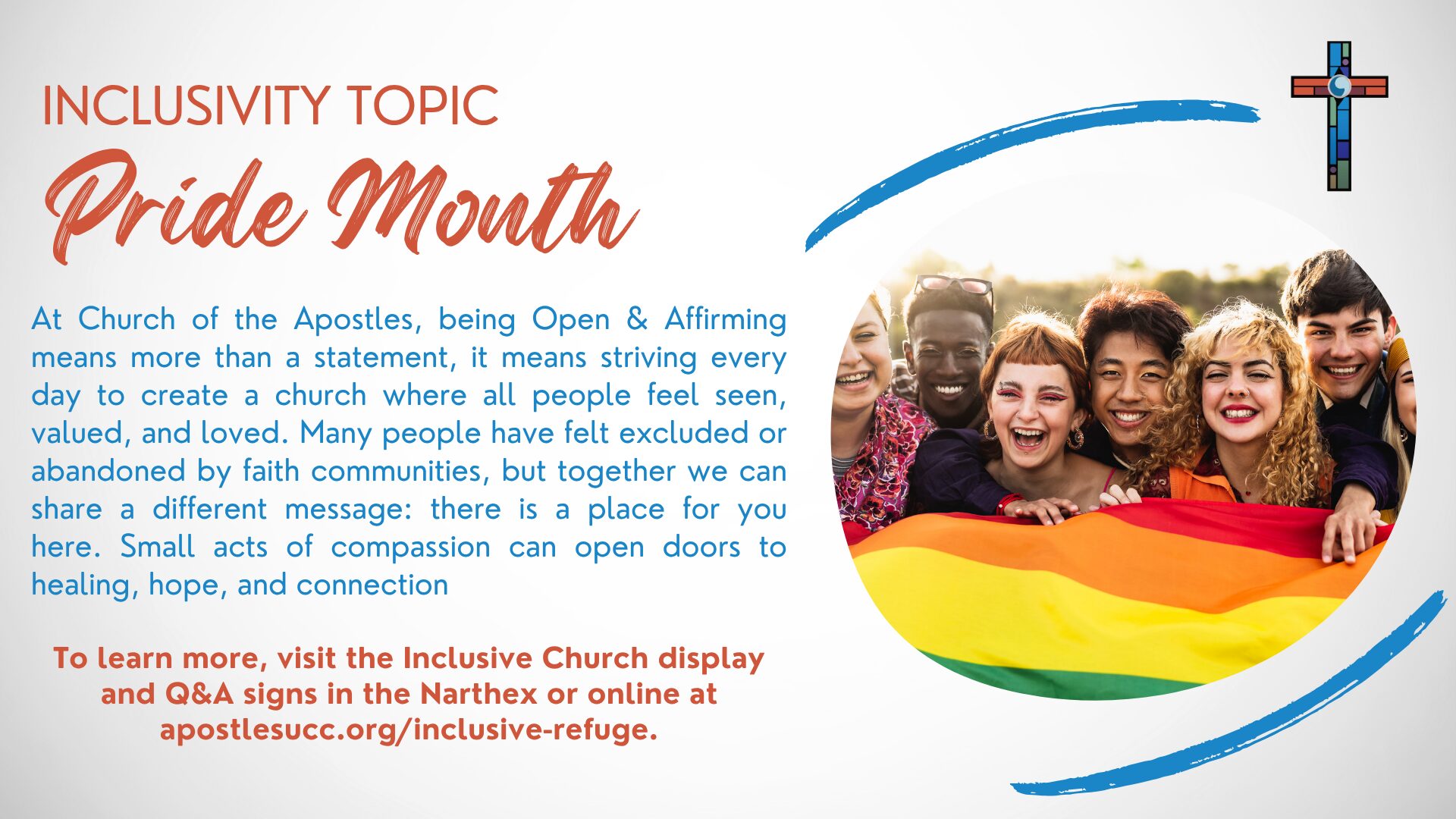
June 2026 Inclusive Church Topic – PRIDE Month

I’d like to share the story of one of my family members. He knew at the age of eight that he was “different.” Living in a conservative coal-mining region of the state, he hid his true self into his early 20s, terrified that he would be found out. On the outside, he was successful: good grades, lots of friends, Senior Class President, and an athlete. He dated girls to keep up appearances.

After college, he began working with troubled youth. In those days, as he puts it, “Queers should never work with youth.” Feeling even more pressure to keep his sexuality a secret, he fell into a deep depression. He sought help from a therapist and from his parish priest. The therapist was somewhat helpful, but his priest told him that he would go to Hell if he became a practicing homosexual.

Aunt Letty, a woman of deep faith and a devout Catholic, saw he was struggling even though he never shared his secret with her. She told him that God never makes a mistake and because of that, he had great purpose in life and that he was to be who he was meant to be. He immediately felt a sense of hope and lightness come over him. The very next day, he met the man who would become his husband, and he gradually came out to his family and friends.*

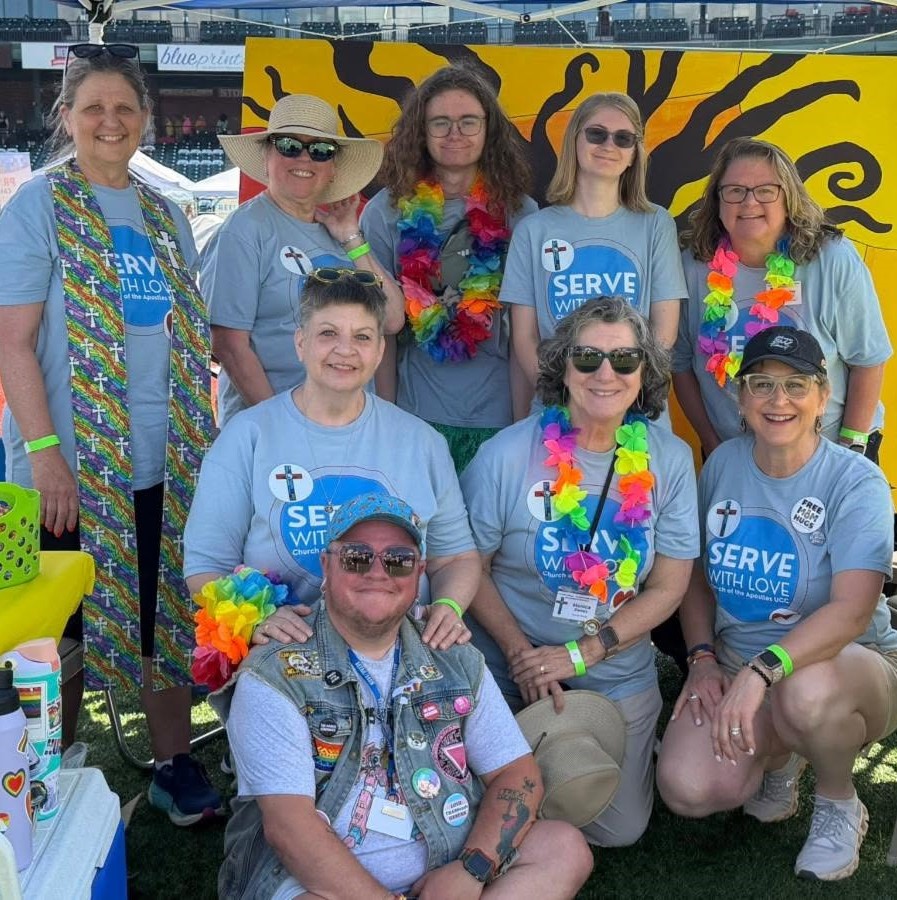
Many of our LGBTQ+ sisters and brothers have been deeply hurt by the Church. We have members who will be attending Lititz Pride and Lancaster Pride to share Letty’s message:

For it was you who formed my inward parts; You knit me together in my mother’s womb. I praise you, for I am fearfully and wonderfully made. – Psalm 139:13-14

May all of us feel that sense of hope and lightness knowing that God loves us completely.
Cathy Kenlin  and the Inclusive Church Team

May 2026 Inclusive Church Topic – Invisible Disabilities

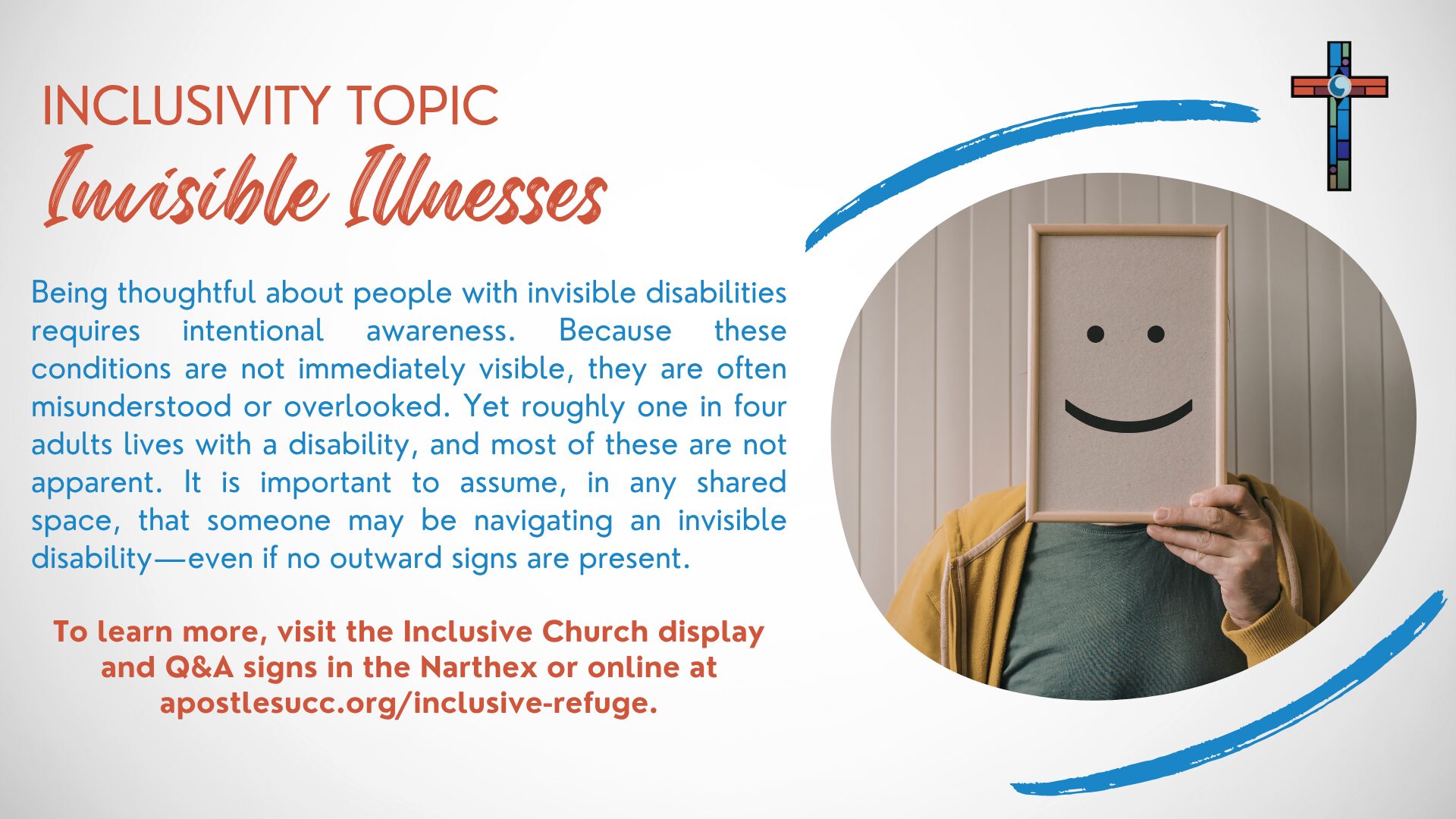
Being thoughtful about people with invisible disabilities requires intentional awareness. Because these conditions are not immediately visible, they are often misunderstood or overlooked. Yet roughly one in four adults lives with a disability, and most of these are not apparent. It is important to assume, in any shared space, that someone may be navigating an invisible disability—even if no outward signs are present.

Invisible disabilities vary widely, including chronic pain, autoimmune conditions, neurological and cardiac conditions, neurodivergence, mental health conditions, and sensory impairments. Many fluctuate, making it difficult for individuals to predict their capacity or commit consistently.

Because disclosure is personal, individuals should not be expected to explain their needs to everyone. Instead, we should normalize supportive environments. Flexibility and empathy matter: offer options when possible, normalize changing plans, and avoid assumptions about what others can or cannot do.

Practical planning can reduce barriers. Share agendas or expectations in advance so people can prepare. Offer hybrid or remote participation options when possible. Build in breaks and allow people to step away without drawing attention. Use clear, accessible communication—both spoken and written—and avoid relying solely on one format. Be mindful of lighting, noise, and strong scents, which can trigger symptoms for some individuals. When planning events, include accessible, comfortable seating; easy exits; and a variety of foods to accommodate allergies.

Equally important is cultivating trust. Believe people when they share their experiences; respect boundaries; and create simple, private ways to request accommodations.

Small, consistent actions make spaces more accessible—and more humane—for everyone.

From  the Inclusive Church Team

April 2026 Inclusive Church Topic – Antisemitism & Islamophobia

Another synagogue was physically attacked in March. The 2025 survey conducted by the American Jewish Center (AJC) indicates that 93% of American Jews feel that antisemitism is a problem in the US and 70% of the general public agree with that statement. Since the Hamas attack, 86% of American Jews and 63% of the general public believe that antisemitism has increased.

The Council on American Islamic Relations (CAIR) states that Islamophobia is at an all-time high in the US.  In 2024, CAIR registered the highest number of anti-Muslim complaints since it started publishing data in 1996. CAIR also noted that employment discrimination reached a new high, comprising 15.4% of all reported complaints. 

A large majority of American Jews report hearing one or more antisemitic comments online and/or in person.  21% felt physically threatened by those comments. In the AJC survey, 46% of the non-Jewish population said they saw one or more antisemitic comments either online or in person, but 76% of those people were silent and did not report it.

How can we, as followers of Jesus, help create a community that provides security to those who are not Christians? It can be hard for us to know what to say and how to say it when you face a situation like that. Spend some time now thinking about how you might react and how you might be an ally in that situation.
From the Inclusive Church Team

March 2026 Inclusive Church Topic – Women’s History Month

March’s Inclusive Church focus invites us to celebrate Women’s History Month and honor the countless ways women have shaped Church of the Apostles, our community, and our world. From clergy and lay leaders who have guided decisions, to those who taught our children, organized ministries, and offered care in quiet, faithful ways, women have long been a steady and creative force in the life of COA. We invite you to take time this month to explore the names of the women who have helped make COA what it is today, displayed in the Narthex.

February 2026 Inclusive Church Topic – Black History Month

February invites us into Black History Month, a time to reflect, listen, and grow together as a community committed to inclusion. This month, our Inclusive Church focus turns toward understanding the experiences of people of color, both within our congregation and in the wider community, and asking how awareness can help us become better bystanders, neighbors, and friends. What might it feel like to be a person of color in our community? What is seen, what is unseen, and what is carried quietly? These questions invite curiosity and humility rather than assumptions, reminding us that each person’s experience is shaped by their history and the spaces they move through each day.

January 2026 Inclusive Church Topic – ADHD

This month, our focus returns to neurodiversity, with particular attention to Attention-Deficit/Hyperactivity Disorder (ADHD). One way we live out our covenant is by growing in understanding of how different people experience worship, learning, and community life. ADHD can look different across ages and genders, and not all of its characteristics are immediately visible. For some individuals, staying engaged may involve movement or “fidgeting” such as using a small object, knitting, or holding a textured item during a service or conversation. Recognizing and welcoming these differences helps create a space where more people can fully participate and feel at ease.

December 2025 Inclusive Church Topic – Inclusivity During the Holidays

The holiday season can be a time of joy, but it can also bring unique challenges for many in our community. This month, our Inclusive Church Team is highlighting ways we can offer compassion, understanding, and support to those who may be experiencing grief, financial strain, loneliness, or other hardships. We’re also lifting the ministries at Church of the Apostles, such as our Holiday Gifting Ministry for Martin Elementary students, our Preschool’s food and toy collections, our Compassion Team, and our Carols of Comfort & Hope service that brings light to those who need it most.

November 2025 Inclusive Church Topic – Neuroableism

This November, our Inclusive Church focus turns to Neuroableism, the discrimination or prejudice against people who are neurodivergent, including those with autism, ADHD, learning differences, and other neurological variations. Creating inclusive communities means recognizing and valuing the many ways people think, process, and experience the world.

October 2025 Inclusive Church Topic – LGBTQ+ Inclusion

This October, our Inclusive Church focus highlights how we can better welcome and support the LGBTQ+ community. Many LGBTQ+ people have experienced rejection or harm from faith communities, and Christ calls us to offer a safe, loving, and affirming space where everyone knows they are a beloved child of God. Inclusion starts with listening, learning, and honoring people’s identities, even when it feels unfamiliar or challenging.

September 2025 Inclusive Church Topic – Audism

This month, our Inclusive Church topic is Hearing Loss and Deaf Inclusion, called Audism. Hearing loss can take many forms and have different causes, and each person’s experience is unique. Some individuals use hearing aids, cochlear implants, or other devices, but the benefits of these tools vary widely.

August 2025 Inclusive Church Topic – Ageism

When we talk about Diversity, Equity, and Inclusion (DEI), the “I” is often the most personal. Inclusion means creating spaces where every individual feels welcomed, valued, and able to participate fully, regardless of background, ability, race, gender, age, religion, or sexual orientation.
But one of the most overlooked dimensions of inclusion is age.

image_pdfimage_print