

I’m very fond of historical period pieces, such as movies and TV series.
I love Downton Abbey, and I kept hearing about this series on HBO called The Gilded Age. So, I started watching it to see what I thought. Then, when I read Luke 7:44-50, I thought these two go together. Because the thing about The Gilded Age is, a lot of the period pieces that I watch are about England, but this is set in America.

This is set in New York City in the late 1800s, and it is about old money versus new money. The families who started in New York City, old money. Then, the people who were making money, and a lot of it in the beginning of the Industrial Revolution and moving into the city, such as the Rockefellers. That’s a name they drop a lot during the movie. I don’t think that any of the characters are based on real people. I think that it is all fictional. But they certainly talk about the Rockefellers.
But what I noticed in this is how the old money generation uses their privilege to be arrogant and judgmental of others. The old money people are always peeking out their windows and peeking around corners. I think that there’s a bit of that at play in our scripture today.
On Friday, when I was at home, my neighbor next door got a new shed, and it came as the heavens opened, and it just started pouring. I realized I was the neighbor peeking around the corner saying that they better not drive that through my yard. I don’t know how they’re gonna get that in his backyard, but it better not go in mine, because that’s gonna make some ruts. I’m no better.
We need those realizations that we can be just as petty as the rich people.
There’s a moment where the one woman doesn’t want to have anything to do with her new money neighbor across the street, but she finds out that her lead servant had asked for time off, and is serving at the house across the street. She barges in there with gusto until she realizes she’s just walked into a dinner party, and she has to save face because she just broke her own rules.
The old money people created rules that the new funny people don’t even know about. They only find out about them when they bump into them.
I hope that helps you to see where this ties in into the scripture because it’s about figuring out how we can be together.
I think that there’s a bigger societal lesson in this, too, where those of us who want to make the rules need to realize that not everyone has the same life experiences that we’ve had.
So, how do we open ourselves to hear the stories of others with compassion? How much room do we make for those who think differently from us? I think that’s big for us right now. Do we put ourselves in places to hear stories of different people?
So, as we look at the scripture, Luke 7:36-50, I want you to think about where you would be in the scene. Who do you most identify with? Do you identify with the woman at Jesus’ Feet? Crying and washing his feet with her hair. Are you the Pharisee saying these are the rules? Or are you just one of the disciples or a bystander watching the scene unfold? I want you to think about that as we look at this.
This scripture was very important to the early church, and I say that because it’s in all four gospels, and that does not happen often, so that means it’s something to pay attention to. Now, each one is a little bit different. In Luke’s version, the woman is unnamed. She is unnamed, and she has no voice. That’s important. In other versions, she’s called Mary Magdalene or a prostitute, but here she’s just a woman of sin. It doesn’t tell us what kind of sin. We put all kinds of labels on her. We want to name her sin, but here’s the thing: that’s not for us to do.
That’s not our place. This scene makes us uncomfortable because there is a lavishness to this. She is so grateful that she is weeping at his feet and bathing them with her hair. That is very sensuous, even a little on the erotic side. And that makes us uncomfortable.
It makes sense that we go there because when Ruth was trying to get with Boaz, she walked into his tent and uncovered his feet. So, there is something about all of this that has a sexual overtone to it that makes us uncomfortable. But Jesus recognizes what she needs. Jesus sees her need for healing and immediately forgives her and blesses her by saying, “Go in Peace.”
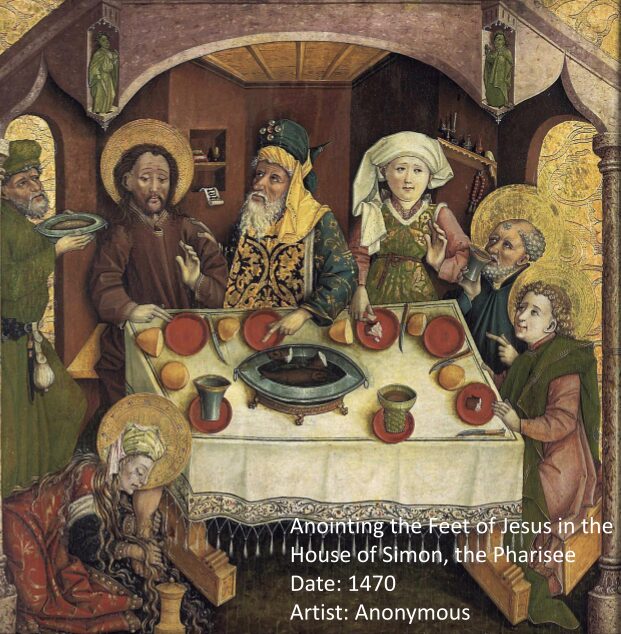
In contrast, I did choose this particular artist rendering of this scene. I hope you can see that there’s a golden halo. This is a classic icon that artists put a golden halo around people whom they want you to perceive as divine or having some holiness about them. The artist gave one to the woman, gave one to Jesus, and gave one to the two other people sitting across the table. Which makes me think that maybe they’re disciples of Jesus, but the Pharisee does not get a golden halo. He is all dressed up in his finery, which is where my brain was going with the connection to the Gilded Age. It’s like those from the upper class who think that because they are upper class, because they are the 1%, they get to write all the rules for everyone else.
Luke’s version is a little different in that he gives us Simon’s thoughts. We get to know that Simon thinks this is not a good thing. He says, “If this man were a prophet, he would have known who and what kind of woman this is who is touching him, that she is a sinner.” His thinking is not wanting to have anything to do with her. She would be at the of the servant class, but without noting what Simon’s thinking, Jesus tells that little parable about people who had borrowed money, and their debt was forgiven.
He has this classic line, which to me is the heart of it, “But the one to whom little is forgiven loves little.” (7:47) I think we have to sit with that. Jesus is letting Simon know he knows what he’s thinking. While Simon’s trying to discern who Jesus is. Jesus’ answer proves that he is much more than he appears, as he knows the character of both the woman and of Simon.
So who do you think you most connect with?
I’m guessing there aren’t a lot of us that want to be the Pharisee, even though, like I was telling you in my story about the neighbor’s shed, I think far too often we are the Pharisee judging other people. Judging other things as being less than or how we might be taken advantage of.
Do you feel like the woman who’s broken and in need of healing? Because if so, I hope that you find it today. I hope that you connect with someone here and they are able to hear you, be a listening ear, and a comfort to you.

If you’re like the Pharisee and you wanna remind us all about the rules, maybe we need to look in the mirror more closely and recognize our own failings because none of us in here are without sin. The image of the church as a hospital where sinners can come for healing is certainly more attractive to me than a place where only saints hang out.
If you’re a disciple, then I think that our job as disciples is to come alongside people, knowing that we’re not here to fix it. We’re here to listen, to comfort, and to say that we’re going to walk with you. I think that we are here to create a spiritual home where grief can be tended and rage can be organized, and hope can be reimagined because hopelessness is the worst. We don’t wanna reach that point, but together we can remind each other to see the things that help draw us along.
May it be so. Amen.
Like this Sermon? Click Here to View More in this Series
Prefer to Listen to this Sermon? Click Here to Listen to our Being Apostles Podcast

