

As we consider how much we live into our vision and mission that God gave to us, I want you to consider for yourselves why you came today.

What brought you here, and the little sarcastic voice in my head says “My car.” But, I mean, why did you come today? Did you come looking for healing, hoping to have a need fulfilled, or did you not have anything better to do? No other better option, so I’ll just go to church. Or is it just what you do on Sundays? I think of my grandfather, I love my grandfather, and I do think he had a good faith, but for my grandfather, Sunday was the day he wound the clock, read the paper, and went to church, and then to lunch. That was Sunday. That’s what you did on Sundays.
So if it’s Sunday, this is what you’re doing, whether you want to or not, but what brought you here? Did you come to receive? Did you come to give or some of both?
Our desire within ourselves to take care of our needs is very strong. It is much easier to only see what we need than to see or think of the needs of others. Did it cross your mind that there may be someone else here who needs you today? Because when given the option of following our best angels or not, we usually don’t. So those questions that I asked, I really want you to think about. I think they’re important questions. We have to get at our own values, and what really drives us.
These scriptures were written as correctives to change our attitudes and our actions. Our gospel reading, Luke 16:19-31, is one of the parables of Jesus.
Jesus wasn’t talking about a specific man as the rich man, and there wasn’t a Lazarus, even though Lazarus is a name that comes up at other times in the Bible, but because it’s a parable, we know that it’s mysterious. It is meant to challenge us to really think about why we do what we do and what we do? Where are our priorities?
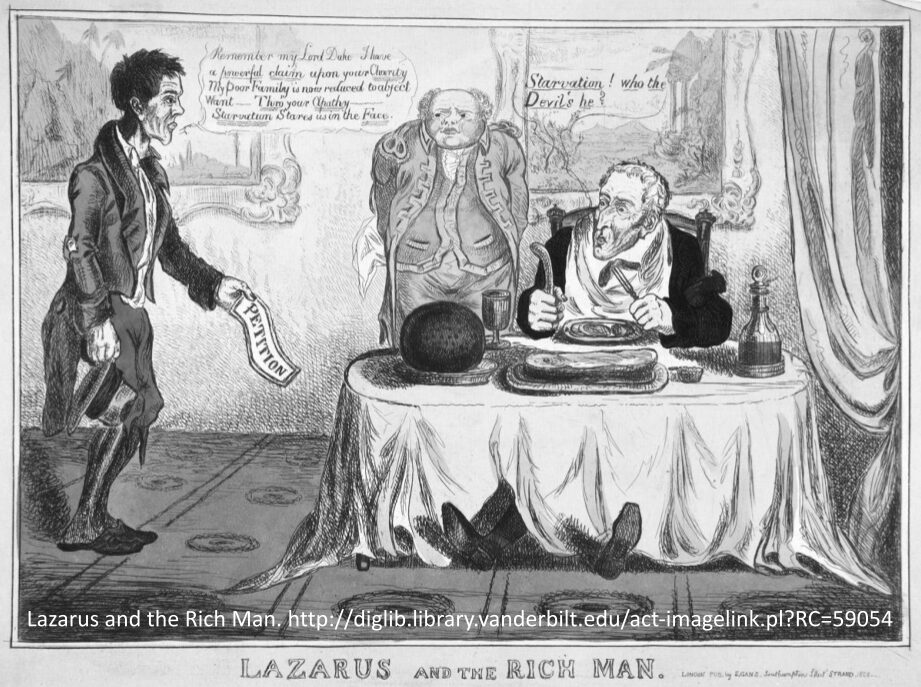
I chose this artwork when I was looking for artwork because it came out of a Dickens novel to me, and I want you to read the conversation there. The person on the left would be Lazarus, and the person on the right, who’s being served, is the rich man. So Lazarus in the picture says, “Remember, my Lord Duke, I have a powerful claim upon your charity. My poor family is now reduced to abject want, through your apathy starvation stares us in the face.” And the rich man’s reply, “Starvation, who the devil’s he?”
Do you feel as if starvation were a person? We are living in a period of time where billionaires and millionaires are making decisions that affect the rest of us. They are manipulating the world in ways that benefit them, and they really don’t see our needs. I’m gonna go as far as, I don’t think they care about our needs. I think they care about their needs and what they want.
They have no need to reopen a government. Their pantries are full, their resources are great. What are we crying about? Starvation? Who the devil is he? While there are those among us and around us, our military, our teachers, our educational system, all the people in our educational system, all the people in our social networks, our care networks, are beginning to wonder how they’re gonna continue to feed their families. How are they going to continue to keep shelter, whether they’re gonna be cold this winter because they can’t afford the heat? And for those of us who are not affected, because I’m assuming there are some of us here who are not being affected by this yet. We need to think about what we can do.
I got an email from a preschool parent asking about the food pantries because they want to do something. They want to make sure they’re not having a food shortage, but they wanna make sure that there’s food there for others.
Do we notice the Lazarus on our streets? What’s striking to me in this parable is that the rich man is not condemned in this. Actually, in our other scripture, 1 Timothy 6:13-19, it says, “If you are rich, then be rich in good works, generous, ready to share.” That’s all that’s being asked in this scripture. The man has; there’s no condemnation for the fact that he has the food that he needs. The issue is that he’s not generous or willing to share, and even more than that, in the course of that parable, he still expects to be served. Send Lazarus down here to take care of me because I need to be served.
That’s the attitude we need to be wary of when we think that we are the privileged ones and others should serve us. That’s where we get in trouble. How often do we expect others to serve us as people being manipulated, like pawns on a chessboard?
Behind this scripture is the golden rule. How you treat others is how you will be treated.
We don’t know how that’s gonna play out, but there’s a lot of wisdom in it. The rest of the world calls that karma. I’ve said to my daughter as she’s dealing with her daughter, who doesn’t want to listen to her. I smile and say “Karma. Huh?” Gotta love it, because things come around right.
So it reminds us that it matters how we treat others. There’s a reality that we don’t want to share with others because we’re afraid that if we share with others, we might not have enough. Or we might, God forbid, be dependent on someone else as opposed to recognizing that this was set up as us being interdependent. We are. That is the point that we rely on each other as opposed to thinking we can take hold of those bootstraps and take care of ourselves.
So what are we doing? What are we doing here together? Our vision from God says that we are to be inclusive, generous advocates for social justice, and care of the environment.
A safe space for those who feel afraid or powerless. We are called to create beloved community. I believe that so much.
We are called to be a community that cares for each other and looks at those around us and meets the needs of those around us. Even as I was talking with the kids, if that means maybe given space to somebody when they need it, but also just sitting with someone who’s lonely. Reaching out and knowing, letting them know that someone cares because there may be people even right here this morning who came because they didn’t want to be alone this morning. It’s a time in the week when they can be with others.
Let’s celebrate that and be with them, be with each other. But I think that there’s more than that. It’s not just about being in here. I think we need to be advocating for people. We need to be speaking out against the systems that are trying to bring people down.
I invite you to look at your resources. What are the resources that you have? Do you have time? Is that a resource you have? Is skill a resource you have? Do you have an ability you can share with others? Do you have finances? Can you make a financial gift that will benefit others? We each have different gifts, but we need to look and take stock of our assets and resources and use them. Do the good work, spend the time with someone who needs the attention, give the funds so that they may be shared.
I challenge you to really look at this week and how you are helping to build the beloved community. Individually, we can each do a little bit, but together we can really make a difference.
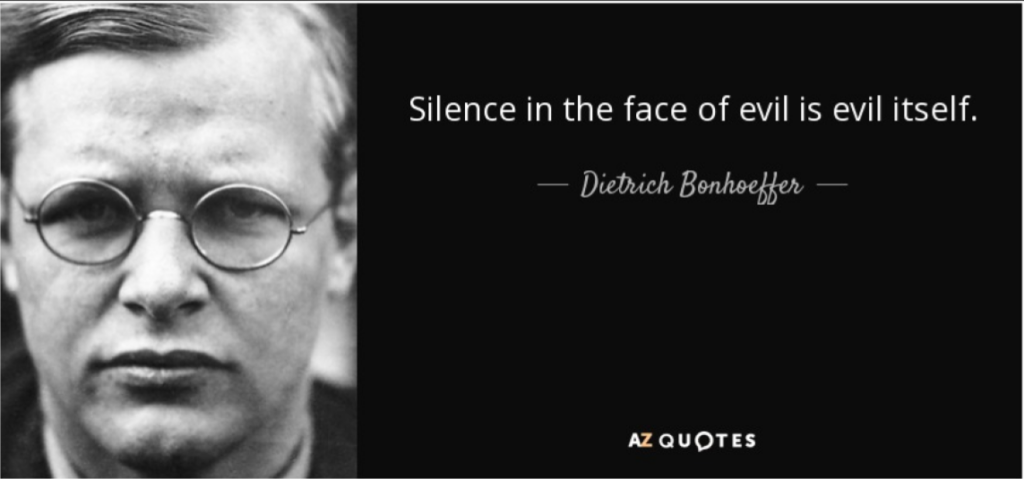
This is one of the thoughts that I’m gonna read from Dietrich Bonhoeffer, “The ultimate test of a moral society, the kind of world it leaves for its children.” I’m always gonna bring us back to the kids, because we need to be thinking about the kids.
“Silence in the face of evil is evil itself.” If we’re silent, we’re complicit. We’re going along with it. Not to speak, is to speak. I’ll say that again. Slowly not to speak is to speak. Not to act is an action.
May we recognize what we can do and share and be generous.
May it be so. Amen.
Like this Sermon? Click Here to View More in this Series
Prefer to Listen to this Sermon? Click Here to Listen to our Being Apostles Podcast

